• Fri frakt över 249 kr
  • •
  • Snabba leveranser
  • •
  • Billiga böcker
Kundservice

Du är på sajten för privatpersoner.

Företag, bibliotek eller offentlig verksamhet?

Du handlar på classic.bokus.com, där alla dina funktioner finns intakta.
Till classic.bokus.com
Bokus logotyp. Gå till startsidan.
  • Erbjudanden
  • Nyheter
  • Student
  • Topplistor
  • Barn & ungdom
  • Bokus Play
  • E-böcker
  • Pocketböcker
  • Spel & pussel

10% rabatt på allt med kod NYSTART10 →

Sidfot

Mina sidor

    Hjälp

    • Kundservice
    • Vanliga frågor och svar
    • Frakt och leverans
    • Retur vid ångerrätt
    • Reklamera vara
    • Betalning
    • Köpvillkor
    • Allmänna villkor
    • Information om webbplatsens tillgänglighet

    Om Bokus

    • Om oss
    • Pressrum
    • För studenter
    • För företag
    • För bibliotek och offentlig verksamhet
    • För leverantörer
    • Hållbarhet

    Populärt

    • Aktuella erbjudanden
    • Presentkort
    • Studentlitteratur
    • Nya böcker
    • Topplistor
    • Signerade böcker
    • Engelska böcker

    Inspiration

    • Boktips
    • BookTok
    • Populära bokserier
    • Barnbokskaraktärer
    • Populära författare
    Logotyp för Bokus
    Följ oss på Facebook (extern länk)Följ oss på Instagram (extern länk)Följ oss på YouTube (extern länk)Följ oss på TikTok (extern länk)
    bokus @ CookiesAnpassa cookiesIntegritetspolicyKöpvillkor
    Till Citymail hemsida (extern länk)Till Budbee hemsida (extern länk)Till Postnord hemsida (extern länk)Till Schenker hemsida (extern länk)Till Early Bird hemsida (extern länk)Till Walleys hemsida (extern länk)
    1. Data och IT
    2. Systemvetenskap och AI

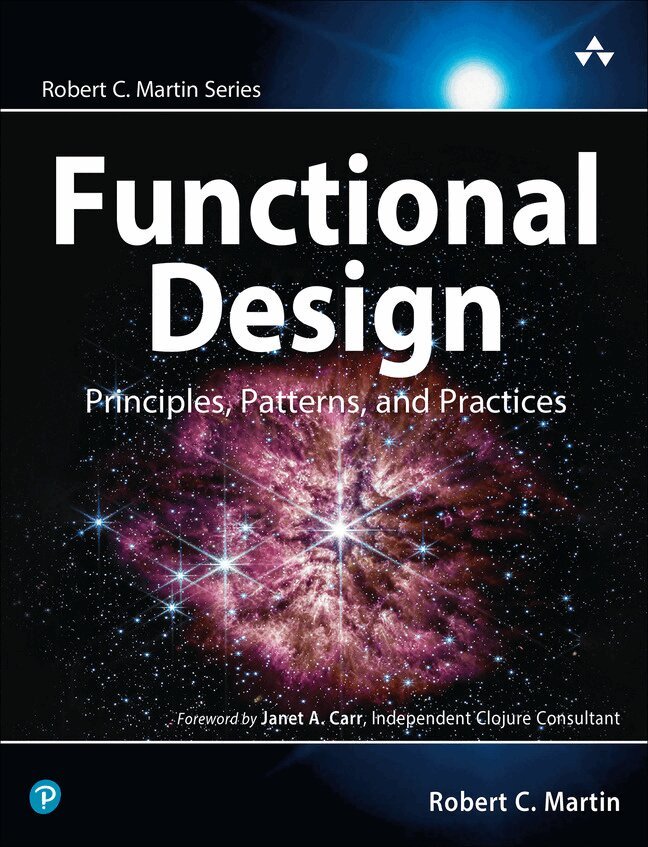
    Functional Design

    Principles, Patterns, and Practices

    AvRobert Martin

    Häftad, Engelska, 2023

    Del i serien Robert C. Martin Series

    355 kr

    Beställningsvara. Skickas inom 7-10 vardagar. Fri frakt över 249 kr.

    Beskrivning

    A Practical Guide to Better, Cleaner Code with Functional Programming

    In Functional Design, renowned software engineer Robert C. Martin ("Uncle Bob") explains how and why to use functional programming to build better systems for real customers. Martin compares conventional object-oriented coding structures in Java to those enabled by functional languages, identifies the best roles for each, and shows how to build better systems by judiciously using them in context.

    Martin's approach is pragmatic, minimizing theory in favor of "in the-trenches" problem-solving. Through accessible examples, working developers will discover how the easy-to-learn, semantically rich Clojure language can help them improve code cleanliness, design, discipline, and outcomes. Martin examines well-known SOLID principles and Gang of Four Design Patterns from a functional perspective, revealing why patterns remain extremely valuable to functional programmers, and how to use them to achieve superior results.

    • Understand functional basics: immutability, persistent data, recursion, iteration, laziness, and statefulness
    • Contrast functional and object approaches through expertly crafted case studies
    • Explore functional design techniques for data flow
    • Use classic SOLID principles to write better Clojure code
    • Master pragmatic approaches to functional testing, GUIs, and concurrency
    • Make the most of design patterns in functional environments
    • Walk through building an enterprise-class Clojure application

    "Functional Design exudes 'classic-on-arrival'. Bob pulls back the curtain to reveal how functional programming elements make software design simple yet pragmatic. He does so without alienating experienced object-oriented programmers coming from languages like C#, C++, or Java."
    --Janet A. Carr, Independent Clojure Consultant

    Register your book for convenient access to downloads, updates, and/or corrections as they become available. See inside book for details.

    Produktinformation

    • Utgivningsdatum:2023-10-11
    • Mått:228 x 20 x 176 mm
    • Vikt:660 g
    • Format:Häftad
    • Språk:Engelska
    • Serie:Robert C. Martin Series
    • Antal sidor:384
    • Upplaga:1
    • Förlag:Pearson Education
    • ISBN:9780138176396

    Utforska kategorier

    • Systemvetenskap och AI inom Data och IT
    • Programspråk inom Data och IT

    Mer om författaren

    Robert C. Martin ("Uncle Bob") wrote his first line of code at the age of 12 in 1964 and has been employed as a programmer since 1970. He is cofounder of cleancoders.com, offering online video training for software developers, and is founder of Uncle Bob Consulting LLC, offering software consulting, training, and skill development services to major corporations worldwide. He served as the Master Craftsman at 8th Light, Inc., a Chicago-based software consulting firm. Mr. Martin has published dozens of articles in various trade journals, authored many books, and is a regular speaker at international conferences and trade shows.

    Innehållsförteckning

    • Foreword xiiiPreface xvAcknowledgments xxiAbout the Author xxiiiPart I: Functional Basics 1Chapter 1: Immutability 3What Is Functional Programming? 4The Problem with Assignment 7So Why Is It Called Functional? 10No Change of State? 12Immutability 15Chapter 2: Persistent Data 17On Cheating 19Making Copies 20Structural Sharing 23Chapter 3: Recursion and Iteration 27Iteration 28Recursion 32Chapter 4: Laziness 37Lazy Accumulation 40OK, but Why? 41Coda 42Chapter 5: Statefulness 43When We MUST Mutate 47Software Transactional Memory (STM) 48Life Is Hard, Software Is Harder 51Part II: Comparative Analysis 53Chapter 6: Prime Factors 55Java Version 56Clojure Version 60Conclusion 63Chapter 7: Bowling Game 65Java Version 66Clojure Version 71Conclusion 75Chapter 8: Gossiping Bus Drivers 77Java Solution 78Clojure 88Conclusion 93Chapter 9: Object-Oriented Programming 95Functional Payroll 98Namespaces and Source Files 107Conclusion 108Chapter 10: Types 109Part III: Functional Design 115Chapter 11: Data Flow 117Chapter 12: SOLID 125The Single Responsibility Principle (SRP) 126The Open-Closed Principle (OCP) 131The Liskov Substitution Principle (LSP) 138The Interface Segregation Principle (ISP) 147The Dependency Inversion Principle (DIP) 152Part IV: Functional Pragmatics 181Chapter 13: Tests 183But What about the REPL? 184What about Mocks? 184Property-Based Testing 186A Diagnostic Technique 190Functional 197Chapter 14: GUI 199Turtle-Graphics in Quil 200Chapter 15: Concurrency 215Conclusion 225Part V: Design Patterns 227Chapter 16: Design Patterns Review 229Patterns in Functional Programming 233Abstract Server 233Adapter 236Command 242Composite 249Decorator 260Visitor 264Abstract Factory 274Conclusion 281Postscript: OO Poison? 282Part VI: Case Study 285Chapter 17: Wa-Tor 287Scratch That Itch 309Showers Solve Problems 312It's Time to Wildly Reproduce 322What about the Sharks? 324Conclusion 335Afterword 337Index 341