• Fri frakt över 249 kr
  • •
  • Snabba leveranser
  • •
  • Billiga böcker
Kundservice

Du är på sajten för privatpersoner.

Företag, bibliotek eller offentlig verksamhet?

Du handlar på classic.bokus.com, där alla dina funktioner finns intakta.
Till classic.bokus.com
Bokus logotyp. Gå till startsidan.
  • Erbjudanden
  • Nyheter
  • Student
  • Topplistor
  • Barn & ungdom
  • Bokus Play
  • E-böcker
  • Pocketböcker
  • Spel & pussel

10% rabatt på allt med kod NYSTART10 →

Sidfot

Mina sidor

    Hjälp

    • Kundservice
    • Vanliga frågor och svar
    • Frakt och leverans
    • Retur vid ångerrätt
    • Reklamera vara
    • Betalning
    • Köpvillkor
    • Allmänna villkor
    • Information om webbplatsens tillgänglighet

    Om Bokus

    • Om oss
    • Pressrum
    • För studenter
    • För företag
    • För bibliotek och offentlig verksamhet
    • För leverantörer
    • Hållbarhet

    Populärt

    • Aktuella erbjudanden
    • Presentkort
    • Studentlitteratur
    • Nya böcker
    • Topplistor
    • Signerade böcker
    • Engelska böcker

    Inspiration

    • Boktips
    • BookTok
    • Populära bokserier
    • Barnbokskaraktärer
    • Populära författare
    Logotyp för Bokus
    Följ oss på Facebook (extern länk)Följ oss på Instagram (extern länk)Följ oss på YouTube (extern länk)Följ oss på TikTok (extern länk)
    bokus @ CookiesAnpassa cookiesIntegritetspolicyKöpvillkor
    Till Citymail hemsida (extern länk)Till Budbee hemsida (extern länk)Till Postnord hemsida (extern länk)Till Schenker hemsida (extern länk)Till Early Bird hemsida (extern länk)Till Walleys hemsida (extern länk)
    1. Naturvetenskap och teknik
    2. Matematik och naturvetenskap
    3. Matematik
    4. Matematikens grunder

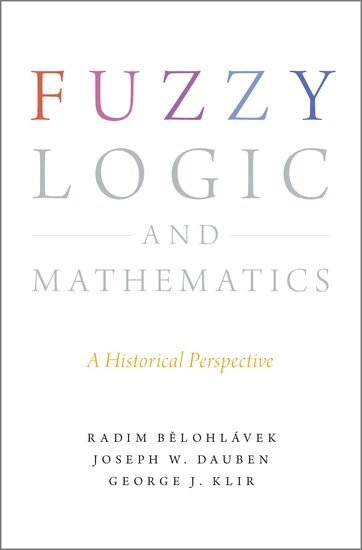
    Fuzzy Logic and Mathematics

    A Historical Perspective

    AvRadim Belohlavek,Joseph W. Dauben

    Inbunden, Engelska, 2017

    2 145 kr

    Beställningsvara. Skickas inom 5-8 vardagar. Fri frakt över 249 kr.

    Beskrivning

    The term "fuzzy logic" (FL), as it is understood in this book, stands for all aspects of representing and manipulating knowledge based on the rejection of the most fundamental principle of classical logic: the principle of bivalence. According to this principle, each declarative sentence is required to be either true or false. In fuzzy logic, these classical truth values are not abandoned. However, additional, intermediary truth values between true and false are allowed, which are interpreted as degrees of truth. This opens a new way of thinking--thinking in terms of degrees rather than absolutes. For example, it led to the definition of a new category of sets, referred to as fuzzy sets, in which membership is a matter of degree. The book examines the genesis and development of fuzzy logic. It surveys the prehistory of fuzzy logic and inspects circumstances that eventually lead to the emergence of fuzzy logic. The book explores in detail the development of propositional, predicate, and other calculi that admit degrees of truth, which are known as fuzzy logic in the narrow sense. Fuzzy logic in the broad sense, whose primary aim is to utilize degrees of truth for emulating common-sense human reasoning in natural language, is scrutinized as well. The book also examines principles for developing mathematics based on fuzzy logic and provides overviews of areas in which this has been done most effectively. It also presents a detailed survey of established and prospective applications of fuzzy logic in various areas of human affairs, and provides an assessment of the significance of fuzzy logic as a new paradigm.

    Produktinformation

    • Utgivningsdatum:2017-06-29
    • Mått:239 x 163 x 45 mm
    • Vikt:834 g
    • Format:Inbunden
    • Språk:Engelska
    • Antal sidor:544
    • Förlag:OUP USA
    • ISBN:9780190200015

    Utforska kategorier

    • Matematikens grunder inom Naturvetenskap och teknik
    • Matematikens filosofi inom Naturvetenskap och teknik

    Mer om författaren

    Radim Belohlávek is Professor of Computer Science and Head of Department of Computer Science at the Palacky University, Olomouc in the Czech Republic. He obtained PhD in Computer Science, PhD in Mathematics, and DSc in Mathematical and Physical Sciences. He is the author of over 150 papers in peer reviewed journals and conferences on various aspects of uncertainty, logic, and discrete mathematics.Joseph W. Dauben is Distinguished Professor of History and the History of Science at the City University of New York. A graduate of Claremont McKenna College (A.B. '66) and Harvard University (A.M., Ph.D. '72), Professor Dauben is the author of biographies of Georg Cantor and Abraham Robinson. He has been a member of the Institute for Advanced Study (Princeton) and Clare Hall (Cambridge), and the recipient of a Guggenheim Fellowship and a Senior ACLS Fellowship. In January of 2012 he received the Albert Leon Whiteman Memorial Prize for History of Mathematics, conferred by the American Mathematical Society in recognition of a career of outstanding contributions to the history of mathematics.George J. Klir spent most of his academic career (1969-2008) with the State University of New York at Binghamton where he was appointed Distinguished Professor of Systems Science in 1978. He published well over 300 research papers and 31 scholarly books. He received numerous awards and honors including 6 honorary doctoral degrees.

    Recensioner i media

    While the book certainly contains a very comprehensive and thoughtfully organized, up-to-date overview over almost all research areas connected to fuzzy logic that subscribe to a mathematical methodology, it also provides a highly informative and very balanced account of the debates and controversies that accompanied its history. ... it is not only invariably informative, but also a pleasure to read: central actors come to life and important events are reviewed in a vivid manner. Moreover, even technical material is presented in an accessible style. ... the book will certainly remain an invaluable resource for more than one class of readers for quite some time.

    Innehållsförteckning

    • PrefaceNotes for the Reader 1. Aims and Scope of This Book2. Prehistory, Emergence, and Evolution of Fuzzy Logic3. Fuzzy Logic in the Broad Sense4. Fuzzy Logic in the Narrow Sense5. Mathematics Based on Fuzzy Logic6. Applications of Fuzzy Logic7. Significance of Fuzzy Logic AppendicesA. The Enigma of Cox's ProofB. Overview of Classical LogicC. Photographs Glossary of Symbols References