Joseph W. Dauben - Böcker
Visar alla böcker från författaren Joseph W. Dauben. Handla med fri frakt och snabb leverans.
4 produkter
4 produkter
1 531 kr
Skickas inom 5-8 vardagar
The term "fuzzy logic" (FL), as it is understood in this book, stands for all aspects of representing and manipulating knowledge based on the rejection of the most fundamental principle of classical logic: the principle of bivalence. According to this principle, each declarative sentence is required to be either true or false. In fuzzy logic, these classical truth values are not abandoned. However, additional, intermediary truth values between true and false are allowed, which are interpreted as degrees of truth. This opens a new way of thinking--thinking in terms of degrees rather than absolutes. For example, it led to the definition of a new category of sets, referred to as fuzzy sets, in which membership is a matter of degree. The book examines the genesis and development of fuzzy logic. It surveys the prehistory of fuzzy logic and inspects circumstances that eventually lead to the emergence of fuzzy logic. The book explores in detail the development of propositional, predicate, and other calculi that admit degrees of truth, which are known as fuzzy logic in the narrow sense. Fuzzy logic in the broad sense, whose primary aim is to utilize degrees of truth for emulating common-sense human reasoning in natural language, is scrutinized as well. The book also examines principles for developing mathematics based on fuzzy logic and provides overviews of areas in which this has been done most effectively. It also presents a detailed survey of established and prospective applications of fuzzy logic in various areas of human affairs, and provides an assessment of the significance of fuzzy logic as a new paradigm.
6 855 kr
Skickas inom 7-10 vardagar
Numeracy has shaped human history as much as literacy: mathematics has enabled us to measure the cosmos, control the Earth, and create all technological change. A Cultural History of Mathematics presents the first comprehensive and global history from antiquity to today. The work is divided into 6 volumes, with each volume covering the same topics, so readers can either study a period/volume or follow a topic across history. The 6 volumes cover: Antiquity (c.3000 BCE-500 CE); the Medieval Age (500-1400); the Early Modern Age (1450-1687); the Eighteenth Century (1687-1800); the Nineteenth Century (1800-1914); the Modern Age (1914-present).Themes (and chapter titles) are: everyday numeracy; practice & profession; inventing mathematics; mathematics & worldviews; describing & understanding the world; mathematics & technological change; representing mathematics.The page extent for the pack is approximately 1536pp. Each volume opens with notes on contributors and an Introduction and concludes with notes, bibliography, and an index.Special introductory offer (valid up to 3 months after publication): £395 / $550 (full price: £440 / $610)The Cultural Histories SeriesA Cultural History of Mathematics is part of The Cultural Histories Series. Titles are available as hardcover sets for libraries needing just one subject or preferring a tangible reference for their shelves or as part of a fully-searchable digital library. The digital product is available to institutions by annual subscription or on perpetual access via www.bloomsburyculturalhistory.com. Individual volumes for academics and researchers interested in specific historical periods are also available in print or digitally via www.bloomsburycollections.com.
Del 15 - Science Networks. Historical Studies
Intersection of History and Mathematics
Häftad, Engelska, 2012
535 kr
Skickas inom 10-15 vardagar
The Twenty-First International Congress of Mathematicians (ICM) was held in Kyoto, Japan, from August 21 through 29, 1990, the first congress that has taken place in the Eastern hemisphere. On this occasion, Japanese historians of mathe- matics organized the History of Mathematics Symposium which was held at the Sanjo Conference Hall of the University of Tokyo on August 31 and September 1, as one of the related conferences of the Congress. The symposium was officially sponsored by the Executive Committee of the ICM 90, the History of Science So- ciety of Japan, and the International Commission on the History of Mathematics. The Executive Committee consisted of Murata Tamotsu (Chairperson, Momoyama Gakuin University), Sugiura Mitsuo (Vice-Chairperson, Tsuda College), Sasaki Chikara (Secretary, The University of Tokyo), Adachi Norio (Waseda University), Nagaoka Ryosuke (Tsuda College until 1990, now Daito Bunka University), and Hirano Yoichi (Treasurer, Tokai University).The symposium emphasized the following three fields of study: (1) mathe- matical traditions in the East, (2) the history of modern European mathematics, and (3) interaction between mathematical research and the history of mathemat- ics. These fields were chosen mainly because, first, the symposium was related to the ICM, the most important congress of working mathematicians, and, second, the Kyoto ICM was held in a non-Western country for the first time. The sym- posium consisted of the two Sessions: Session A for invited speakers and Session B for short communications.
Del 27 - Science Networks. Historical Studies
Writing the History of Mathematics: Its Historical Development
Häftad, Engelska, 2002
1 064 kr
Skickas inom 10-15 vardagar
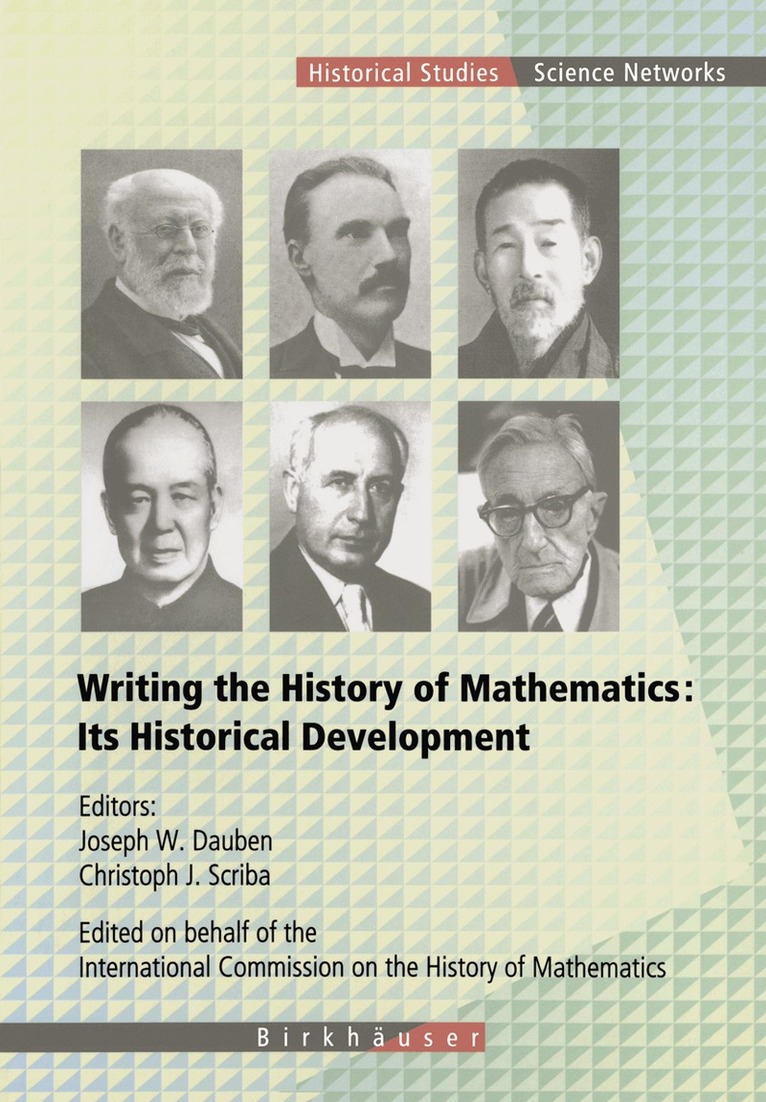
Writing the History of Mathematics provides both an intellectual and a social history of the development of the subject from the first such effort written in ancient Greece to recent efforts in the 20th century. A special project of the International Commission on History of Mathematics, this work is the result of more than ten years of collaboration by a team of 32 experts, each writing about the history of mathematics in their own countries or regions, and drawing upon extensive research and archival study. In addition to individuals, such institutions as universities, academies, institutes, libraries, and the like are also covered, including journals, encyclopedias, and other collective projects that promote history of mathematics. The book also includes portraits of twenty-five historians of mathematics.