• Fri frakt över 249 kr
  • •
  • Snabba leveranser
  • •
  • Billiga böcker
Kundservice

Du är på sajten för privatpersoner.

Företag, bibliotek eller offentlig verksamhet?

Du handlar på classic.bokus.com, där alla dina funktioner finns intakta.
Till classic.bokus.com
Bokus logotyp. Gå till startsidan.
  • Erbjudanden
  • Nyheter
  • Student
  • Topplistor
  • Barn & ungdom
  • Bokus Play
  • E-böcker
  • Pocketböcker
  • Spel & pussel

10% rabatt på allt med kod: NYSTART10 →

Sidfot

Mina sidor

    Hjälp

    • Kundservice
    • Vanliga frågor och svar
    • Frakt och leverans
    • Retur vid ångerrätt
    • Reklamera vara
    • Betalning
    • Köpvillkor
    • Allmänna villkor
    • Information om webbplatsens tillgänglighet

    Om Bokus

    • Om oss
    • Pressrum
    • För studenter
    • För företag
    • För bibliotek och offentlig verksamhet
    • För leverantörer
    • Hållbarhet

    Populärt

    • Aktuella erbjudanden
    • Presentkort
    • Studentlitteratur
    • Nya böcker
    • Topplistor
    • Signerade böcker
    • Engelska böcker

    Inspiration

    • Boktips
    • BookTok
    • Populära bokserier
    • Barnbokskaraktärer
    • Populära författare
    Logotyp för Bokus
    Följ oss på Facebook (extern länk)Följ oss på Instagram (extern länk)Följ oss på YouTube (extern länk)Följ oss på TikTok (extern länk)
    bokus @ CookiesAnpassa cookiesIntegritetspolicyKöpvillkor
    Till Citymail hemsida (extern länk)Till Budbee hemsida (extern länk)Till Postnord hemsida (extern länk)Till Schenker hemsida (extern länk)Till Early Bird hemsida (extern länk)Till Walleys hemsida (extern länk)
    1. Samhälle och politik
    2. Sociologi och antropologi
    3. Antropologi

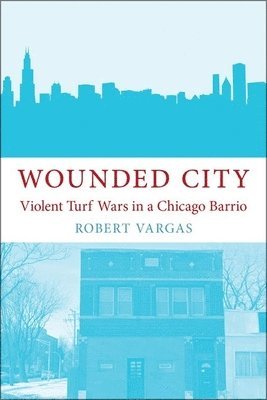
    Wounded City

    Violent Turf Wars in a Chicago Barrio

    AvVargas

    Inbunden, Engelska, 2016

    Del i serien Academic

    2 722 kr

    Beställningsvara. Skickas inom 5-8 vardagar. Fri frakt över 249 kr.

    Fler format och utgåvor

    Häftad

    691 kr

    Beskrivning

    In 2009, Chicago spent millions of dollars to create programs to prevent gang violence in some of its most disadvantaged neighborhoods. Yet in spite of the programs, violence has grown worse in some of the very neighborhoods that the violence prevention programs were intented to help. While public officials and social scientists often attribute the violence - and the failure of the programs - to a lack of community in poor neighborhoods, closer study reveals another source of community division: local politics. Through an ethnographic case study of Chicago's Little Village neighborhood, Wounded City dispells the popular belief that a lack of community is the primary source of violence, arguing that competition for political power and state resources often undermine efforts to reduce gang violence. Robert Vargas argues that the state, through the way it governs, can contribute to distrust and division among community members, thereby undermining social cohesion.The strategic actions taken by police officers, politicians, nonprofit organizations, and gangs to collaborate or compete for power and resources can vary block by block, triggering violence on some blocks while successfully preventing it on others. A rich blend of urban politics, sociology, and criminology, Wounded City offers a cautionary tale for elected officials, state agencies, and community based organizations involved with poor neighborhoods.

    Produktinformation

    • Utgivningsdatum:2016-05-02
    • Mått:157 x 235 x 20 mm
    • Vikt:560 g
    • Format:Inbunden
    • Språk:Engelska
    • Serie:Academic
    • Antal sidor:256
    • Förlag:Oxford University Press Inc
    • ISBN:9780190245900

    Utforska kategorier

    • Antropologi inom Samhälle och politik
    • Våld och övergrepp inom Samhälle och politik
    • Sociala grupper och identitet inom Samhälle och politik

    Mer om författaren

    Robert Vargas is Assistant Professor of Sociology at the University of Notre Dame.

    Recensioner i media

    "Wounded City is one of the most important books about urban violence that has been published in a long time. In a style that is engaging and insightful, Robert Vargas pushes the reader to consider why some communities are highly organized against violence while others are not, and shows that the answer lies in the intersection between politics, institutions and residents." - Patrick Sharkey, author of Stuck in Place"Wounded City is extraordinarily bold and smart. Through meticulous research, Vargas uncovers the precise points at which relationships go bad and the blame game for urban violence begins. Vargas exposes a system that breeds competition rather than cooperation, and turf wars among and between the most dispossessed and the most powerful. This book should fundamentally change both the study of and the interventions against crime in the city." - MaryPattillo, Harold Washington Professor of Sociology and African American Studies, Northwestern University"Street gangs and politicians both spend their time protecting turf. In Chicago, sometimes the boundaries between a gang's turf and the politician's turf are a bit hazy. Wounded City dives deeply into the intersection of politics and street gangs as one Latino community navigates the social and political boundaries of its own health and safety. Vargas masterfully describes how gang leaders, politicians, and community members negotiate and create their socialorder through the use of violence, unsuspecting alliances, community organizing, and federal grants." - Andrew V. Papachristos, Associate Professor of Sociology, Yale University"Vargas, a diligent ethnologist at the Univ. of Notre Dame, made Little Village the study site for five field workers and himself. The author writes mostly about the corporatist Latin Kings, who control much of the neighborhood studied. Speaking Spanish and playing basketball with the Kings, Vargas came to understand what engenders persistent criminality in Little Village." - CHOICE"This book is very important for several reasons. First, the author uses multiple methods in carrying out an ingenious new study. Second, the research was conducted in a gang hotspot (the west-side Little Village community) in Chicago, which often is considered the gang capital of the United States. Third, it draws attention to the ongoing conflicts in Little Village among self-help indigenous community organizations, gangs, politicians, and police. Fourth, itprovides valuable insights into gang-police relations. Fifth, it is very well written." - James C. Howell, Criminal Law and Criminal Justice Books Review, Rutgers University

    Innehållsförteckning

    • 1) Introduction POLITICAL TURF2) Battles for Political Turf in Little Village3) Burbs and Violent Blocks4) Transforming Violent Streets on the West Side STREET TURF5) Silence and the Art of Arson6) Locking Up Social Order CONCLUSION7) Toward a Relational Understanding of Urban Violence8) Appendix A: Navigating Turf Wars9) Appendix B: Methods