• Fri frakt över 249 kr
  • •
  • Snabba leveranser
  • •
  • Billiga böcker
Kundservice

Du är på sajten för privatpersoner.

Företag, bibliotek eller offentlig verksamhet?

Du handlar på classic.bokus.com, där alla dina funktioner finns intakta.
Till classic.bokus.com
Bokus logotyp. Gå till startsidan.
  • Erbjudanden
  • Nyheter
  • Student
  • Topplistor
  • Barn & ungdom
  • Bokus Play
  • E-böcker
  • Pocketböcker
  • Spel & pussel

10% rabatt på allt med kod: NYSTART10 →

Sidfot

Mina sidor

    Hjälp

    • Kundservice
    • Vanliga frågor och svar
    • Frakt och leverans
    • Retur vid ångerrätt
    • Reklamera vara
    • Betalning
    • Köpvillkor
    • Allmänna villkor
    • Information om webbplatsens tillgänglighet

    Om Bokus

    • Om oss
    • Pressrum
    • För studenter
    • För företag
    • För bibliotek och offentlig verksamhet
    • För leverantörer
    • Hållbarhet

    Populärt

    • Aktuella erbjudanden
    • Presentkort
    • Studentlitteratur
    • Nya böcker
    • Topplistor
    • Signerade böcker
    • Engelska böcker

    Inspiration

    • Boktips
    • BookTok
    • Populära bokserier
    • Barnbokskaraktärer
    • Populära författare
    Logotyp för Bokus
    Följ oss på Facebook (extern länk)Följ oss på Instagram (extern länk)Följ oss på YouTube (extern länk)Följ oss på TikTok (extern länk)
    bokus @ CookiesAnpassa cookiesIntegritetspolicyKöpvillkor
    Till Citymail hemsida (extern länk)Till Budbee hemsida (extern länk)Till Postnord hemsida (extern länk)Till Schenker hemsida (extern länk)Till Early Bird hemsida (extern länk)Till Walleys hemsida (extern länk)
    1. Samhälle och politik
    2. Social välfärd och brottslighet
    3. Brottslighet och kriminologi
    4. Brottsutredning och kriminalteknik

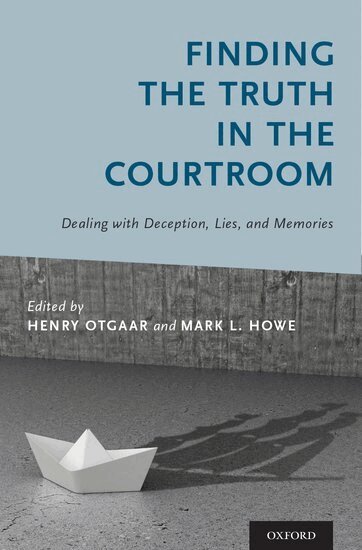
    Finding the Truth in the Courtroom

    Dealing with Deception, Lies, and Memories

    AvOtgaar,Henry Otgaar

    Inbunden, Engelska, 2017

    979 kr

    . Fri frakt över 249 kr.

    Beskrivning

    In many criminal trials, forensic technical evidence is lacking and triers of fact must rely on the reliability of eyewitness statements, identifications, and testimony; however, such reports can be riddled with deceptive statements or erroneous recollections. Based on such considerations, the question arises as to how one should weigh such eyewitness accounts given the theoretical and empirical knowledge in this field. Finding the Truth in the Courtroom focuses on how legal professionals, legal/forensic psychologists, and memory researchers can decide when statements or identifications are based on truthful or fabricated experiences and whether one can distinguish between lies, deception, and false memories. The contributors, key experts in the field, assemble recent experimental work and case studies in which deception or false memory plays a dominant role. Topics discussed relate to the susceptibility to suggestive pressure (e.g., "Under which circumstances are children or adults the most vulnerable to suggestion?"), the fabrication of symptoms (e.g., "How to detect whether PTSD symptoms are malingered?"), and the detection of deceit (e.g., "Which paradigms are promising in deception detection?"), among others. By using this approach, this volume unites diverse streams of research (i.e., deception, malingering, false memory) that are involved in the reliability of eyewitness statements.

    Produktinformation

    • Utgivningsdatum:2017-11-16
    • Mått:155 x 239 x 20 mm
    • Vikt:567 g
    • Format:Inbunden
    • Språk:Engelska
    • Antal sidor:296
    • Förlag:OUP USA
    • ISBN:9780190612016

    Utforska kategorier

    • Brottsutredning och kriminalteknik inom Samhälle och politik
    • Kognitiv psykologi inom Psykologi och pedagogik
    • Kriminalvård och straff inom Samhälle och politik

    Mer om författaren

    Henry Otgaar works as Assistant Professor at the Forensic Psychology section, Faculty of Psychology and Neuroscience, Maastricht University. His research expertise revolves around issues such as the development of memory, false memory, the link between trauma, memory, and psychopathology, and memory in the legal area. He has published numerous peer-reviewed articles, book chapters, and books on memory (e.g., What Is Adaptive About Adaptive Memory?, OUP 2014). He has received many (inter)national awards for his research such as the Edmond Hustinx Science Award and the Early Career Excellence Award. He also works as an expert witness for the Maastricht Forensic Institute and is an associate editor for Memory and a co-editor for In-Mind.Mark L. Howe holds a Chair in Cognitive Science at City, University of London. His over 35 years of research on memory has addressed questions concerning memory development, memory illusions, the adaptive functions of memory, links between reasoning and memory, memory in traumatized and maltreated children, as well as memory and the law. He has published numerous peer-reviewed articles, book chapters, and books on memory development (e.g., The Nature of Early Memory, OUP 2011) and memory and the law (e.g., Memory and Miscarriages of Justice, 2017). In addition to editing a variety of books (e.g., Stress, Trauma, and Children's Memory Development, OUP 2008; What Is Adaptive About Adaptive Memory?, OUP 2014), he is the Associate Editor of Developmental Review and an Editor-in-Chief for Memory.

    Recensioner i media

    This book contains chapters by leading international experts on crucial topics in applying psychology to legal cases that hinge on psychological issues. Witnesses who are lying, reporting false information from memory, or feigning illness or forgetfulness can all compromise the search for truth in a case. The authors discuss the latest research on these topics and others. Lawyers and judges, as well as forensic psychologists, will find this book of great interest.

    Innehållsförteckning

    • About the EditorsContributors Chapter 1: Deception and Memory in the Courtroom: An Overview Henry Otgaar and Mark L. Howe Part I: Memory in the CourtroomChapter 2: Misinformation in the Courtroom Shari R. Berkowitz and Elizabeth F. LoftusChapter 3: Suggestibility in the Courtroom: How Memory Can Be Distorted During the Investigative and Legal Process Fiona Gabbert and Lorraine HopeChapter 4: When Spontaneous Statements Should Not Be Trusted: False Memories in Children and Adults Henry Otgaar and Mark L. HoweChapter 5: A Neurobiological Account False Memories Vincent van de Ven, Henry Otgaar, and Mark L. Howe Part II: Children in the CourtroomChapter 6: Assessing the Veracity of Children's Forensic Interviews: Implications for the Courtroom Hayden M. Henderson and Samantha J. AndrewsChapter 7: Putting Children's Memory and Suggestibility in their Place: An Analysis Considering Person, Topic, and Context Deborah Goldfarb, Gail S. Goodman, Rakel P. Larson, Alejandra Gonzalez, and Mitchell L. Eisen Part III: Deception in the CourtroomChapter 8: Nonverbal Detection of Deception Aldert VrijChapter 9: Building a Case: The Role of Empirically Based Interviewing Techniques in Case Construction Timothy J. Luke, Maria Hartwig, Laure Brimbal, and Pär Anders GranhagChapter 10: Deception Detection Using Psychophysiological and Neural Measures Ewout H. Meijer and Bruno Verschuere Part IV: Malingering in the CourtroomChapter 11: Seven Myths About Feigning Marko Jelicic, Harald Merckelbach, and Irena BoskoviChapter 12: False Symptom Claims and Symptom Validity Assessment Thomas Merten Index