• Fri frakt över 249 kr
  • •
  • Snabba leveranser
  • •
  • Billiga böcker
Kundservice

Du är på sajten för privatpersoner.

Företag, bibliotek eller offentlig verksamhet?

Du handlar på classic.bokus.com, där alla dina funktioner finns intakta.
Till classic.bokus.com
Bokus logotyp. Gå till startsidan.
  • Erbjudanden
  • Student
  • Topplistor
  • Barn & ungdom
  • Bokus Play
  • E-böcker
  • Ljudböcker
  • Pocketböcker
  • Spel och pussel

5% studentrabatt – använd koden KURSBOK27 →

Sidfot

Mina sidor

    Hjälp

    • Kundservice
    • Vanliga frågor och svar
    • Frakt och leverans
    • Retur vid ångerrätt
    • Reklamera vara
    • Betalning
    • Köpvillkor
    • Allmänna villkor
    • Information om webbplatsens tillgänglighet

    Om Bokus

    • Om oss
    • Pressrum
    • För studenter
    • För företag
    • För bibliotek och offentlig verksamhet
    • För leverantörer
    • Hållbarhet

    Populärt

    • Aktuella erbjudanden
    • Presentkort
    • Studentlitteratur
    • Nya böcker
    • Topplistor
    • Signerade böcker
    • Engelska böcker

    Inspiration

    • Boktips
    • BookTok
    • Barnbokskaraktärer
    • Populära författare
    Logotyp för Bokus
    Följ oss på Facebook (extern länk)Följ oss på Instagram (extern länk)Följ oss på YouTube (extern länk)Följ oss på TikTok (extern länk)
    bokus @ CookiesAnpassa cookiesIntegritetspolicyKöpvillkor
    Till Citymail hemsida (extern länk)Till Budbee hemsida (extern länk)Till Postnord hemsida (extern länk)Till Schenker hemsida (extern länk)Till Early Bird hemsida (extern länk)Till Walleys hemsida (extern länk)
    1. Naturvetenskap och teknik
    2. Geovetenskap
    3. Miljövetenskap och miljöpolitik

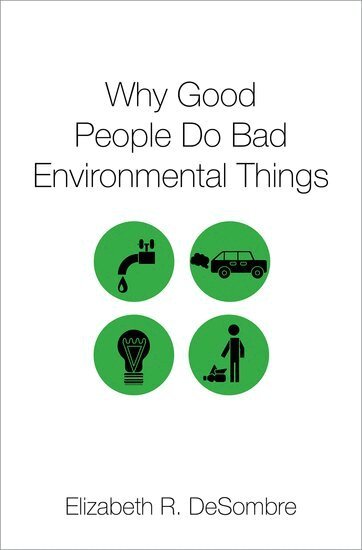
    Why Good People Do Bad Environmental Things

    AvElizabeth R. DeSombre

    Inbunden, Engelska, 2018

    580 kr

    Beställningsvara. Skickas inom 5-8 vardagar. Fri frakt över 249 kr.

    Fler format och utgåvor

    E-bok

    199 kr

    E-bok

    204 kr

    Häftad

    393 kr

    Beskrivning

    No one sets out to intentionally cause environmental problems. All things being equal, we are happy to protect environmental resources; in fact, we tend to prefer our air cleaner and our species protected. But despite not wanting to create environmental problems, we all do so regularly in the course of living our everyday lives. Why do we behave in ways that cause environmental harm?It is often easy and inexpensive to behave in ways with bad environmental consequences, but more difficult and costly to take environmentally friendly actions. The incentives we face, some created by the nature of environmental resources, some by social and political structures, often do not make environmentally beneficial behavior the most likely choice. Furthermore, our behavior is conditioned by habits and social norms that fail to take environmental protection into consideration.In this book, Elizabeth R. DeSombre integrates research from political science, sociology, psychology, and economics to understand why bad environmental behavior makes perfect sense. As she notes, there is little evidence that having more information about environmental problems or the way an individual's actions contribute to them changes behavior in meaningful ways, and lack of information is rarely the underlying cause that connects behavior to harm. In some cases such knowledge may even backfire, as people come to see themselves as powerless to address huge global problems and respond by pushing these issues out of their minds. The fact that causing environmental problems is never anyone's primary goal means that people are happy to stop causing them if the alternative behavior still accomplishes their underlying goals. If we can figure out why those problems are caused, when no one intends to cause them, we can develop strategies that work to shift behavior in a positive direction. Over the course of this book, DeSombre considers the role of structure, incentives, information, habit, and norms on behavior in order to formulate lessons about how these factors lead to environmentally problematic behavior, and what understanding their effects can tell us about ways to change behavior. To prevent or address environmental problems, we have to understand why even good people do bad environmental things.

    Produktinformation

    • Utgivningsdatum:2018-06-28
    • Mått:236 x 157 x 27 mm
    • Vikt:499 g
    • Format:Inbunden
    • Språk:Engelska
    • Antal sidor:264
    • Förlag:OUP USA
    • ISBN:9780190636272

    Utforska kategorier

    • Miljövetenskap och miljöpolitik inom Naturvetenskap och teknik
    • Folkrätt inom Juridik
    • Miljöekonomi inom Ekonomi och Ledarskap

    Mer om författaren

    Elizabeth R. DeSombre is the Camilla Chandler Frost Professor of Environmental Studies at Wellesley College, where she directs the Environmental Studies Program. Her background is in international environmental law (with a particular focus on oceans) and United States environmental policy. She has written seven books and won two book prizes. She is also a touring folk singer-songwriter and has recorded four CDs.

    Recensioner i media

    This volume combines psychological, economic, and environmental approaches to offer a unique perspective on environmental policy. Addressing the widespread polarization over global climate change, DeSombre (Wellesley College) argues that nobody intends bad environmental effects...these and other themes are explored in a tightly organized book featuring factors such as social structures, extrinsic versus intrinsic factors, positive incentivization (e.g., subsidy), negative incentivization (e.g., regulation), attitudes, and scientific knowledge. Documented with 30 pages of notes and 26 pages of references, the book is an excellent resource for readers concerned about environmental policy.

    Innehållsförteckning

    • Acknowledgments 1. Why Good People Do Bad Environmental Things 2. Problem Characteristics 3. Incentives 4. Information 5. Habits and Other Routines 6. Attitudes and Norms 7. What to Do About It Notes Bibliography Index