• Fri frakt över 249 kr
  • •
  • Snabba leveranser
  • •
  • Billiga böcker
Kundservice

Du är på sajten för privatpersoner.

Företag, bibliotek eller offentlig verksamhet?

Du handlar på classic.bokus.com, där alla dina funktioner finns intakta.
Till classic.bokus.com
Bokus logotyp. Gå till startsidan.
  • Erbjudanden
  • Nyheter
  • Student
  • Topplistor
  • Barn & ungdom
  • Bokus Play
  • E-böcker
  • Pocketböcker
  • Spel & pussel

10% rabatt på allt med kod: NYSTART10 →

Sidfot

Mina sidor

    Hjälp

    • Kundservice
    • Vanliga frågor och svar
    • Frakt och leverans
    • Retur vid ångerrätt
    • Reklamera vara
    • Betalning
    • Köpvillkor
    • Allmänna villkor
    • Information om webbplatsens tillgänglighet

    Om Bokus

    • Om oss
    • Pressrum
    • För studenter
    • För företag
    • För bibliotek och offentlig verksamhet
    • För leverantörer
    • Hållbarhet

    Populärt

    • Aktuella erbjudanden
    • Presentkort
    • Studentlitteratur
    • Nya böcker
    • Topplistor
    • Signerade böcker
    • Engelska böcker

    Inspiration

    • Boktips
    • BookTok
    • Populära bokserier
    • Barnbokskaraktärer
    • Populära författare
    Logotyp för Bokus
    Följ oss på Facebook (extern länk)Följ oss på Instagram (extern länk)Följ oss på YouTube (extern länk)Följ oss på TikTok (extern länk)
    bokus @ CookiesAnpassa cookiesIntegritetspolicyKöpvillkor
    Till Citymail hemsida (extern länk)Till Budbee hemsida (extern länk)Till Postnord hemsida (extern länk)Till Schenker hemsida (extern länk)Till Early Bird hemsida (extern länk)Till Walleys hemsida (extern länk)
    1. Juridik
    2. Rättsvetenskap
    3. Lag och samhälle

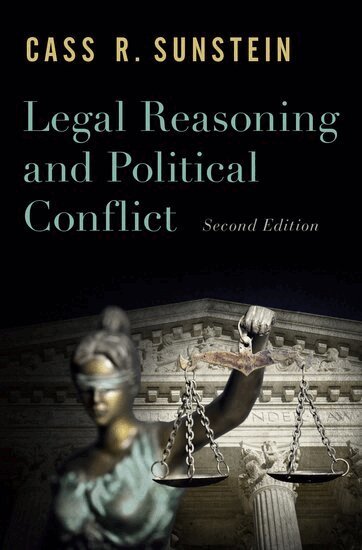
    Legal Reasoning and Political Conflict

    AvCass R. Sunstein

    Inbunden, Engelska, 2018

    652 kr

    Beställningsvara. Skickas inom 5-8 vardagar. Fri frakt över 249 kr.

    Fler format och utgåvor

    E-bok

    376 kr

    E-bok

    376 kr

    Inbunden

    348 kr

    Beskrivning

    In Legal Reasoning and Political Conflict, Cass R. Sunstein, one of America's best known commentators on our legal system, offers a bold, new thesis about how the law should work in America, arguing that the courts best enable people to live together, despite their diversity, by resolving particular cases without taking sides in broader, more abstract conflicts. Professor Sunstein closely analyzes the way the law can mediate disputes in a diverse society, examining how the law works in practical terms, and showing that, to arrive at workable, practical solutions, judges must avoid broad, abstract reasoning. He states that judges purposely limit the scope of their decisions to avoid reopening large-scale controversies, calling such actions incompletely theorized agreements. In identifying them as the core feature of legal reasoning, he takes issue with advocates of comprehensive theories and systemization, from Robert Bork to Jeremy Bentham, and Ronald Dworkin. Equally important, Sunstein goes on to argue that it is the living practice of the nation's citizens that truly makes law.Legal reasoning can seem impenetrable, mysterious, baroque. Legal Reasoning and Political Conflict helps dissolve the mystery. Whether discussing abortion, homosexuality, or free speech, the meaning of the Constitution, or the spell cast by the Warren Court, Cass Sunstein writes with grace and power, offering a striking and original vision of the role of the law in a diverse society. In his flexible, practical approach to legal reasoning, he moves the debate over fundamental values and principles out of the courts and back to its rightful place in a democratic state: to the legislatures elected by the people.In this Second Edition, the author updates the previous edition bringing the book into the current mainstream of twenty-first century legal reasoning and judicial decision-making focusing on the many relevant contemporary issues and developments that occurred since its initial 1996 publication.

    Produktinformation

    • Utgivningsdatum:2018-04-26
    • Mått:160 x 236 x 27 mm
    • Vikt:499 g
    • Format:Inbunden
    • Språk:Engelska
    • Antal sidor:272
    • Upplaga:2
    • Förlag:OUP USA
    • ISBN:9780190864446

    Utforska kategorier

    • Lag och samhälle inom Juridik
    • Juridik: metod och teori inom Juridik
    • Författningsrätt och förvaltningsrätt inom Juridik

    Mer om författaren

    Cass R. Sunstein is the Robert Walmsley University Professor at Harvard University. From 2009 to 2012, he was Administrator of the White House Office of Information and Regulatory Affairs. He is the founder and director of the Program on Behavioral Economics and Public Policy at Harvard Law School. He has been involved in law reform activities in nations all over the world, often with a focus on behavioral economics. He is the author of many articles and books, including Republic.com (2001); Designing Democracy: What Constitutions Do (2001); Infotopia: How Many Minds Produce Knowledge (2006); Nudge: Improving Decisions about Health, Wealth, and Happiness (with Richard Thaler, 2008), Going to Extremes: How Like Minds Unite and Divide (2009); Simpler: The Future of Government (2013); and Choosing Not to Choose: Understanding the Value of Choice (2015).

    Recensioner i media

    The best of American legal theory has attempted to explain and justify an approach focusing on the features of individual cases and avoiding reliance on rigid rules. Sunstein's book not only offers the most comprehensive attempt to defend particularistic decision-making in all of its manifestations, but also gives the most powerful defense. Defenders of rules, categories, and abstraction will have a formidable task in trying to penetrate the armor of Sunstein's normative defense of particularistic decision-making." Frederick Schauer, David and Mary Harrison Distinguished Professor of Law, University of Virginia School of Law

    Innehållsförteckning

    • Preface Introduction Chapter 1: Reasoning and Legal Reasoning Chapter 2: Incompletely Theorized Agreements Chapter 3: Analogical Reasoning Chapter 4: Trimming Chapter 5: Understanding (and Misunderstanding) the Rule of Law Chapter 6: In Defense of Casuistry Chapter 7: Without Reasons, Without Rules Chapter 8: Adapting Rules, Privately and Publicly Chapter 9: Interpretation Conclusion Notes Index

    Betyg & recensioner

    4/5