• Fri frakt över 249 kr
  • •
  • Snabba leveranser
  • •
  • Billiga böcker
Kundservice

Du är på sajten för privatpersoner.

Företag, bibliotek eller offentlig verksamhet?

Du handlar på classic.bokus.com, där alla dina funktioner finns intakta.
Till classic.bokus.com
Bokus logotyp. Gå till startsidan.
  • Erbjudanden
  • Nyheter
  • Student
  • Topplistor
  • Barn & ungdom
  • Bokus Play
  • E-böcker
  • Pocketböcker
  • Spel & pussel

10% rabatt på allt med kod: NYSTART10 →

Sidfot

Mina sidor

    Hjälp

    • Kundservice
    • Vanliga frågor och svar
    • Frakt och leverans
    • Retur vid ångerrätt
    • Reklamera vara
    • Betalning
    • Köpvillkor
    • Allmänna villkor
    • Information om webbplatsens tillgänglighet

    Om Bokus

    • Om oss
    • Pressrum
    • För studenter
    • För företag
    • För bibliotek och offentlig verksamhet
    • För leverantörer
    • Hållbarhet

    Populärt

    • Aktuella erbjudanden
    • Presentkort
    • Studentlitteratur
    • Nya böcker
    • Topplistor
    • Signerade böcker
    • Engelska böcker

    Inspiration

    • Boktips
    • BookTok
    • Populära bokserier
    • Barnbokskaraktärer
    • Populära författare
    Logotyp för Bokus
    Följ oss på Facebook (extern länk)Följ oss på Instagram (extern länk)Följ oss på YouTube (extern länk)Följ oss på TikTok (extern länk)
    bokus @ CookiesAnpassa cookiesIntegritetspolicyKöpvillkor
    Till Citymail hemsida (extern länk)Till Budbee hemsida (extern länk)Till Postnord hemsida (extern länk)Till Schenker hemsida (extern länk)Till Early Bird hemsida (extern länk)Till Walleys hemsida (extern länk)
    1. Naturvetenskap och teknik
    2. Matematik och naturvetenskap
    3. Biologi
    4. Biovetenskap

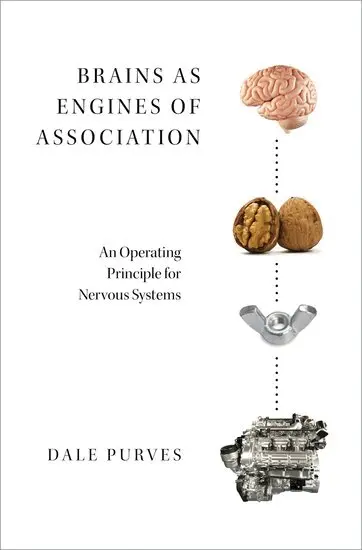
    Brains as Engines of Association

    An Operating Principle for Nervous Systems

    AvDale Purves

    Inbunden, Engelska, 2019

    973 kr

    Beställningsvara. Skickas inom 5-8 vardagar. Fri frakt över 249 kr.

    Fler format och utgåvor

    E-bok

    585 kr

    E-bok

    585 kr

    Beskrivning

    Brains as Engines of Association tackles a fundamental question in neuroscience: what is the operating principle of the human brain? While a similar question has been asked and answered for virtually every other human organ during the last few centuries, how the brain operates has remained a central challenge in biology. Based on evidence derived from vision, audition, speech and music--much of it based on the author's own work over the last twenty years--Brains as Engines of Association argues that brains operate wholly on the basis of trial and error experience, encoded in neural circuitry over evolutionary and individual time. This concept of neural function runs counter to current concepts that view the brain as a computing machine, and research programs based on the idea that the only way to answer such questions is by reconstructing the connectivity of brains in their entirety. This view also implies that the best way to understand the details of brain function is to recapitulate their history using artificial neural networks. While this viewpoint has received support in the last few years from work showing that computers can win complex games, the brain plays a much more complex game--the "game" of biological survival--which Purves concludes is based on trial-and-error experience.

    Produktinformation

    • Utgivningsdatum:2019-05-30
    • Mått:239 x 163 x 20 mm
    • Vikt:499 g
    • Format:Inbunden
    • Språk:Engelska
    • Antal sidor:216
    • Förlag:OUP USA
    • ISBN:9780190880163

    Utforska kategorier

    • Biovetenskap inom Naturvetenskap och teknik
    • Kognitiv psykologi inom Psykologi och pedagogik

    Mer om författaren

    Dale Purves is Geller Professor of Neurobiology Emeritus at Duke University, where he moved in 1990 as the founding chair of the Department of Neurobiology. He was subsequently Director of Duke's Center for Cognitive Neuroscience and the Director of the Neuroscience and Behavioral Disorders Program at the Duke-NUS Graduate Medical School in Singapore. His research has sought to explain why we see and hear what we do. He is a member of the National Academy of Sciences, the American Academy of Arts and Sciences, and the National Academy of Medicine.

    Recensioner i media

    Purves has produced a thought-provoking, beautifully written, and illustrated book that is well worth the time for any reader interested in how the brain works.

    Innehållsförteckning

    • Preface PART I. What Nervous Systems Do for Animals Chapter 1. Putting the Question in PerspectiveIntroductionLife on EarthDefining lifeEnergyEvolutionMechanisms TeleologyConclusionSuggested Reading Chapter 2. Organisms without Nervous Systems IntroductionBacteriaProtistsPlantsThe general strategy ConclusionSuggested Reading Chapter 3. Organisms with Nervous SystemsIntroductionDefining nervous systems The emergence of nervous systems The emergence of central nervous systemsWhat do nervous systems add?What do brains add?ConclusionSuggested Reading PART II. Neural Systems as Engines of Association Chapter 4. The Organization of Nervous Systems IntroductionStimuliPre-neural processingNeural processingBehavioral outputNeural systems and subsystems are interactive ConclusionSuggested Reading Chapter 5. The ProblemIntroductionVision as an exampleThe basic challengeThe answer in general termsQualia determined by empirical rankingPerceptual discrepanciesMechanismsOther modalitiesThe meaning of 'illusions'ConclusionSuggested Reading Chapter 6. Neural Associations IntroductionAssociations wrought be evolutionAssociations wrought by lifetime learningAssociations wrought by cultureBehavioral categories of associationsRewardBehavioral responses as reflexesWhat gets associated?Counterarguments ConclusionSuggested Reading PART III. Evidence that Neural Systems Operate EMPIRICALLY Chapter 7. Evidence from Lightness and Color IntroductionLuminance and lightnessAnalyzing the occurrence of luminance patternsEffects of other luminance patterns Spectral energy and colorThe general strategyConclusionSuggested Reading Chapter 8. Evidence from Geometry IntroductionSeeing intervals Seeing angles Seeing object sizes in 2-D Seeing object sizes in 3-D Seeing stereo depthConclusionSuggested Reading Chapter 9. Evidence from MotionIntroductionApparent motionThe perception of speedImplications for the perception of timeThe perception of directionConclusionSuggested Reading Chapter 10. Evidence from AuditionIntroductionSound signalsSources of tonesSound signal spectraThe problem in auditionAn empirical approachEvidence from speechEvidence from musicImplications for any sensory system ConclusionSuggested Reading PART IV. alternative Concepts Neural Function Chapter 11. The Major OptionsIntroductionNeural function as feature detection Neural function as statistical inferenceNeural function as efficient codingNeural function as computationConclusionSuggested Reading Chapter 12. Summing Up IntroductionA way around some fundamental obstaclesEmpirical rankingInsight from gamesArtificial intelligence Consequences for neuroscience The status of reasoningNovel situationsChoiceCultureThe frequency of stimuliConclusionSuggested Reading BibliographyGlossaryIndexAcknowledgments