• Fri frakt över 249 kr
  • •
  • Snabba leveranser
  • •
  • Billiga böcker
Kundservice

Du är på sajten för privatpersoner.

Företag, bibliotek eller offentlig verksamhet?

Du handlar på classic.bokus.com, där alla dina funktioner finns intakta.
Till classic.bokus.com
Bokus logotyp. Gå till startsidan.
  • Erbjudanden
  • Student
  • Topplistor
  • Barn & ungdom
  • Bokus Play
  • E-böcker
  • Ljudböcker
  • Pocketböcker
  • Spel och pussel

Pocketfynda! Hundratals böcker för 49 kr/st →

Sidfot

Mina sidor

    Hjälp

    • Kundservice
    • Vanliga frågor och svar
    • Frakt och leverans
    • Retur vid ångerrätt
    • Reklamera vara
    • Betalning
    • Köpvillkor
    • Allmänna villkor
    • Information om webbplatsens tillgänglighet

    Om Bokus

    • Om oss
    • Pressrum
    • För studenter
    • För företag
    • För bibliotek och offentlig verksamhet
    • För leverantörer
    • Hållbarhet

    Populärt

    • Aktuella erbjudanden
    • Presentkort
    • Studentlitteratur
    • Nya böcker
    • Topplistor
    • Signerade böcker
    • Engelska böcker

    Inspiration

    • Boktips
    • BookTok
    • Barnbokskaraktärer
    • Populära författare
    Logotyp för Bokus
    Följ oss på Facebook (extern länk)Följ oss på Instagram (extern länk)Följ oss på YouTube (extern länk)Följ oss på TikTok (extern länk)
    bokus @ CookiesAnpassa cookiesIntegritetspolicyKöpvillkor
    Till Citymail hemsida (extern länk)Till Budbee hemsida (extern länk)Till Postnord hemsida (extern länk)Till Schenker hemsida (extern länk)Till Early Bird hemsida (extern länk)Till Walleys hemsida (extern länk)
    1. Samhälle och politik
    2. Politik och statsskick
    3. Politisk aktivism

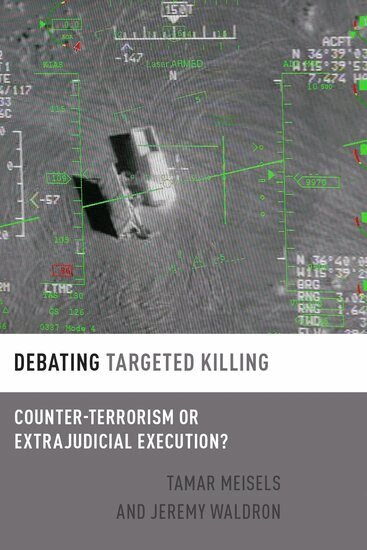
    Debating Targeted Killing

    Counter-Terrorism or Extrajudicial Execution?

    AvTamar Meisels,Jeremy Waldron

    Häftad, Engelska, 2020

    Del i serien Debating Ethics

    340 kr

    Beställningsvara. Skickas inom 5-8 vardagar. Fri frakt över 249 kr.

    Fler format och utgåvor

    Inbunden

    1 759 kr

    Beskrivning

    Known terrorists are often targeted for death by the governments of Israel and the United States. Several thousand have been killed by drones or by operatives on the ground in the last twenty years. Is this form of killing justified, when hundreds or thousands of lives are possibly at risk at the hands of a known terrorist? Is there anything about it that should disturb us? Ethically-sound and practical answers to these questions are more difficult to come by than it might seem. Renowned political theorists Jeremy Waldron and Tamar Meisels here defend two competing positions on the legitimacy of targeted killing as used in counterterrorism strategy in this riveting and essential for-and-against book. The volume begins with a joint introduction, briefly setting out the terms of discussion, and presenting a short historical overview of the practice: what targeted killing is, and how it has been used in which conflicts and by whom. It then hones in on killings themselves and the element of targeting. The authors tackle difficult and infinitely complex subjects, for example the similarities and differences between targeted killing of terrorists and ordinary killings in combat, and they ask whether targeted killing can be regarded as a law enforcement strategy, or as a hybrid between combat and law enforcement. They compare the practice of targeted killing with assassination and the use of death squads. And they consider the likelihood that targeted killing has been or will be abused against insurgents, criminals, or political opponents. Meisels analyzes the assassination by Israeli operatives of nuclear scientists working for regimes hostile to Israel. Meisels and Waldron carefully consider whether this sort of killing can ever be justified in terms of the danger it, in theory, averts. The conclusions drawn are at once as surprising as they are insightful, cautioning us against a world in which targeted killing is the norm as it proliferates rapidly. This is essential reading not only for students of political and war theory and military personnel, but for anyone interested in or concerned by the future of targeted killing.

    Produktinformation

    • Utgivningsdatum:2020-06-29
    • Mått:206 x 135 x 20 mm
    • Vikt:363 g
    • Format:Häftad
    • Språk:Engelska
    • Serie:Debating Ethics
    • Antal sidor:328
    • Förlag:OUP USA
    • ISBN:9780190906924

    Utforska kategorier

    • Politisk aktivism inom Samhälle och politik
    • Filosofiska discipliner inom Filosofi och religion
    • Politiskt förtryck inom Samhälle och politik

    Mer om författaren

    Tamar Meisels is a political theorist, associate professor at The School of Political Science, Government and IR, Tel-Aviv University. She is the author of Territorial Rights (Springer, 2005 and 2009), The Trouble with Terror: Liberty, Security and the Response to Terrorism (Cambridge University Press, 2008), Contemporary Just War: Theory and Practice (Routledge, 2017), and co-editor (with Michael L. Gross) of Soft War: The Ethics of Unarmed Conflict (Cambridge University Press, 2017).Jeremy Waldron is University Professor and Professor of Law at New York University. His recent books include Torture, Terror and Trade-offs: Philosophy for the White House (Oxford, 2010), The Harm in Hate Speech (Harvard University Press, 2012), Political Theory (Harvard University Press, 2016), and One Another's Equals: The Basis of Human Equality (Harvard University Press, 2017). Professor Waldron was elected to the American Academy of Arts and Sciences in 1998 and, in 2015, to the American Philosophical Society (which also awarded him its Phillips Prize for Lifetime Achievement in Jurisprudence). He has been a Fellow of the British Academy since 2011.

    Recensioner i media

    The book will certainly be a useful jumping-off point to stimulate discussion, not only in the classroom but elsewhere as well... Recommended. All readers.

    Innehållsförteckning

    • Chapter 1: IntroductionChapter 2: For, Tamar MeiselsChapter 3: Against, Jeremy WaldronChapter 4: A Reply to Jeremy Waldron, Tamar MeiselsChapter 5: A Reply to Tamar Meisels, Jeremy WaldronChapter 6: Conclusion