• Fri frakt över 249 kr
  • •
  • Snabba leveranser
  • •
  • Billiga böcker
Kundservice

Du är på sajten för privatpersoner.

Företag, bibliotek eller offentlig verksamhet?

Du handlar på classic.bokus.com, där alla dina funktioner finns intakta.
Till classic.bokus.com
Bokus logotyp. Gå till startsidan.
  • Erbjudanden
  • Nyheter
  • Student
  • Topplistor
  • Barn & ungdom
  • Bokus Play
  • E-böcker
  • Pocketböcker
  • Spel & pussel

10% rabatt på allt med kod NYSTART10 →

Sidfot

Mina sidor

    Hjälp

    • Kundservice
    • Vanliga frågor och svar
    • Frakt och leverans
    • Retur vid ångerrätt
    • Reklamera vara
    • Betalning
    • Köpvillkor
    • Allmänna villkor
    • Information om webbplatsens tillgänglighet

    Om Bokus

    • Om oss
    • Pressrum
    • För studenter
    • För företag
    • För bibliotek och offentlig verksamhet
    • För leverantörer
    • Hållbarhet

    Populärt

    • Aktuella erbjudanden
    • Presentkort
    • Studentlitteratur
    • Nya böcker
    • Topplistor
    • Signerade böcker
    • Engelska böcker

    Inspiration

    • Boktips
    • BookTok
    • Populära bokserier
    • Barnbokskaraktärer
    • Populära författare
    Logotyp för Bokus
    Följ oss på Facebook (extern länk)Följ oss på Instagram (extern länk)Följ oss på YouTube (extern länk)Följ oss på TikTok (extern länk)
    bokus @ CookiesAnpassa cookiesIntegritetspolicyKöpvillkor
    Till Citymail hemsida (extern länk)Till Budbee hemsida (extern länk)Till Postnord hemsida (extern länk)Till Schenker hemsida (extern länk)Till Early Bird hemsida (extern länk)Till Walleys hemsida (extern länk)
    1. Samhälle och politik
    2. Sociologi och antropologi
    3. Antropologi

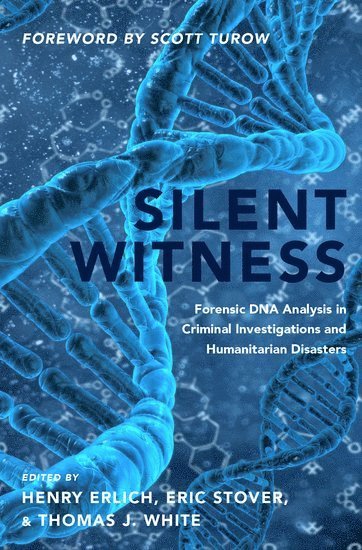
    Silent Witness

    Forensic DNA Evidence in Criminal Investigations and Humanitarian Disasters

    AvHenry Erlich,Eric Stover

    Inbunden, Engelska, 2020

    1 607 kr

    Beställningsvara. Skickas inom 7-10 vardagar. Fri frakt över 249 kr.

    Beskrivning

    Since its introduction in the late 1980s, DNA analysis has revolutionized the forensic sciences: it has helped to convict the guilty, exonerate the wrongfully convicted, identify victims of mass atrocities, and reunite families whose members have been separated by war and repressive regimes. Yet, many of the scientific, legal, societal, and ethical concepts that underpin forensic DNA analysis remain poorly understood, and their application often controversial.Told by over twenty experts in genetics, law, and social science, Silent Witness relates the history and development of modern DNA forensics and its application in both the courtroom and humanitarian settings. Across three thematic sections, Silent Witness tracks the scientific advances in DNA analysis and how these developments have affected criminal and social justice, whether through the arrests of new suspects, as in the case of the Golden State Killer, or through the ability to identify victims of war, terrorism, and human rights abuses, as in the cases of the disappeared in Argentina and the former Yugoslavia and those who perished during the 9/11 attacks. By providing a critical inquiry into modern forensic DNA science, Silent Witness underscores the need to balance the benefits of using forensic genetics to solve crime with the democratic right to safeguard against privacy invasion and unwarranted government scrutiny, and raises the question of what it means to be an autonomous individual in a world where the most personal elements of one's identity are now publicly accessible.

    Produktinformation

    • Utgivningsdatum:2020-11-19
    • Mått:159 x 241 x 27 mm
    • Vikt:708 g
    • Format:Inbunden
    • Språk:Engelska
    • Antal sidor:412
    • Förlag:OUP USA
    • Medarbetare:Scott Turow
    • ISBN:9780190909444

    Utforska kategorier

    • Antropologi inom Samhälle och politik
    • Biovetenskap inom Naturvetenskap och teknik
    • Brottsutredning och kriminalteknik inom Samhälle och politik

    Mer om författaren

    Henry Erlich is Senior Scientist at the Benioff Children's Hospital Oakland Research Institute. He was previously Vice President of Discovery Research at Roche Molecular Systems and Director of Human Genetics at Cetus Corporation. He is a pioneer in the development and application of PCR in forensic DNA analysis and performed the first DNA-based forensic analysis in the United State in 1986 and the first DNA-based exoneration in 1988. Erlich also pioneered the development of DNA-based HLA typing and its application to the study of the genetics of autoimmune diseases. He is the author of over 450 scientific articles and has been the recipient of numerous awards, including the "DNA Profiles in Courage Award" from the National Institute of Justice in 2001.Eric Stover is Faculty Director and Adjunct Professor of Law and Public Health at the Human Rights Center, School of Law, University of California, Berkeley. Since the 1980s, he has led forensic missions to investigate the fate of the disappeared in Argentina, Guatemala, Brazil, El Salvador, Mexico, Iraq, the former Yugoslavia, and Rwanda. In 1984, Stover testified about the forensic search for the disappeared in the trial of Argentina's former ruling junta He is the author and co-editor of several books on the forensic sciences and human rights and has co-produced several documentaries, including the 2017 PBS three-part series "Dead Reckoning: War, Crime, and Justice from World War II to the War on Terror."Thomas J. White is an advisor to the Human Rights Center, School of Law, University of California, Berkeley, and former 2012-2013 Regents Lecturer at the University of California, Berkeley. He previously held the positions of Vice President of Research at Cetus Corporation, Senior Vice President of Research & Development at Roche Molecular Systems, and Chief Scientific Officer at Celera Corporation. He is co-editor of four books on DNA analysis, two published by Academic Press and two by the American Association for Microbiology Press, and is co-author on 100 articles in peer-reviewed scientific and medical journals.

    Recensioner i media

    There are many books on the science of forensic DNA profiling. There are many books on the legal issues its raises. There are none as comprehensive and effective as Silent Witness in bringing together the thoughts of leading scientists, lawyers, and other researchers on the history of this revolutionary forensic science, the most recent advances and applications, and the ethical and policy issues it poses across the globe.

    Innehållsförteckning

    • TABLE OF CONTENTS Foreword by Scott Turow Acknowledgments List of Contributors Introduction: Genetics for Justice PART I: DNA Technology and Individual Identification1. In the Beginning: Forensic Applications of DNA Technologies Henry Erlich 2. Exonerating the Wrongfully Convicted Justin Brooks and Desiree Moshayedi 3. Analysis of Forensic Mixtures Michael Coble, Bruce Budowle, and Henry Erlich 4. Forensic DNA Data Banks and Data Mining: The Balance Between Privacy Interests and Public SafetyFrederick R. Bieber 5. Recent Developments in Forensic DNA Technology Henry Erlich, Cassandra Calloway, and Steven Lee 6. Microbial Forensics: Concepts and Application from Epidemiology to Crime Investigations Antti Sajantila and Bruce Budowle PART II: Human Rights and Humanitarian Disasters 7. The Living Disappeared: Forensic DNA Typing and the Search for Argentina's Stolen Children Mariana Herrera Pinero, Eric Stover, Melina Tupa, and Victor B. Penchaszadeh 8. Disappeared, Not Lost: Finding El Salvador's Missing Children Andrea Lampros, Montserrat Martinez Gomez, Cristian Orrego Benavente, and Patricia Vasquez Marias 9. Large Scale Identification of the Missing: Experiences and Perspectives of the International Commission on Missing PersonsAndreas Kleiser and Thomas J. Parsons 10. Tracing Windblown Seeds: Genetic Information as a Biometric for Tracking Migrants in the United StatesSara H. Katsanis 11. Preventing a Third Death: Identification of Missing Migrants at the US-Mexico BorderSara H. Katsanis and Katherine M. Spradley 12. Taking Stock: DNA Testing and Its Complex TruthsDawnie Steadman and Sarah Wagner PART III: Challenges and Debates 13. Admissibility of DNA Evidence in CourtAndrea Roth 14. Immediacy and Authority: Identification Efforts in Bosnia and Herzegovina and the World Trade Center ComparedAmy Mundorff and Sarah Wagner 15. Forensic Genetics, Ethics, Privacy, and Public PolicyThomas J. White and Steven B. Lee Conclusion: The Future of Forensic DNA Analysis Index