• Fri frakt över 249 kr
  • •
  • Snabba leveranser
  • •
  • Billiga böcker
Kundservice

Du är på sajten för privatpersoner.

Företag, bibliotek eller offentlig verksamhet?

Du handlar på classic.bokus.com, där alla dina funktioner finns intakta.
Till classic.bokus.com
Bokus logotyp. Gå till startsidan.
  • Erbjudanden
  • Nyheter
  • Student
  • Topplistor
  • Barn & ungdom
  • Bokus Play
  • E-böcker
  • Pocketböcker
  • Spel & pussel

10% studentrabatt med kod TERM26

Sidfot

Mina sidor

    Hjälp

    • Kundservice
    • Vanliga frågor och svar
    • Frakt och leverans
    • Retur vid ångerrätt
    • Reklamera vara
    • Betalning
    • Köpvillkor
    • Allmänna villkor
    • Information om webbplatsens tillgänglighet

    Om Bokus

    • Om oss
    • Pressrum
    • För studenter
    • För företag
    • För bibliotek och offentlig verksamhet
    • För leverantörer
    • Hållbarhet

    Populärt

    • Aktuella erbjudanden
    • Presentkort
    • Studentlitteratur
    • Nya böcker
    • Topplistor
    • Signerade böcker
    • Engelska böcker

    Inspiration

    • Boktips
    • BookTok
    • Populära bokserier
    • Barnbokskaraktärer
    • Populära författare
    Logotyp för Bokus
    Följ oss på Facebook (extern länk)Följ oss på Instagram (extern länk)Följ oss på YouTube (extern länk)Följ oss på TikTok (extern länk)
    bokus @ CookiesAnpassa cookiesIntegritetspolicyKöpvillkor
    Till Citymail hemsida (extern länk)Till Budbee hemsida (extern länk)Till Postnord hemsida (extern länk)Till Schenker hemsida (extern länk)Till Early Bird hemsida (extern länk)Till Walleys hemsida (extern länk)
    1. Naturvetenskap och teknik
    2. Matematik och naturvetenskap
    3. Biologi

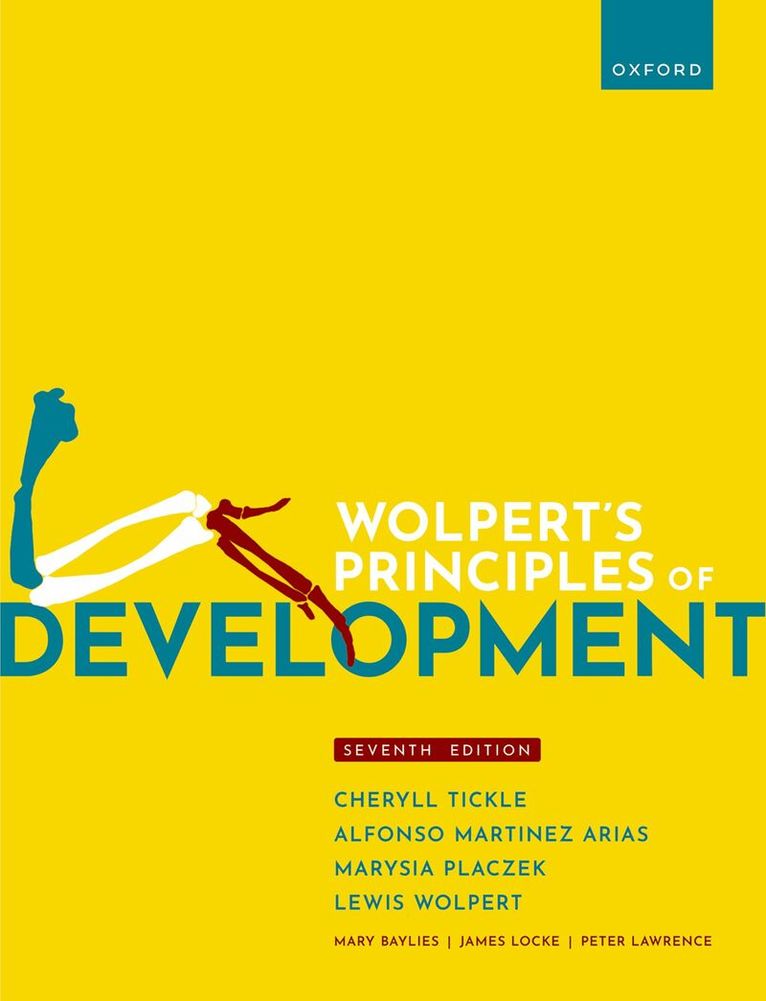
    Wolpert's Principles of Development

    AvCheryll Tickle,Alfonso Martinez Arias

    Häftad, Engelska, 2025

    899 kr

    Beställningsvara. Skickas inom 5-8 vardagar. Fri frakt över 249 kr.

    Beskrivning

    Wolpert's Principles of Development, the latest edition of the prize-winning textbook, opens up the fascinating field of developmental biology to undergraduates studying biology, medicine, and veterinary science. By focusing on the underlying processes shared by diverse organisms, the textbook lays the foundation for a deep understanding. Key features - An emphasis throughout on the underlying principles - which underpin the commonalities between different organisms and their development - enables students to get a clear sense of the 'big picture' of the subject. - Custom-drawn artwork and integrated animations and videos help to make the visualisation of processes and mechanisms in this challenging subject as straightforward as possible. - Medical Boxes explore key developmental diseases and explain how developmental biology furthers our understanding human health and disease. Further experimental detail, including Experimental Boxes, from both classic and current research, demonstrates 'how we know what we know'. - Also available as an e-book enhanced with learning objectives, self-assessment interactive quizzes and multi-media content to offer a fully immersive experience and extra learning support. New to this edition - Chapter 7, a new chapter on Embryonic stem cells, embryo models, and regenerative medicine, to ensure the book's coverage stays up to date with this very active area of developmental biology research. - Chapters 3 and 4 on vertebrate development have been restructured and updated, especially in relation to mouse development, to ensure major concepts and principles are explained with recent supporting experimental evidence. - Chapter 10 on the nervous system has been completely revised and updated, with more emphasis on neural tube patterning. - Chapter 14, which covers nematodes and sea urchins, now appears online as part of the ebook. - There are more examples of the use of CRISPR to address problems like sickle cell disease (Ch6), and evolution of limbs from fins (Ch13). - Examples of single-cell RNA sequencing can be found throughout the book (Ch3, Ch6, Ch7, Ch10, Ch11, Ch12). - Smaller revisions, updates, and new figures have been included throughout. Digital formats and resources The seventh edition is available for students and institutions to purchase in a variety of formats: the e-book and Science Trove offer a mobile experience and convenient access along with interactive self-test questions, videos, flashcards, supplementary materials, functionality tools, navigation features and links that offer extra learning support. For more information about e-books, please visit www.oxfordtextbooks.co.uk/ebooks

    Produktinformation

    • Utgivningsdatum:2025-04-10
    • Mått:206 x 268 x 32 mm
    • Vikt:1 796 g
    • Format:Häftad
    • Språk:Engelska
    • Antal sidor:800
    • Upplaga:7
    • Förlag:OUP OXFORD
    • ISBN:9780192896612

    Utforska kategorier

    • Biologi inom Naturvetenskap och teknik

    Mer om författaren

    Cheryll Tickle, Emeritus Professor, University of Bath. Her research focused on how cells become organized in embryos using the developing chick limb as her main experimental model. She has lectured on developmental biology to biology undergraduates, also medical and dental students, and to scientists from a wide range of different backgrounds, including industry and veterinarians on continuing professional development coursesAlfonso Martinez Arias, ICREA Research Professor at the Universitat Pompeu Fabra. His research makes use of Pluripotent Stem Cells to develop in vitro models of early mammalian development with a focus on the process of gastrulation. Before moving to the UPF he spent 35 years at the University of Cambridge (UK) where he did research and taught Developmental Biology in graduate and undergraduate courses.Marysia Placzek, Professor at the University of Sheffield. Marysia is a neurobiologist who studies development of the vertebrate neural tube, with a particular focus on the hypothalamus. For the last 30 years she has combined research with undergraduate and postgraduate teaching, co-ordinating modules in basic and translational developmental biology.Lewis Wolpert was Emeritus Professor of Biology as Applied to Medicine at University College London. He was an eminent developmental biologist whose ideas have had a profound and lasting impact on the way we think about development. He believed that, even though the development of different organisms seems to be overwhelmingly complex, there are general principles. His philosophy forms the basis of Principles of Development which was first published in 1998. Lewis also authored several books aimed at the general public including The Triumph of the Embryo and an influential book on depression Malignant Sadness based partly on his own experiences.ContributorsMary Baylies is a Professor at Weill Graduate School of Medical Sciences, Cornell UniversityJames Locke is a Professor at the Sainsbury Laboratory, University of CambridgePeter Lawrence is an Emeritus Scientist at the MRC Laboratory of Molecular Biology, CambridgeEleanor Lawrence is a freelance science writer and editorMatthew McClements is a Science Illustrator

    Recensioner i media

    I am incredibly thankful for this book, and wish more study books used your method of layout and explanation, as I have not seen it in any of the other course material I'e had over the past three years.

    Innehållsförteckning

    • 1: History and basic concepts 2: Development of the Drosophila body plan 3: Vertebrate development I: Establishing the body plan 4: Vertebrate development II: completing the body plan 5: Morphogenesis: change in form in the early embryo 6: Cell differentiation and stem cells 7: Embryonic stem cells, embryo models, and regenerative medicine 8: Germ cells, fertilization, and sex determination 9: Organogenesis 10: Development of the nervous system 11: Growth, post-embryonic development, and regeneration 12: Plant development 13: Evolution and development