• Fri frakt över 249 kr
  • •
  • Snabba leveranser
  • •
  • Billiga böcker
Kundservice

Du är på sajten för privatpersoner.

Företag, bibliotek eller offentlig verksamhet?

Du handlar på classic.bokus.com, där alla dina funktioner finns intakta.
Till classic.bokus.com
Bokus logotyp. Gå till startsidan.
  • Erbjudanden
  • Nyheter
  • Student
  • Topplistor
  • Barn & ungdom
  • Bokus Play
  • E-böcker
  • Pocketböcker
  • Spel & pussel

10% rabatt på allt med kod: NYSTART10 →

Sidfot

Mina sidor

    Hjälp

    • Kundservice
    • Vanliga frågor och svar
    • Frakt och leverans
    • Retur vid ångerrätt
    • Reklamera vara
    • Betalning
    • Köpvillkor
    • Allmänna villkor
    • Information om webbplatsens tillgänglighet

    Om Bokus

    • Om oss
    • Pressrum
    • För studenter
    • För företag
    • För bibliotek och offentlig verksamhet
    • För leverantörer
    • Hållbarhet

    Populärt

    • Aktuella erbjudanden
    • Presentkort
    • Studentlitteratur
    • Nya böcker
    • Topplistor
    • Signerade böcker
    • Engelska böcker

    Inspiration

    • Boktips
    • BookTok
    • Populära bokserier
    • Barnbokskaraktärer
    • Populära författare
    Logotyp för Bokus
    Följ oss på Facebook (extern länk)Följ oss på Instagram (extern länk)Följ oss på YouTube (extern länk)Följ oss på TikTok (extern länk)
    bokus @ CookiesAnpassa cookiesIntegritetspolicyKöpvillkor
    Till Citymail hemsida (extern länk)Till Budbee hemsida (extern länk)Till Postnord hemsida (extern länk)Till Schenker hemsida (extern länk)Till Early Bird hemsida (extern länk)Till Walleys hemsida (extern länk)
    1. Filosofi och religion
    2. Filosofi
    3. Filosofiska discipliner

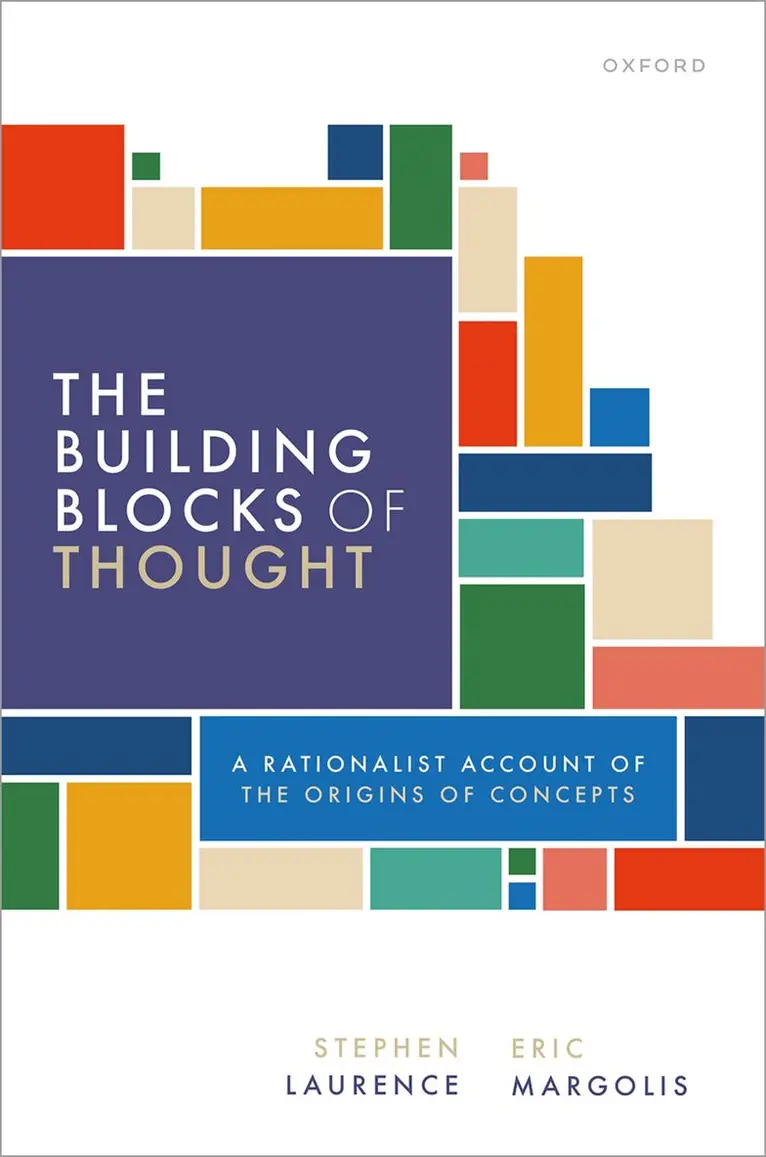
    The Building Blocks of Thought

    A Rationalist Account of the Origins of Concepts

    AvStephen Laurence,Eric Margolis

    Häftad, Engelska, 2024

    433 kr

    Beställningsvara. Skickas inom 5-8 vardagar. Fri frakt över 249 kr.

    Fler format och utgåvor

    Inbunden

    1 905 kr

    Beskrivning

    This is an open access title available under the terms of a CC BY-NC-ND 4.0 International licence. It is free to read on Oxford Academic and offered as a free PDF download from OUP and selected open access locations.This is a broad and authoritative study of one of the central topics in the study of the mind: the origins of concepts. The authors survey the debate between rationalists and empiricists which stretches back to the very beginnings of philosophy, and has been at the centre of some of the most exciting research in cognitive science. Many have charged that the debate is riddled with confusion or that rationalist approaches, in particular, are deeply problematic. The Building Blocks of Thought offers a comprehensive rethinking of the foundations of this debate, showing that these negative appraisals are based on misunderstandings. Stephen Laurence and Eric Margolis argue that the debate should be understood to concern the nature of the unlearned psychological traits that provide the foundation for learning all concepts. They go on to argue for a version of concept nativism according to which there is a rationalist account of the origins of many concepts across many different conceptual domains. This rationalist view is developed around seven distinct arguments, drawing on a wealth of data across the cognitive sciences, which are shown to come together to form a unified large-scale argument to the best explanation for a rationalist account of the origins of concepts. Rounding out the case for concept nativism, the book contrasts this view with the most important and influential empiricist views, as well as alternative rationalist views, including Fodor's infamous radical concept nativism and his claim that concept learning is impossible. The Building Blocks of Thought argues for the enormous importance of learning and culture, showing how a thoroughly rationalist approach facilitates and enhances cultural learning and provides the foundations for the best overall account of the origins of concepts.

    Produktinformation

    • Utgivningsdatum:2024-08-22
    • Mått:167 x 235 x 33 mm
    • Vikt:1 146 g
    • Format:Häftad
    • Språk:Engelska
    • Antal sidor:704
    • Förlag:OUP OXFORD
    • ISBN:9780192898920

    Utforska kategorier

    • Filosofiska discipliner inom Filosofi och religion
    • Barnpsykologi och utvecklingspsykologi inom Psykologi och pedagogik
    • Kognitiv psykologi inom Psykologi och pedagogik

    Mer om författaren

    Stephen Laurence is Professor of Philosophy at the University of Sheffield. He received his PhD in Philosophy at Rutgers University and taught at the University of Manchester, Hampshire College, the London School of Economics, and the University of Hull. He is Director of the Hang Seng Centre for Cognitive Studies and directed the AHRC Innateness and the Structure of the Mind Project and the AHRC Culture and the Mind Project. He is co-editor of The Conceptual Mind and Concepts: Core Readings (both The MIT Press) among other books, and has published numerous articles in both philosophical and scientific journals.Eric Margolis is Professor of Philosophy at the University of British Columbia. He received his PhD in Philosophy at Rutgers University and taught at Rice University and the University of Wisconsin prior to his appointment at the University of British Columbia. He has received research funding from The Wisconsin Alumni Research Foundation, The Peter Wall Institute for Advanced Studies, and Canada's Social Science and Humanities Research Council. He is co-editor of The Oxford Handbook of Philosophy of Cognitive Science (OUP, 2012), and The Conceptual Mind (The MIT Press), among other books, and has published extensively in philosophical journals.

    Recensioner i media

    Anybody interested in the nature and origins of the human mind must read Laurence and Margolis' monumental book, The Building Blocks of Thought. It is accessible to both philosophers and experimental scientists and is so wide ranging that it discusses some work that any expert in any part of the relevant discourse will not yet know and will find fascinating. Dispelling confusion about the rationalist/empiricist debate, the book restores this debate to its rightful place at the center of cognitive science.

    Innehållsförteckning

    • 1: Introduction: Whatever Happened to the Debate Over Innate Ideas? PART I: The Rationalism-Empiricism Debate 2: What the Rationalism-Empiricism Debate is Really About 3: Why the Rationalism-Empiricism Debate Isn't the Nature-Nurture Debate 4: The Viability of Rationalism 5: Abstraction and the Allure of Illusory Explanation 6: Concepts, Innateness, and Why Concept Nativism is about More Than Just Innate Concepts 7: Conclusion to Part I PART II: Seven Arguments for Concept Nativism 8: The Argument from Early Development (1) 9: The Argument from Early Development (2) 10: The Argument from Animals 11: The Argument from Universality 12: The Argument from Initial Representational Access 13: The Argument from Neural Wiring 14: The Argument from Prepared Learning 15: The Argument from Cognitive and Behavioural Quirks 16: Conclusion to Part II PART III. Alternative Empiricist Perspectives 17: Methodological Empiricism 18: Neo-Associationism 19: Artificial Neural Networks: From Connectionism to Deep Learning 20: Neuroconstructivism 21: Perceptual Meaning Analysis 22: Embodied Cognition 23: Conclusion to Part III PART IV. Fodorian Concept Nativism 24: The Evolution of Fodor's Case Against Concept Learning 25: Not All Concepts Are Innate 26: Fodor's Biological Account of Concept AcquisitionDLand the Importance of Cultural Learning 27: Conclusion to Part IV 28: Coda: Innate Ideas Revisited