• Fri frakt över 249 kr
  • •
  • Snabba leveranser
  • •
  • Billiga böcker
Kundservice

Du är på sajten för privatpersoner.

Företag, bibliotek eller offentlig verksamhet?

Du handlar på classic.bokus.com, där alla dina funktioner finns intakta.
Till classic.bokus.com
Bokus logotyp. Gå till startsidan.
  • Erbjudanden
  • Nyheter
  • Student
  • Topplistor
  • Barn & ungdom
  • Bokus Play
  • E-böcker
  • Pocketböcker
  • Spel & pussel

10% rabatt på allt med kod: NYSTART10 →

Sidfot

Mina sidor

    Hjälp

    • Kundservice
    • Vanliga frågor och svar
    • Frakt och leverans
    • Retur vid ångerrätt
    • Reklamera vara
    • Betalning
    • Köpvillkor
    • Allmänna villkor
    • Information om webbplatsens tillgänglighet

    Om Bokus

    • Om oss
    • Pressrum
    • För studenter
    • För företag
    • För bibliotek och offentlig verksamhet
    • För leverantörer
    • Hållbarhet

    Populärt

    • Aktuella erbjudanden
    • Presentkort
    • Studentlitteratur
    • Nya böcker
    • Topplistor
    • Signerade böcker
    • Engelska böcker

    Inspiration

    • Boktips
    • BookTok
    • Populära bokserier
    • Barnbokskaraktärer
    • Populära författare
    Logotyp för Bokus
    Följ oss på Facebook (extern länk)Följ oss på Instagram (extern länk)Följ oss på YouTube (extern länk)Följ oss på TikTok (extern länk)
    bokus @ CookiesAnpassa cookiesIntegritetspolicyKöpvillkor
    Till Citymail hemsida (extern länk)Till Budbee hemsida (extern länk)Till Postnord hemsida (extern länk)Till Schenker hemsida (extern länk)Till Early Bird hemsida (extern länk)Till Walleys hemsida (extern länk)
    1. Samhälle och politik
    2. Samhälle och kultur
    3. Sociala och etiska frågor

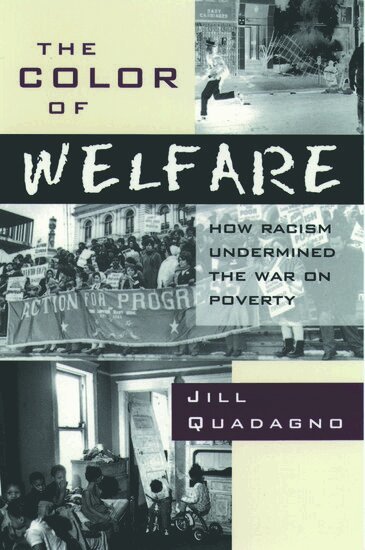
    The Color of Welfare

    How Racism Undermined the War on Poverty

    AvJill Quadagno

    Inbunden, Engelska, 1994

    923 kr

    Beställningsvara. Skickas inom 5-8 vardagar. Fri frakt över 249 kr.

    Fler format och utgåvor

    Häftad

    409 kr

    Beskrivning

    Thirty years after Lyndon Johnson declared a War on Poverty, the United States still lags behind most Western democracies in national welfare systems, lacking such basic programs as national health insurance and child care support. Some critics have explained the failure of social programs by citing our tradition of individual freedom and libertarian values, while others point to weaknesses within the working class. In The Color of Welfare, Jill Quadagno takes exception to these claims, placing race at the centre of the "American Dilemma," as Swedish economist Gunnar Myrdal did half a century ago. The "American creed" of liberty, justice, and equality clashed with a history of active racial discrimination, says Quadagno. It is racism that has undermined the War on Poverty, and America must come to terms with this history if there is to be any hope of addressing welfare reform today.From Reconstruction to Lyndon Johnson and beyond, Quadagno reveals how American social policy has continually foundered on issues of race. Drawing on extensive primary research, Quadagno shows, for instance, how Roosevelt, in need of support from southern congressmen, excluded African Americans from the core programs of the Social Security Act. Turning to Lyndon Johnson's "unconditional war on poverty," she contends that though anti-poverty programs for job training, community action, health care, housing, and education have accomplished much, they have not been fully realized because they became inextricably intertwined with the civil rights movement of the 1960s, which triggered a white backlash. Job training programs, for instance, became affirmative action programs, programs to improve housing became programs to integrate housing, programs that began as community action to upgrade the quality of life in the cities were taken over by local civil rights groups. This shift of emphasis eventually alienated white, working-class Americans, who had some of the same needs--for health care, subsidized housing, and job training opportunities--but who got very little from these programs. At the same time, affirmative action clashed openly with organized labor, and equal housing raised protests from the white suburban middle-class, who didn't want their neighborhoods integrated. Quadagno shows that Nixon, who initially supported many of Johnson's programs, eventually caught on that the white middle class was disenchanted. He realized that his grand plan for welfare reform, the Family Assistance Plan, threatened to undermine wages in the South and alienate the Republican party's new constituency--white, southern Democrats--and therefore dropped it.In the 1960s, the United States embarked on a journey to resolve the "American dilemma." Yet instead of finally instituting full democratic rights for all its citizens, the policies enacted in that turbulent decade failed dismally. The Color of Welfare reveals the root cause of this failure--the inability to address racial inequality.

    Produktinformation

    • Utgivningsdatum:1994-12-08
    • Mått:147 x 218 x 26 mm
    • Vikt:522 g
    • Format:Inbunden
    • Språk:Engelska
    • Antal sidor:272
    • Förlag:OUP USA
    • ISBN:9780195079197

    Utforska kategorier

    • Sociala och etiska frågor inom Samhälle och politik
    • Socialt arbete och välfärd inom Samhälle och politik
    • Etnicitet inom Samhälle och politik

    Mer om författaren

    About the Author: Jill Quadagno is Professor of Sociology and Mildred and Claude Pepper Chair in Social Gerontology at Florida State University. She is the author of The Transformation of Old Age Security.

    Recensioner i media

    "This important book provides a lucid and perceptive analysis of the War on Poverty and the turbulent race politics which surrounded and ultimately engulfed it. More than that, by placing racial inequality at the very center of her analysis, Jill Quadagno makes a major contribution to our understanding of the distinctive development of the American welfare state."--Frances Fox Piven, co-author of Why Americans Don't Vote and Regulating the Poor"A leading authority on the American welfare state, Jill Quadagno makes a compelling case for her thesis that racism has done more than any other fact to limit generous and dignified public social provision in the United States. Scholars, students, and policy-makers all have much to learn from this important book."--Theda Skocpol, author of Protecting Soldiers and Mothers--The Political Origins of Social Policy in the United States"A telling analysis of race as the key faultline of American social policy."--Joel Blau, author of The Visible Poor: Homelessness in the U.S."The graceful prose of Jill Quadagno's new book conceals a hard-hitting argument about the critical importance of racism in shaping the American welfare state. Based on exhaustive research in primary sources, she tells a story which has not been told before. Even child care programs, not to mention family assistance, job training, and housing programs have been decisively shaped by the politics of race. Theoretically, her argument challenges the claim thatAmerica's 'liberal values' have been a main barrier to the expansion of the American welfare state."--Robert R. Alford, author of Health Care Politics