Häftad, Engelska, 2000
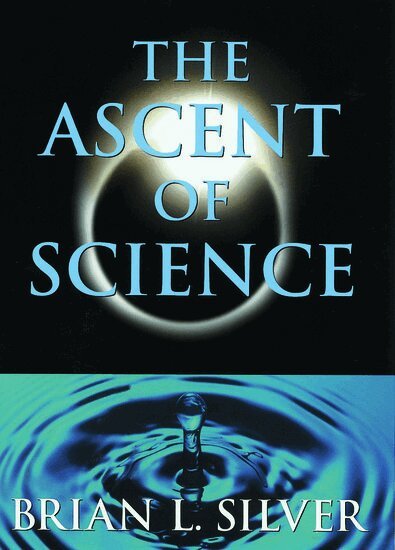
The Ascent of Science
Av Silver
406 kr
Beställningsvara. Skickas inom 5-8 vardagar. Fri frakt över 249 kr.
Beskrivning
"Despite the shelves of 'popular' books on quantum mechanics, the Big Bang, chaos, black holes and so on," writes Brian Silver, "the average reader finds himself in a state akin to that of a medieval peasant attending mass in a great gothic cathedral: he is awed, he knows that something terribly important is being said, but he understands very little because it's all in Latin. He takes the wafer and remains mystified." In The Ascent of Science, Silver provides a sweeping and dynamic history of the whole of Western science, from the Renaissance to the present. In it, he translates the most profoundly important, and often impenetrably obscure, scientific developments into a vernacular that is not only accessible and illuminating but highly enjoyable as well.In the tradition of Jacob Bronowski, Stephen Jay Gould, and Carl Sagan, Silver writes with extraordinary grace and sparkling wit--and with a comprehensiveness unparalleled in science writing. From the revolutionary discoveries of Galileo and Newton to the mind-bending theories of Einstein and Heisenberg; from plate tectonics to particle physics; from the origin of life to universal entropy; from biology to cosmology, Silver takes the reader on a guided tour not only of the history of science but of the very nature of scientific inquiry and its role in our society. Thus, while explaining with great clarity the scientific breakthroughs that have shaped and often shaken our world, Silver places each in a broad historical context and supplies a keen awareness of parallel developments in art, literature, music, politics and philosophy. He also argues forcefully that it is the open-mindedness of science, its ability to subject itself to continual validation, and its willingness to abandon scientific beliefs when they are undercut by new facts or better theories, that has accounted for the magnificent success of science. Silver does realize that science can have disastrous consequences--that breakthroughs in nuclear physics can lead to Hiroshimas--and he insists on a more fruitful dialogue between science and ethical philosophy, an insistence that takes on greater urgency given the current advances in genetics. But he ably defends the scientific method from recent arguments that characterize science as merely one more socially constructed and fatally flawed way of knowing, or that suggest that the Age of Science is nearing its end. Throughout the book, it is science as the height of human reason, and reason as the surest guide to truth, that enlivens the story of our emergence from ignorance and superstition to the ability to fathom the deepest mysteries of nature.For anyone interested in but intimidated by the scientific enterprise, The Ascent of Science provides a vivid history of the discipline. That it does so without diminishing either the complexity or the awe-inspiring power of science is a major accomplishment, one that opens the door to humanity's greatest intellectual adventure and reveals the many ways science has altered forever the way we see the world and ourselves.
Produktinformation
- Utgivningsdatum: 2000-03-16
- Mått: 211 x 280 x 30 mm
- Vikt: 1 234 g
- Format: Häftad
- Språk: Engelska
- Antal sidor: 552
- Förlag: OUP USA
- ISBN: 9780195134278
Utforska kategorier
Betyg & recensioner
0 recensioner
Inga recensioner tillgängliga.