• Fri frakt över 249 kr
  • •
  • Snabba leveranser
  • •
  • Billiga böcker
Kundservice

Du är på sajten för privatpersoner.

Företag, bibliotek eller offentlig verksamhet?

Du handlar på classic.bokus.com, där alla dina funktioner finns intakta.
Till classic.bokus.com
Bokus logotyp. Gå till startsidan.
  • Erbjudanden
  • Student
  • Topplistor
  • Barn & ungdom
  • Bokus Play
  • E-böcker
  • Ljudböcker
  • Pocketböcker
  • Spel och pussel

Pocketfynda! Hundratals böcker för 49 kr/st →

Sidfot

Mina sidor

    Hjälp

    • Kundservice
    • Vanliga frågor och svar
    • Frakt och leverans
    • Retur vid ångerrätt
    • Reklamera vara
    • Betalning
    • Köpvillkor
    • Allmänna villkor
    • Information om webbplatsens tillgänglighet

    Om Bokus

    • Om oss
    • Pressrum
    • För studenter
    • För företag
    • För bibliotek och offentlig verksamhet
    • För leverantörer
    • Hållbarhet

    Populärt

    • Aktuella erbjudanden
    • Presentkort
    • Studentlitteratur
    • Nya böcker
    • Topplistor
    • Signerade böcker
    • Engelska böcker

    Inspiration

    • Boktips
    • BookTok
    • Barnbokskaraktärer
    • Populära författare
    Logotyp för Bokus
    Följ oss på Facebook (extern länk)Följ oss på Instagram (extern länk)Följ oss på YouTube (extern länk)Följ oss på TikTok (extern länk)
    bokus @ CookiesAnpassa cookiesIntegritetspolicyKöpvillkor
    Till Citymail hemsida (extern länk)Till Budbee hemsida (extern länk)Till Postnord hemsida (extern länk)Till Schenker hemsida (extern länk)Till Early Bird hemsida (extern länk)Till Walleys hemsida (extern länk)
    1. Naturvetenskap och teknik
    2. Matematik och naturvetenskap
    3. Naturvetenskap:allmänt

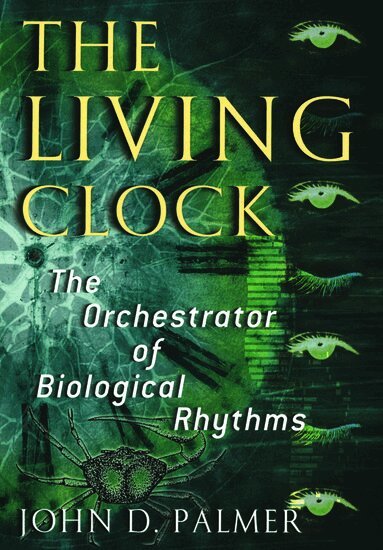
    The Living Clock

    The Orchestrator of Biological Rhythms

    AvJohn D. Palmer

    Inbunden, Engelska, 2002

    346 kr

    Beställningsvara. Skickas inom 5-8 vardagar. Fri frakt över 249 kr.

    Beskrivning

    This book is an introduction to a basic property of life, one mostly unknown to science and the public until the latter half of the last century: Humans, plants, and animals have within their bodies a kind of clock that synchronizes much of what they do throughout their lives to the time of day and the seasons, and in the case of the sea-dwelling organisms, the tides. This timepiece performs its service autonomously - it rules silently within us without us giving a thought to it.Three chapters are devoted to the human clock: its disruptive action in transmeridional travel and shift work, its oversight in most every aspect of our physiology, and how doctors being aware of its action can save lives. Other major subjects describe the role in piloting birds in homing and migration, guiding the seasonal reproduction of plants and animals, and its influence on shore dwellers. The book closes with a description of the clockworks' escapement.

    Produktinformation

    • Utgivningsdatum:2002-07-25
    • Mått:175 x 214 x 19 mm
    • Vikt:376 g
    • Format:Inbunden
    • Språk:Engelska
    • Antal sidor:176
    • Förlag:OUP USA
    • ISBN:9780195143409

    Utforska kategorier

    • Naturvetenskap:allmänt inom Naturvetenskap och teknik
    • Människans biologi inom Naturvetenskap och teknik

    Mer om författaren

    After earning his doctorate at Northwestern in 1962, John Palmer taught at the University of Illinois, and chaired the Biology Departments at New York University, and the University of Massachusetts. He spends most summers at the Marine Biological Laboratory in Woods Hole. MA, and has worked at other marine labs around the world. He has done research in the field of chronobiology for 39 years, and has published more books on the subject than any other author.

    Recensioner i media

    "Palmer has written a whimsical, 'gosh can you believe that' account for the interested lay reader, which is also a book that will further fascinate serious chronobiologists with the wonders of their subject. It is a reminder of the marvels of nature and of the critical role that endogenous biological timing plays in the life cycles of almost every organism." -- C.P. Kyriacou, Science"Its rare to be able to recommend a book on science for holiday reading, but this one, The Living Clock, is a griper from the first page and never lets go.... The topic is fascinating: the internal clocks that we all possess in common with almost every form of life on Earth.... Take it with you to the beach."--Roy Herbert, New Scientist"Anyone fortunate enough to read Professor Palmer's new book will not only appreciate the crucial role of rhythms in all of life's forms, but will be greatly entertained, and even astonished, by the wonderful tales woven into the plot."--John Carlson Aldrich, Department of Zoology, Trinity College, Dublin"Everyone knows somebody who claims not to need an alarm clock. These people will tell you that they have woken up every day at 6:00 a.m. for twenty years and don't even bother to set the alarm anymore. How do they do that? In The Living Clock, Professor John Palmer tells us the story of the discovery of the internal clocks which exist in almost every living thing, from bacteria to humans. This book is both a work of scientific popularization and ascientific autobiography since Professor Palmer has personally contributed a great deal to our understanding of the living clock. Professor Palmer's personal annecdotes are, in fact, the highlight of the book.Told with humor but also with a seasoned scientist's keen eye for detail, these stories take us on a journey of discovery."--Marc R. Roussel, Department of Chemistry and Biochemistry, University of Lethbridge"An erudite and entertaining journey through the world of biological clocks, ranging from such human details as when best to take aspirin to the ubiquitous per gene. Gleaning illustrations from the entire spectrum, botanical and zoological, Palmer demonstrates the universal importance of temporal rhythms in organismal and cellular biology. The clock concept plays an equally crucial role in modern medical practice and in understanding such arcane phenomena asthe annual breeding cycle of the palolo worm. The Living Clock belongs in that small exclusive library of books ideally suited for creating an exciting introductory course in biology fornon-biologists, and even for non-scientists. It was fun to read."--Peter Marler, Section of Neurobiology, Physiology & Behavior, University of California, Davis"Palmer has written a whimsical, 'gosh can you believe that' account for the interested lay reader, which is also a book that will further fascinate serious chronobiologists with the wonders of their subject. It is a reminder of the marvels of nature and of the critical role that endogenous biological timing plays in the life cycles of almost every organism." -- C.P. Kyriacou, Science"It's rare to be able to recommend a book on science for holiday reading, but this one, The Living Clock, is a gripper from the first page and never lets go.... The topic is fascinating: the internal clocks that we all possess in common with almost every form of life on Earth.... Take it with you to the beach."--Roy Herbert, New Scientist"Anyone fortunate enough to read Professor Palmer's new book will not only appreciate the crucial role of rhythms in all of life's forms, but will be greatly entertained, and even astonished, by the wonderful tales woven into the plot."--John Carlson Aldrich, Department of Zoology, Trinity College, Dublin"Everyone knows somebody who claims not to need an alarm clock. These people will tell you that they have woken up every day at 6:00 a.m. for twenty years and don't even bother to set the alarm anymore. How do they do that? In The Living Clock, Professor John Palmer tells us the story of the discovery of the internal clocks which exist in almost every living thing, from bacteria to humans. This book is both a work of scientific popularization and ascientific autobiography since Professor Palmer has personally contributed a great deal to our understanding of the living clock. Professor Palmer's personal annecdotes are, in fact, the highlight of the book.Told with humor but also with a seasoned scientist's keen eye for detail, these stories take us on a journey of discovery."--Marc R. Roussel, Department of Chemistry and Biochemistry, University of Lethbridge"An erudite and entertaining journey through the world of biological clocks, ranging from such human details as when best to take aspirin to the ubiquitous per gene. Gleaning illustrations from the entire spectrum, botanical and zoological, Palmer demonstrates the universal importance of temporal rhythms in organismal and cellular biology. The clock concept plays an equally crucial role in modern medical practice and in understanding such arcane phenomena asthe annual breeding cycle of the palolo worm. The Living Clock belongs in that small exclusive library of books ideally suited for creating an exciting introductory course in biology fornon-biologists, and even for non-scientists. It was fun to read."--Peter Marler, Section of Neurobiology, Physiology & Behavior, University of California, Davis

    Innehållsförteckning

    • Introduction to Rhythms and Clocks ; Human Rhythms: Basic Processes ; Rhythmic Pharmacology ; Jet Lag Can Be a Drag ; Daily Rhythm in Single-Cell Organisms ; Rhythms in Shore Dwellers ; Some Animal Rhythms ; A Few Plant Clocks ; Denouement: The Living Clock