• Fri frakt över 249 kr
  • •
  • Snabba leveranser
  • •
  • Billiga böcker
Kundservice

Du är på sajten för privatpersoner.

Företag, bibliotek eller offentlig verksamhet?

Du handlar på classic.bokus.com, där alla dina funktioner finns intakta.
Till classic.bokus.com
Bokus logotyp. Gå till startsidan.
  • Erbjudanden
  • Nyheter
  • Student
  • Topplistor
  • Barn & ungdom
  • Bokus Play
  • E-böcker
  • Pocketböcker
  • Spel & pussel

10% rabatt på allt med kod: NYSTART10 →

Sidfot

Mina sidor

    Hjälp

    • Kundservice
    • Vanliga frågor och svar
    • Frakt och leverans
    • Retur vid ångerrätt
    • Reklamera vara
    • Betalning
    • Köpvillkor
    • Allmänna villkor
    • Information om webbplatsens tillgänglighet

    Om Bokus

    • Om oss
    • Pressrum
    • För studenter
    • För företag
    • För bibliotek och offentlig verksamhet
    • För leverantörer
    • Hållbarhet

    Populärt

    • Aktuella erbjudanden
    • Presentkort
    • Studentlitteratur
    • Nya böcker
    • Topplistor
    • Signerade böcker
    • Engelska böcker

    Inspiration

    • Boktips
    • BookTok
    • Populära bokserier
    • Barnbokskaraktärer
    • Populära författare
    Logotyp för Bokus
    Följ oss på Facebook (extern länk)Följ oss på Instagram (extern länk)Följ oss på YouTube (extern länk)Följ oss på TikTok (extern länk)
    bokus @ CookiesAnpassa cookiesIntegritetspolicyKöpvillkor
    Till Citymail hemsida (extern länk)Till Budbee hemsida (extern länk)Till Postnord hemsida (extern länk)Till Schenker hemsida (extern länk)Till Early Bird hemsida (extern länk)Till Walleys hemsida (extern länk)
    1. Naturvetenskap och teknik
    2. Matematik och naturvetenskap
    3. Kemi
    4. Fysikalisk kemi

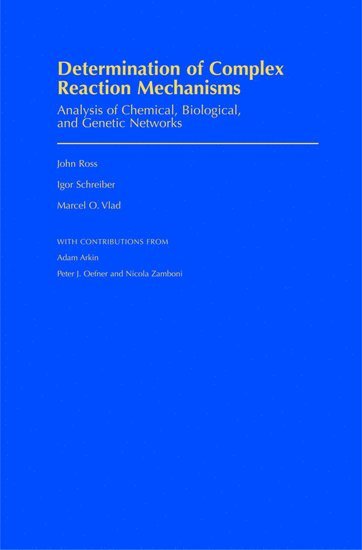
    Determination of Complex Reaction Mechanisms

    Analysis of Chemical, Biological, and Genetic Networks

    AvJohn Ross,Igor Schreiber

    Inbunden, Engelska, 2006

    1 137 kr

    Skickas . Fri frakt över 249 kr.

    Beskrivning

    In a chemical system with many chemical species several questions can be asked: what species react with other species: in what temporal order: and with what results? These questions have been asked for over one hundred years about simple and complex chemical systems, and the answers constitute the macroscopic reaction mechanism. In Determination of Complex Reaction Mechanisms authors John Ross, Igor Schreiber, and Marcel Vlad present several systematic approaches for obtaining information on the causal connectivity of chemical species, on correlations of chemical species, on the reaction pathway, and on the reaction mechanism. Basic pulse theory is demonstrated and tested in an experiment on glycolysis. In a second approach, measurements on time series of concentrations are used to construct correlation functions and a theory is developed which shows that from these functions information may be inferred on the reaction pathway, the reaction mechanism, and the centers of control in that mechanism. A third approach is based on application of genetic algorithm methods to the study of the evolutionary development of a reaction mechanism, to the attainment given goals in a mechanism, and to the determination of a reaction mechanism and rate coefficients by comparison with experiment. Responses of non-linear systems to pulses or other perturbations are analyzed, and mechanisms of oscillatory reactions are presented in detail. The concluding chapters give an introduction to bioinformatics and statistical methods for determining reaction mechanisms.

    Produktinformation

    • Utgivningsdatum:2006-01-26
    • Mått:236 x 163 x 22 mm
    • Vikt:522 g
    • Format:Inbunden
    • Språk:Engelska
    • Antal sidor:242
    • Förlag:OUP USA
    • ISBN:9780195178685

    Utforska kategorier

    • Fysikalisk kemi inom Naturvetenskap och teknik
    • Biovetenskap inom Naturvetenskap och teknik
    • Biokemi inom Naturvetenskap och teknik

    Recensioner i media

    "The main value of this book is that it discusses experimental protocols and theoretical methods for the rational elucidation of reaction networks and their kinetic parameters by utilizing such techniques. In other words, it is a manual that describes nontraditional methodologies for the determination of reaction mechanisms from kinetic data sets."-- Angewandte Chemie"For readers who want a fresh view of one of the central challenges in reaction kinetics, this is the book for you. There's no other book like it on the market. It should be useful to a wide audience in many fields including chemistry, biochemistry, biotechnology, engineering, and genomics."-- Chemical & Engineering News"The main value of this book is that it discusses experimental protocols and theoretical methods for the rational elucidation of reaction networks and their kinetic parameters by utilizing such techniques. In other words, it is a manual that describes nontraditional methodologies for he determination of reaction mechanisms from kinetic data sets."-- Angewandte Chemie"For readers who want a fresh view of one of the central challenges in reaction kinetics, this is the book for you. There's no other book like it on the market. It should be useful to a wide audience in many fields including chemistry, biochemistry, biotechnology, engineering, and genomics."-- Chemical & Engineering News

    Innehållsförteckning

    • 1.: Introduction 1.1: Some Basic Definitions 1.2: Introduction to Classical Identification 2.: Introduction to Chemical Kinetic Processes 2.1: Macroscopic, Deterministic Chemical Kinetics 2.2: Disordered Kinetics 2.3: Fluctuations 3.: A Brief Review of Methodology for the Analysis of Biochemical Reactions and Cells 3.1: Introduction 3.2: Measurement of Metabolite Concentrations 3.3: Principles and Applications of Mass Spectrometry 3.4: Genome-Wide Analyses of mRNA and Proteins 3.5: Fluorescent Imaging 3.6: Conclusions 4.: Computations by Means of Macroscopic Chemical Kinetics 4.1: Chemical Neurons and Logic Gates 4.2: Implementation of Computers by Macroscopic Chemical Kinetics 4.3: Computational Functions in Biochemical Reaction Systems 5.: Response of Systems to Pulse Perturbations 5.1: Theory 5.2: An Example: The Glycolytic Pathway 6.: Experimental Test of the Pulse Pertubation Method for Determining Casual Connectivities of Chemical Species in a Reaction Network 7.: Correlation Metric Construction: Theory of Statistical Construction of Reaction Mechanisms 8.: Experimental Test and Applications of Correlation Metric Construction 9.: Destiny Estimation 9.1: Entropy Metric Construction (EMC) 9.2: Entropy Reduction Method (ERM) 10.: Applications of Genetic Algorithms to the Determination of Reaction Mechanisms 10.1: A Shory Primer on Genetic Algorithms 10.2: Selection Regulation of Flux in a Metabolic Model 10.3: Evolutionary Development of Biochemical Oscillatory Reaction Mechanisms 10.4: Systematic Determination of Reaction Mechanism and Rate Coefficients 10.5: Summary 11.: Oscillatory Reactions 11.1: Introduction 11.2: Concepts and Theoretical Constructs 11.3: Experiments Leading to Information about the Oscillatory Reaction Mechanism 11.4: Examples of Deduction of Reaction Mechanism from Experiments 11.5: Limits of Stoichiometric Network Analysis 12.: Lifetime and Transit Time Distributions and Response Experiments in Chemical Kinetics 12.1: Lifetime Distributions of Chemical Species 12.2: Response Experiments and Lifetime Distributions 12.3: Transit Time Distributions, in Complex Chemical Systems 12.4: Transit Time Distributions, Linear Response, and Extracting Kinetic Information from Experimental Data 12.5: Errors in Response Experiments 12.6: Response Experiments for Reaction-Diffusion Systems 12.7: Conclusions 13.: Mini-Introduction to Bioinformatics 13.1: Clustering 13.2: Linearization in Various Forms 13.3: Modeling of Reaction Mechanisms 13.4: Boolean Networks 13.5: Correlation Metric Construction for Genetic Networks 13.6: Bayesian Networks 13.7: Some Other Illustrative Approaches Index