• Fri frakt över 249 kr
  • •
  • Snabba leveranser
  • •
  • Billiga böcker
Kundservice

Du är på sajten för privatpersoner.

Företag, bibliotek eller offentlig verksamhet?

Du handlar på classic.bokus.com, där alla dina funktioner finns intakta.
Till classic.bokus.com
Bokus logotyp. Gå till startsidan.
  • Erbjudanden
  • Nyheter
  • Student
  • Topplistor
  • Barn & ungdom
  • Bokus Play
  • E-böcker
  • Pocketböcker
  • Spel & pussel

10% rabatt på allt med kod NYSTART10 →

Sidfot

Mina sidor

    Hjälp

    • Kundservice
    • Vanliga frågor och svar
    • Frakt och leverans
    • Retur vid ångerrätt
    • Reklamera vara
    • Betalning
    • Köpvillkor
    • Allmänna villkor
    • Information om webbplatsens tillgänglighet

    Om Bokus

    • Om oss
    • Pressrum
    • För studenter
    • För företag
    • För bibliotek och offentlig verksamhet
    • För leverantörer
    • Hållbarhet

    Populärt

    • Aktuella erbjudanden
    • Presentkort
    • Studentlitteratur
    • Nya böcker
    • Topplistor
    • Signerade böcker
    • Engelska böcker

    Inspiration

    • Boktips
    • BookTok
    • Populära bokserier
    • Barnbokskaraktärer
    • Populära författare
    Logotyp för Bokus
    Följ oss på Facebook (extern länk)Följ oss på Instagram (extern länk)Följ oss på YouTube (extern länk)Följ oss på TikTok (extern länk)
    bokus @ CookiesAnpassa cookiesIntegritetspolicyKöpvillkor
    Till Citymail hemsida (extern länk)Till Budbee hemsida (extern länk)Till Postnord hemsida (extern länk)Till Schenker hemsida (extern länk)Till Early Bird hemsida (extern länk)Till Walleys hemsida (extern länk)
    1. Samhälle och politik
    2. Samhälle och kultur
    3. Sociala grupper och identitet

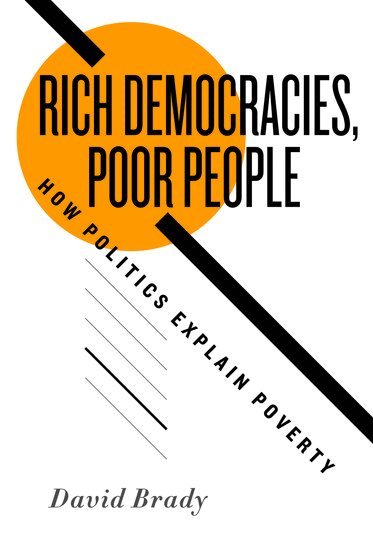
    Rich Democracies, Poor People

    How Politics Explain Poverty

    AvDavid Brady

    Häftad, Engelska, 2009

    646 kr

    Beställningsvara. Skickas inom 5-8 vardagar. Fri frakt över 249 kr.

    Fler format och utgåvor

    Inbunden

    1 790 kr

    E-bok

    373 kr

    E-bok

    332 kr

    Beskrivning

    Poverty is not simply the result of an individual's characteristics, behaviors or abilities. Rather, as David Brady demonstrates, poverty is the result of politics. In Rich Democracies, Poor People, Brady investigates why poverty is so entrenched in some affluent democracies whereas it is a solvable problem in others. Drawing on over thirty years of data from eighteen countries, Brady argues that cross-national and historical variations in poverty are principally driven by differences in the generosity of the welfare state. An explicit challenge to mainstream views of poverty as an inescapable outcome of individual failings or a society's labor markets and demography, this book offers institutionalized power relations theory as an alternative explanation. The power of coalitions for egalitarianism, Leftist political groups and parties, and the social policies they are able to institutionalize shape the amount of poverty in society. Where poverty is low, equality has been institutionalized. Where poverty is widespread, exemplified by the U.S., there has been a failure to institutionalize equality. A comprehensive and state-of-the-art study, Rich Democracies, Poor People places the inherently political choices over resources and the political organization of states, markets, and societies at the center of the study of poverty and social inequality.

    Produktinformation

    • Utgivningsdatum:2009-08-20
    • Mått:155 x 231 x 15 mm
    • Vikt:386 g
    • Format:Häftad
    • Språk:Engelska
    • Antal sidor:280
    • Förlag:OUP USA
    • ISBN:9780195385915

    Utforska kategorier

    • Sociala grupper och identitet inom Samhälle och politik
    • Socialt arbete och välfärd inom Samhälle och politik
    • Statsvetenskap och politisk teori inom Samhälle och politik

    Mer om författaren

    David Brady is Associate Professor in the Department of Sociology at Duke University and is a widely-published author of articles on poverty, inequality, and globalization.

    Recensioner i media

    an ambitious, impressively well-argued and long-overdue contribution to the poverty debate.

    Innehållsförteckning

    • APPENDIX; ACKNOWLEDGEMENTS; REFERENCES