• Fri frakt över 249 kr
  • •
  • Snabba leveranser
  • •
  • Billiga böcker
Kundservice

Du är på sajten för privatpersoner.

Företag, bibliotek eller offentlig verksamhet?

Du handlar på classic.bokus.com, där alla dina funktioner finns intakta.
Till classic.bokus.com
Bokus logotyp. Gå till startsidan.
  • Erbjudanden
  • Nyheter
  • Student
  • Topplistor
  • Barn & ungdom
  • Bokus Play
  • E-böcker
  • Pocketböcker
  • Spel & pussel

10% rabatt på allt med kod: NYSTART10 →

Sidfot

Mina sidor

    Hjälp

    • Kundservice
    • Vanliga frågor och svar
    • Frakt och leverans
    • Retur vid ångerrätt
    • Reklamera vara
    • Betalning
    • Köpvillkor
    • Allmänna villkor
    • Information om webbplatsens tillgänglighet

    Om Bokus

    • Om oss
    • Pressrum
    • För studenter
    • För företag
    • För bibliotek och offentlig verksamhet
    • För leverantörer
    • Hållbarhet

    Populärt

    • Aktuella erbjudanden
    • Presentkort
    • Studentlitteratur
    • Nya böcker
    • Topplistor
    • Signerade böcker
    • Engelska böcker

    Inspiration

    • Boktips
    • BookTok
    • Populära bokserier
    • Barnbokskaraktärer
    • Populära författare
    Logotyp för Bokus
    Följ oss på Facebook (extern länk)Följ oss på Instagram (extern länk)Följ oss på YouTube (extern länk)Följ oss på TikTok (extern länk)
    bokus @ CookiesAnpassa cookiesIntegritetspolicyKöpvillkor
    Till Citymail hemsida (extern länk)Till Budbee hemsida (extern länk)Till Postnord hemsida (extern länk)Till Schenker hemsida (extern länk)Till Early Bird hemsida (extern länk)Till Walleys hemsida (extern länk)
    1. Historia och arkeologi
    2. Historia
    3. Historia: särskilda händelser och ämnen
    4. Socialhistoria och kulturhistoria

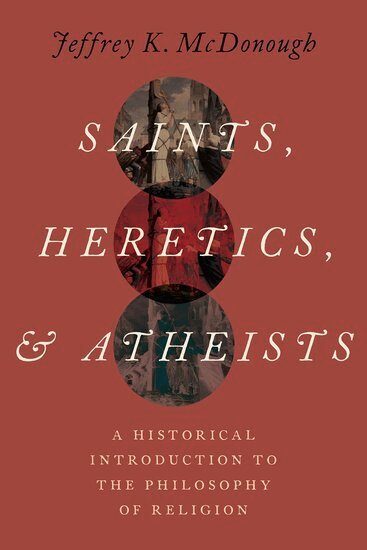
    Saints, Heretics, and Atheists

    A Historical Introduction to the Philosophy of Religion

    AvJeffrey K. McDonough

    Inbunden, Engelska, 2023

    1 236 kr

    Beställningsvara. Skickas inom 7-10 vardagar. Fri frakt över 249 kr.

    Fler format och utgåvor

    Häftad

    583 kr

    E-bok

    356 kr

    E-bok

    355 kr

    Beskrivning

    Does God exist? What is the nature of evil, and where does it come from? Are humans free? Responsible? Immortal? Does it matter? Saints, Heretics and Atheists offers a historical introduction to fundamental questions in the philosophy of religion. Ranging from ancient times to the twentieth century, it is divided into twenty-five succinct, chronological chapters. Individual chapters discuss philosophies from history's greatest thinkers including Plato, Augustine, al-Ghazali, Aquinas, Margarite Porte, Spinoza, Hume, Mary Shepherd, and Nietzche. The book closes with an exploration of William James's defense of the right to believe, possible limitations of that right, and the nature of philosophical progress. Based on lectures from a popular course taught in the Program for General Education at Harvard University for over a decade, Saints, Heretics, and Atheists invites readers along for a journey that is unique in its sweeping historical approach to the philosophy of religion and the balance it strikes between traditional, non-traditional, and atheistic standpoints with respect to religion in the western tradition.

    Produktinformation

    • Utgivningsdatum:2023-05-09
    • Mått:235 x 156 x 20 mm
    • Vikt:535 g
    • Format:Inbunden
    • Språk:Engelska
    • Antal sidor:284
    • Förlag:OUP USA
    • ISBN:9780197563847

    Utforska kategorier

    • Socialhistoria och kulturhistoria inom Historia och arkeologi
    • Biblar inom Filosofi och religion
    • Religion: allmänt inom Filosofi och religion

    Mer om författaren

    Jeffrey K. McDonough is Professor of Philosophy at Harvard University. His research focuses on the intersection of philosophy, science, and religion in the early modern era. He has written numerous articles on philosophy in the early modern period. His Leibniz's Miracle Creed and Teleology: A History were recently published by Oxford University Press.

    Recensioner i media

    The discussions are balanced and clearly presented, if occasionally simplistic, and each chapter ends with a list of accessible readings for further study. There is a useful index.

    Innehållsförteckning

    • AcknowledgementsPreface 1. Plato's Euthyphro: What is Piety? 1.1. The setting 1.2. First attempt: examples of piety1.3. Second attempt: what is dear to the gods1.4. Third attempt: what all the gods love1.5. Fourth attempt: piety is the part of justice that concerns the gods1.6. Fifth attempt: the pious is what is dear to the gods 2. Augustine's On Free Choice of the Will: Where Does Evil Come From?2.1. The setting 2.2. What is the cause of evil? 2.3. The well-ordered person2.4. Sin and ignorance2.5. An objection and two conclusions2.7. Freedom and determinism 3. Augustine's On Free Choice of the Will: Why Do We Have Free Will?3.1. Set up and structure3.2. How is it manifest that God exists?3.3. Do all things, insofar as they are good, come from God? 3.4. Should free will be counted as a good thing that comes from God? 3.5. Happiness and immortality 4. Augustine's On Free Choice of Will: Why Do We Sin?4.1. Why do we sin, and who is to blame? 4.2. Is libertarian freedom consistent with divine foreknowledge?4.3. Can't God be blamed for creating beings that he knows will sin?4.4. Is it the case that some of us must sin?4.5. Three views on divine foreknowledge 5. Anselm's Proslogion: Does Reason Prove that God Exists?5.1. The setting 5.2. Anselm's ontological argument5.3. A Perfect Island?5.4. Two Objections 6. Ibn Sina's The Book of Salvation: What is the Nature of the Soul?6.1. The setting 6.2. What does the intellect do? 6.3. Is the soul immaterial? 6.4. Is the soul immortal? 6.5. What am I? 7. Al-Ghazali's The Rescuer from Error: Is Religious Belief Founded in Reason? 7.1. The setting7.2. Three views on faith and reason7.3. The quest for certainty7.4. Three false foundations7.5. Is God hidden? 8. Al-Ghazali's The Rescuer from Error: Is Religious Belief Founded in Experience?8.1. Al-Ghazali's turn to mysticism8.2. Three accounts of religious experience8.3. Is religious experience a good reason for belief? 9. Aquinas's Summa Theologica: Does Experience Prove that God Exists?9.1. The setting9.2. Is the existence of God self-evident?9.3. Can we prove that God exists?9.4. The argument from motion, the first step9.5. The argument from motion, the second step 9.6. The argument from motion, the conclusion 9.7. The argument from providence 10. Aquinas's Summa Theologica: What is the Impersonal Nature of God?10.1. Is God simple? 10.2. Is God perfect?10.3. Is God infinite?10.4. Is God one?10.5. Analogical predication 11. Aquinas's Summa Theologica: What is the Personal Nature of God?11.1. The big picture11.2. Divine knowledge11.3. Divine will11.4. Divine love 11.5. Is God masculine? 12. Porete's The Mirror of Simple Souls: What is Salvation? 12.1. The setting12.2. Assent and annihilation12.3. Heaven12.4. Hell12.5. Life after Death? 13. Pascal's The Wager: Should We Bet on God?13.1. The setting13.2. A wager13.3. Pascal's wager13.4. Background assumptions13.5. Objections and replies 14. Spinoza's Ethics: Is God Nature?14.1. The setting14.2. Substance monism14.3. The Master Argument14.4. "Deus sive Natura" (God or Nature)? 15. Spinoza's Ethics: Are We Modes of God?15.1. Substance, attributes, modes15.2. Human beings15.3. Against libertarian freedom 15.4. For compatibilist freedom15.5 Moderating the passions 16. Spinoza's Ethics: Good without God?16.1. Two accounts of goodness16.2. Beyond egoism16.3. Good without God? 17. Hume's Dialogues Concerning Natural Religion: Is the Universe Designed?17.1. The setting17.2. The limits of reason17.3. Cleanthes's first design argument17.4. Cleanthes's second design argument 17.5. Is the universe fine-tuned? 18. Hume's Dialogues Concerning Natural Religion: Design without a Designer?18.1. The regress objection18.2. The design argument and traditional theism18.3. An immanent designer?18.4. No designer at all?18.5. Contemporary criticisms 19. Hume's Dialogues Concerning Natural Religion: True Religion?19.1. The "causal" argument 19.2. The problem of evil 19.3. Consistency, evidence and evil 19.4. "True religion" 19.5. Two contemporary views on the problem of evil 20. Shepherd's The Credibility of Miracles: May we believe in miracles? 20.1. The setting20.2. Against miracles20.3. What is a miracle?20.4. Believing in miracles? 21. Mills' Essays on Religion: Is Religion Useful?21.1. The setting21.2. On Nature21.3. Raising the question21.4. Is religion publicly useful?21.5. Is religion privately useful?21.6. What is secular humanism? 22. Nietzsche's On the Genealogy of Morality: What do Good, Bad and Evil mean?22.1. The setting 22.2. Three big ideas22.3. Genealogy of values 22.4. Inversion of values 22.5. Evaluation of values22.6. Debunking morality and religion? 23. Nietzsche's On the Genealogy of Morality: Whence Conscience, Bad Conscience and Guilt?23.1. The origin of conscience23.2. The origin of bad conscience 23.3. The origin of moral guilt 23.4. Should we obey our conscience? 24. Nietzsche's On the Genealogy of Morality: No Alternative?24.1. What do ascetic ideals mean?24.2. The puzzle of ascetic ideals24.3. The "vale of tears"24.4. "pointless suffering"24.5. "the ascetic priest"24.6. No alternative? 25. William James's Will to Believe: The Right to Believe?25.1. The setting25.2. The ethics of belief25.3. The varieties of belief25.4. A first argument25.5. A second argument25.6. Returning to Plato