• Fri frakt över 249 kr
  • •
  • Snabba leveranser
  • •
  • Billiga böcker
Kundservice

Du är på sajten för privatpersoner.

Företag, bibliotek eller offentlig verksamhet?

Du handlar på classic.bokus.com, där alla dina funktioner finns intakta.
Till classic.bokus.com
Bokus logotyp. Gå till startsidan.
  • Erbjudanden
  • Nyheter
  • Student
  • Topplistor
  • Barn & ungdom
  • Bokus Play
  • E-böcker
  • Pocketböcker
  • Spel & pussel

10% studentrabatt med kod TERM26

Sidfot

Mina sidor

    Hjälp

    • Kundservice
    • Vanliga frågor och svar
    • Frakt och leverans
    • Retur vid ångerrätt
    • Reklamera vara
    • Betalning
    • Köpvillkor
    • Allmänna villkor
    • Information om webbplatsens tillgänglighet

    Om Bokus

    • Om oss
    • Pressrum
    • För studenter
    • För företag
    • För bibliotek och offentlig verksamhet
    • För leverantörer
    • Hållbarhet

    Populärt

    • Aktuella erbjudanden
    • Presentkort
    • Studentlitteratur
    • Nya böcker
    • Topplistor
    • Signerade böcker
    • Engelska böcker

    Inspiration

    • Boktips
    • BookTok
    • Populära bokserier
    • Barnbokskaraktärer
    • Populära författare
    Logotyp för Bokus
    Följ oss på Facebook (extern länk)Följ oss på Instagram (extern länk)Följ oss på YouTube (extern länk)Följ oss på TikTok (extern länk)
    bokus @ CookiesAnpassa cookiesIntegritetspolicyKöpvillkor
    Till Citymail hemsida (extern länk)Till Budbee hemsida (extern länk)Till Postnord hemsida (extern länk)Till Schenker hemsida (extern länk)Till Early Bird hemsida (extern länk)Till Walleys hemsida (extern länk)
    1. Medicin
    2. Klinisk medicin och internmedicin
    3. Sjukdomar och rubbningar
    4. Infektionssjukdomar och smittsamma sjukdomar

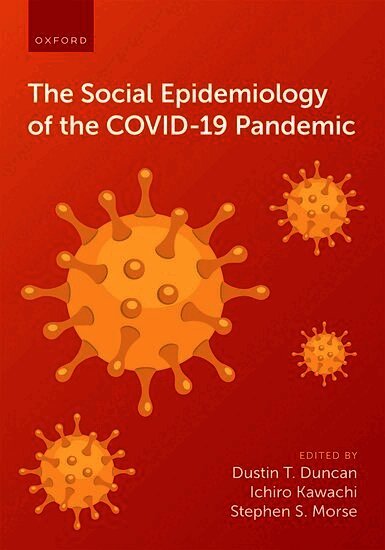
    The Social Epidemiology of the COVID-19 Pandemic

    AvDustin T. Duncan,Ichiro Kawachi

    Inbunden, Engelska, 2024

    1 673 kr

    Beställningsvara. Skickas inom 7-10 vardagar. Fri frakt över 249 kr.

    Beskrivning

    The COVID-19 pandemic has worsened health disparities worldwide. Across all nations, the burden of COVID-19 has fallen most heavily on the socially disadvantaged. In the United States, the COVID-19 mortality rate for Black Americans is over twice that of their White American counterparts, and people in prisons have more than double the COVID-19 mortality rate of the general U.S. population. Other social dimensions such as income, gender, sexuality, and immigration status have also played a significant role in COVID-19 infection, hospitalization, and mortality. The Social Epidemiology of the COVID-19 Pandemic provides an interdisciplinary analysis of the pandemic's effect across populations and its disproportionate impact on vulnerable groups in society, including racial/ethnic minority, immigrant, and incarcerated populations. Written by leading international scholars, this essential volume describes how the COVID-19 pandemic intersects with nearly every social determinant of health, from race and ethnicity to income inequality, and how such interactions compound existing structural disadvantages. Using examples from upper-middle and high-income countries such as the United States, contributing experts delve into the differential impacts of COVID-19 by major social determinants of health and reveal the resultant effect of pandemic-related policy on health outcomes. Together, these authors underline the urgent need for further integration of social epidemiology into public health decision-making to ensure that every population receives the care it requires. Drawing from research across epidemiology, sociology, psychology, and public policy, The Social Epidemiology of the COVID-19 Pandemic illuminates the stark disparities exacerbated by the COVID-19 pandemic and the valuable insights from social epidemiology that can inform a more equitable pandemic response.

    Produktinformation

    • Utgivningsdatum:2024-05-07
    • Mått:178 x 254 x undefined mm
    • Vikt:2 210 g
    • Format:Inbunden
    • Språk:Engelska
    • Antal sidor:496
    • Förlag:OUP USA
    • Medarbetare:SirMichael Marmot
    • ISBN:9780197625217

    Utforska kategorier

    • Infektionssjukdomar och smittsamma sjukdomar inom Medicin
    • Sociala och etiska frågor inom Samhälle och politik
    • Statsvetenskap och politisk teori inom Samhälle och politik

    Mer om författaren

    Dustin T. Duncan, ScD, is Associate Professor of Epidemiology at the Columbia University Mailman School of Public Health, where he directs the Columbia Spatial Epidemiology Lab and codirects the Social and Spatial Epidemiology Unit. In addition to HIV and sleep epidemiology, his interests include characterizing the COVID-19 epidemic, especially among marginalized populations. He has received several early-career and distinguished scientific contribution, mentoring, and leadership awards from organizations such as the Harvard T.H. Chan School of Public Health, the Interdisciplinary Association for Population Health Science and the National Academy of Medicine. Ichiro Kawachi, MBChB, PhD, is John L. Loeb and Frances Lehman Loeb Professor of Social Epidemiology at the Harvard T.H. Chan School of Public Health. Dr. Kawachi is also co-editor of the eponymous first textbook on Social Epidemiology, published by Oxford University Press in 2000. He is an elected member of the Institute ofMedicine of the US National Academy of Sciences and an Honorary Fellow of the Royal Society of New Zealand.Stephen S. Morse, PhD, is Professor of Epidemiology at the Columbia University Mailman School of Public Health. His research focuses on epidemiology and risk assessment of emerging infectious diseases, and improving disease early warning systems. His book, Emerging Viruses (Oxford University Press, 1993) was selected by American Scientist as one of the "100 Top Science Books of the 20th Century." He served on the Steering Committee of the Institute of Medicine's Forum on Microbial Threats, and on numerous National Academies of Sciences and international committees. He is a Fellow of the American Association for the Advancement of Science (AAAS) and the American Academy of Microbiology.Sir Michael Marmot, CH, MBBS, MPH, PhD, FRCP, FFPHM, FMedSci, FBA, is Professor of Epidemiology and Director of the Institute of Health Equity at the University College London.

    Recensioner i media

    The COVID-19 pandemic showed, yet again, that the consequences of pandemics emerge from far more than the pathogen itself. They emerge from the social conditions that set the stage for who becomes sick, who lives, and who dies. This book offers a comprehensive account of the social forces that created the COVID-19 pandemic and points to lessons we would be wise to learn if we are to mitigate the next pandemic.

    Innehållsförteckning

    • ForewordSir Michael Marmot Chapter 1. IntroductionStephen S. Morse, Ichiro Kawachi, and Dustin T. Duncan Chapter 2. COVID-19 across the Life Course Diana Kuh and Joanna Blodgett Chapter 3. Social Class, Poverty, and COVID-19 Alicia R. Riley and M. Maria Glymour Chapter 4. Race/Ethnicity and COVID-19 Merlin Chowkwanyun, Dean Robinson, and Adolph Reed Chapter 5. Racism, Stigma, and the COVID-19 Pandemic David H. Chae, Kara W. Chung, Diamond J. Cunningham, Connor D. Martz, Ethan A. Smith, and Michael Cunningham Chapter 6. International Migration, Immigrant Health, and Social Policies during the COVID-19 Pandemic: A Case Study of Six Countries Sarah Diaz, Rama Hagos, Tod Hamilton, and Carmela Alcántara Chapter 7. Explaining Binary Sex and Gender Patterns in the Direct and Indirect Health Effects of COVID-19: Biologic and Social Constructions of DifferenceLisa M. Bates Chapter 8. Sexual and Gender Minorities in the COVID-19 PandemicLiadh Timmins, Kevalyn Bharadwaj, Krish J. Bhatt, and Dustin T. Duncan Chapter 9. Disability and Ableism in the COVID-19 PandemicKrish J. Bhatt and Bonnielin K. Swenor Chapter 10. COVID-19 and Mass Incarceration Sandhya Kajeepeta and Seth Prins Chapter 11. Income Inequality and COVID-19 Ichiro Kawachi Chapter 12. Work during and after the Pandemic Susan E. Peters and Gregory R. Wagner Chapter 13. Housing Conditions in the COVID-19 PandemicSebastián Sandoval Olascoaga, César García López, Gabriela Zayas del Rio, and Mariana C. Arcaya Chapter 14. Neighborhoods and COVID-19: Current Research, Future Directions, and Place-Based Interventions Byoungjun Kim, Adam Whalen, Andrew Rundle, Christopher Morrison, Charles Branas, and Dustin T. Duncan Chapter 15. Social Capital, Social Cohesion, and COVID-19 Ichiro Kawachi and Yusuf Ransome Chapter 16. Religion, Spirituality, and COVID-19 Yusuf Ransome, Tamara L. Taggart, and Ichiro Kawachi Chapter 17. Trust in Public Health Communications and the COVID-19 Pandemic Rachel McCloud, Mesfin Awoke Bekalu, and K. Vish Viswanath Chapter 18. COVID-19, Welfare States, and Social Policies Wasie Karim, Emilie Courtin, and Peter Muennig Appendix Index