• Fri frakt över 249 kr
  • •
  • Snabba leveranser
  • •
  • Billiga böcker
Kundservice

Du är på sajten för privatpersoner.

Företag, bibliotek eller offentlig verksamhet?

Du handlar på classic.bokus.com, där alla dina funktioner finns intakta.
Till classic.bokus.com
Bokus logotyp. Gå till startsidan.
  • Erbjudanden
  • Nyheter
  • Student
  • Topplistor
  • Barn & ungdom
  • Bokus Play
  • E-böcker
  • Pocketböcker
  • Spel & pussel

10% rabatt på allt med kod: NYSTART10 →

Sidfot

Mina sidor

    Hjälp

    • Kundservice
    • Vanliga frågor och svar
    • Frakt och leverans
    • Retur vid ångerrätt
    • Reklamera vara
    • Betalning
    • Köpvillkor
    • Allmänna villkor
    • Information om webbplatsens tillgänglighet

    Om Bokus

    • Om oss
    • Pressrum
    • För studenter
    • För företag
    • För bibliotek och offentlig verksamhet
    • För leverantörer
    • Hållbarhet

    Populärt

    • Aktuella erbjudanden
    • Presentkort
    • Studentlitteratur
    • Nya böcker
    • Topplistor
    • Signerade böcker
    • Engelska böcker

    Inspiration

    • Boktips
    • BookTok
    • Populära bokserier
    • Barnbokskaraktärer
    • Populära författare
    Logotyp för Bokus
    Följ oss på Facebook (extern länk)Följ oss på Instagram (extern länk)Följ oss på YouTube (extern länk)Följ oss på TikTok (extern länk)
    bokus @ CookiesAnpassa cookiesIntegritetspolicyKöpvillkor
    Till Citymail hemsida (extern länk)Till Budbee hemsida (extern länk)Till Postnord hemsida (extern länk)Till Schenker hemsida (extern länk)Till Early Bird hemsida (extern länk)Till Walleys hemsida (extern länk)
    1. Samhälle och politik
    2. Politik och statsskick
    3. Politisk aktivism

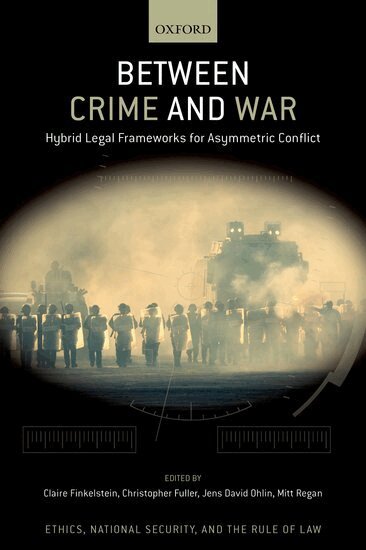
    Between Crime and War

    Hybrid Legal Frameworks for Asymmetric Conflict

    AvJens David Ohlin,Claire Finkelstein

    Inbunden, Engelska, 2023

    Del i serien ETHICS NATIONAL SECURITY RULE LAW SERIES

    1 308 kr

    Beställningsvara. Skickas inom 5-8 vardagar. Fri frakt över 249 kr.

    Beskrivning

    The threat posed by the recent rise of transnational non-state armed groups does not fit easily within either of the two basic paradigms for state responses to violence. The civilian paradigm focuses on the interception of demonstrable immediate threats to the safety of others. The military paradigm focuses on threats posed by collective actors who pose a danger to the state's ability to maintain basic social order and, at times, the very existence of the state. While the United States has responded to the threat posed by non-state armed groups by using tools from both paradigms, it has placed substantially more emphasis on the military paradigm than have other states. While several reasons may contribute to this approach, one may be the assumption that a state must use each set of tools strictly according in accordance with the principles that underlie each paradigm. Implicit in this assumption may be the sense that the only alternative to the civilian paradigm is the unqualified military one. The chapters in this book suggest, however that we need not see the options as confined to this binary choice. It may be profitable to consider borrowing elements from each paradigm on some occasions to act more expansively than the conventional civilian paradigm allows, but less expansively than the conventional military paradigm would permit. At the same time, the mixing of the categories comes with its own ethical and legal risks that should be scrutinized.

    Produktinformation

    • Utgivningsdatum:2023-02-07
    • Mått:238 x 163 x 43 mm
    • Vikt:975 g
    • Format:Inbunden
    • Språk:Engelska
    • Serie:ETHICS NATIONAL SECURITY RULE LAW SERIES
    • Antal sidor:592
    • Förlag:OUP USA
    • ISBN:9780197638798

    Utforska kategorier

    • Politisk aktivism inom Samhälle och politik
    • Internationell rätt: transport och handel inom Juridik
    • Författningsrätt och förvaltningsrätt inom Juridik

    Mer om författaren

    Claire Finkelstein is the Algernon Biddle Professor of Law and Professor of Philosophy at the University of Pennsylvania. Claire Finkelstein's current research addresses national security law and policy and democratic governance with a focus on related ethical and rule of law issues. Professor Finkelstein is the founder and faculty director of the Center for Ethics and the Rule of Law (CERL), a non-partisan interdisciplinary institute affiliated with the University of Pennsylvania's Annenberg Public Policy Center (APPC).Christopher J. Fuller is Associate Professor of Modern U.S. Foreign Policy and Head of Admissions at the University of Southampton. He specializes in U.S. foreign policy from 1945 to the present day with a particular interest in the "War on Terror" and wider U.S. counterterrorism practices. His previous books include See It/Shoot It: The Secret History of the CIA's Lethal Drone Program (2017).Jens David Ohlin became the Allan R. Tessler Dean of Cornell Law School on July 1, 2021. His scholarly work stands at the intersection of four related fields: criminal law, criminal procedure, public international law, and the laws of war. Trained as both a lawyer and a philosopher, his research has tackled questions as diverse as criminal conspiracy and the punishment of collective criminal action, the philosophical foundations of international law, and the role of new technologies in warfare, including cyberwar, remotely piloted drones, and autonomous weapons.Mitt Regan is McDevitt Professor of Jurisprudence, Director of the Center on the Legal Profession, and Co-Director on the Center on National Security and the Law at Georgetown University Law Center. His work focuses on international law, national security, international human rights, and legal and military ethics. Professor Regan is also Senior Fellow at the Stockdale Center for Ethical Leadership at the U.S. Naval Academy, and Adjunct Faculty Member at the Center for Military and Security Law at the Australian National University College of Law.

    Innehållsförteckning

    • Forward Lieutenant General Charles N. PedeIntroductionJens David Ohlin & Mitt Regan Part I: The Framework Problem in Modern Conflict: Can we Still Distinguish War From Crime? Chapter 1. Non-State Actors, Terrorism, and the War Paradigm Revisited Seth Cantey Chapter 2. The Limits of Law and the Value of Rights in Addressing Terrorism: A Study of the UN Counter-Terrorism ArchitectureFionnuala Ní Aoláin Chapter 3. The Paradox of Discrimination: When More Violence Triggers Fewer Legal Constraints Jens David Ohlin Chapter 4. Fighting Terrorism under All Applicable Law Joshua Andresen Chapter 5. When Conflict Recurs: Classification of Conflict when Hostilities Break Out AnewLaurie Blank Part II: War as Criminal Enforcement Chapter 6. Non-State Actors in a Post-War World: Conceptualizing War as Criminal EnforcementClaire Finkelstein Chapter 7. Urban Warfare: Policing Conflict Ken Watkin Chapter 8. Ratchet Down or Ramp Up? Contemporary Threats, Armed Conflict, and Tailored Authority Geoff Corn Chapter 9. Using Law as a Weapon Against Nuclear Proliferation and Terrorism: The U.S. Government's Financial Lawfare Against Iran Orde F. Kittrie Chapter 10. Human Rights Law as an Alternative to Jus in Bello Christopher J. Fuller Part III: Fighting Crime as War Chapter 11. National Security Policymaking in the Shadow of International LawLaura Dickinson Chapter 12. Emerging Transnational Self-Defense Norms and Unrealized Liberal ValuesJohn Dehn Chapter 13. Finding Peace in the Law of WarLieutenant Colonel Bailey Brown Chapter 14. From Armed Conflict to Countering Threat Networks: Counterterrorism and Social Network Analysis Todd Huntley & Mitt Regan Part IV: crime and war: prosecuting terrorism and war crimes Chapter 15. Counting the Ripples: The Challenge of Extraterritorial Jurisdiction to Prosecute Non-State Actors Evan R. Seamone Chapter 16. Diversifying the Sources of Evidence in Terrorism Cases Before Criminal Courts in (Post-)Conflict and High-Risk Situations: The Role of The MilitaryBibi Van Ginkel, Christophe Paulussen, & Tanya Mehra Chapter 17. U.S. Military Prosecutions During Non-International Armed ConflictChris Jenks