• Fri frakt över 249 kr
  • •
  • Snabba leveranser
  • •
  • Billiga böcker
Kundservice

Du är på sajten för privatpersoner.

Företag, bibliotek eller offentlig verksamhet?

Du handlar på classic.bokus.com, där alla dina funktioner finns intakta.
Till classic.bokus.com
Bokus logotyp. Gå till startsidan.
  • Erbjudanden
  • Nyheter
  • Student
  • Topplistor
  • Barn & ungdom
  • Bokus Play
  • E-böcker
  • Pocketböcker
  • Spel & pussel

10% rabatt på allt med kod NYSTART10 →

Sidfot

Mina sidor

    Hjälp

    • Kundservice
    • Vanliga frågor och svar
    • Frakt och leverans
    • Retur vid ångerrätt
    • Reklamera vara
    • Betalning
    • Köpvillkor
    • Allmänna villkor
    • Information om webbplatsens tillgänglighet

    Om Bokus

    • Om oss
    • Pressrum
    • För studenter
    • För företag
    • För bibliotek och offentlig verksamhet
    • För leverantörer
    • Hållbarhet

    Populärt

    • Aktuella erbjudanden
    • Presentkort
    • Studentlitteratur
    • Nya böcker
    • Topplistor
    • Signerade böcker
    • Engelska böcker

    Inspiration

    • Boktips
    • BookTok
    • Populära bokserier
    • Barnbokskaraktärer
    • Populära författare
    Logotyp för Bokus
    Följ oss på Facebook (extern länk)Följ oss på Instagram (extern länk)Följ oss på YouTube (extern länk)Följ oss på TikTok (extern länk)
    bokus @ CookiesAnpassa cookiesIntegritetspolicyKöpvillkor
    Till Citymail hemsida (extern länk)Till Budbee hemsida (extern länk)Till Postnord hemsida (extern länk)Till Schenker hemsida (extern länk)Till Early Bird hemsida (extern länk)Till Walleys hemsida (extern länk)
    1. Kultur
    2. Scenkonst och film
    3. Film

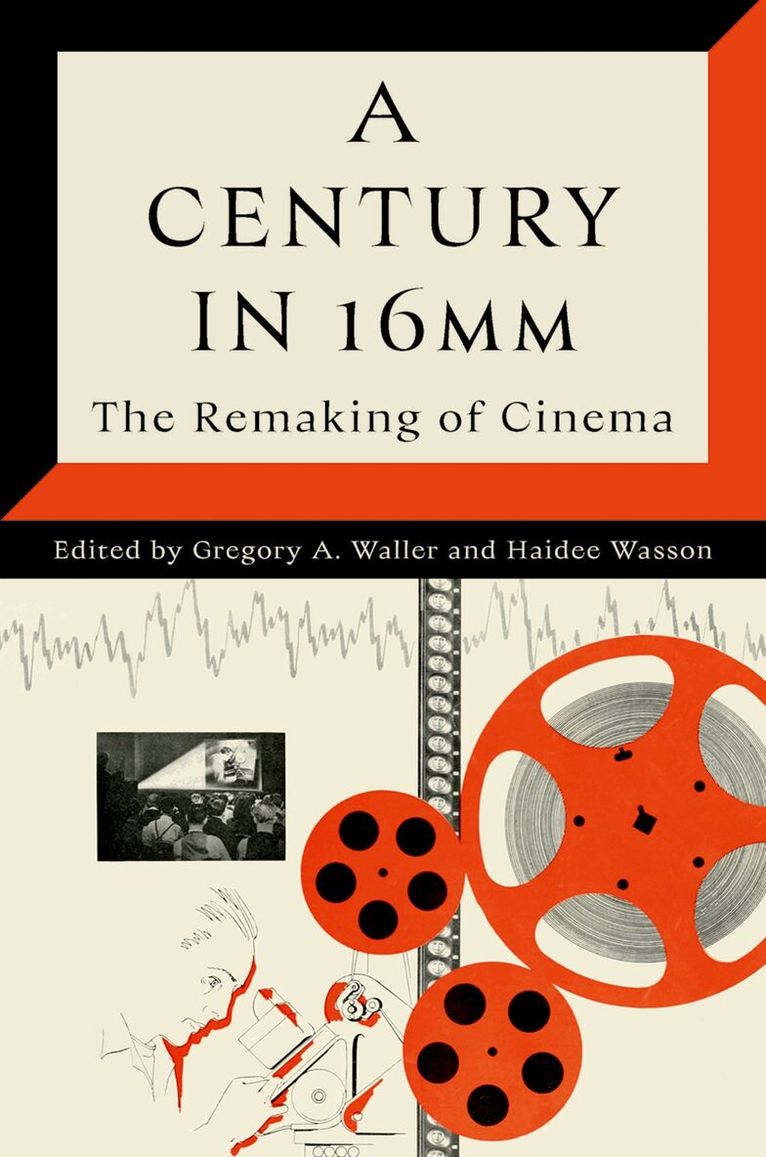
    A Century in 16mm

    The Remaking of Cinema

    AvGregory A. Waller,Gregory A. Waller

    Häftad, Engelska, 2026

    581 kr

    Beställningsvara. Skickas inom 5-8 vardagar. Fri frakt över 249 kr.

    Fler format och utgåvor

    Inbunden

    2 041 kr

    Beskrivning

    When the small cameras and portable projectors that used 16mm film stock emerged in 1923, they allowed--for the first time in history--the possibility that anyone could make, show, and watch movies. A foundational but largely forgotten film format that offered a suite of technologies, 16mm was a democratic alternative to the larger and more expensive 35mm technology used by the commercial film industries around the world. With the remarkable ubiquity and utility of 16mm, moving images came to be integral to the way we play, learn, fight, work, and document the world, seeding the path to our current world of portable technologies and personal media.To mark 16mm's first 100 years, the essays in this book consolidate and catalyse considerations of the uniquely important--but still surprisingly underestimated and understudied--role that 16mm has played in film and media theory, history, and practice. It has long been known that artists and activists relied on 16mm cameras and projectors as tools of experimentation, organization, upheaval, and advocacy. Chapters here revisit these assumptions but also survey its many varied and additional uses: delivering public service messages, promoting corporate public relations, boosting church attendance, preaching good hygiene, instilling efficiency, popularizing political candidates, spreading propaganda, exploring sexuality, and encouraging community dialogue. In short, tis innovative film format facilitated new forms of hobby, play, work, learning and creativity. From the local to the transnational, small gauge filmmaking and showing also became integral to colonialist, imperialist, nationalist, and multi-nationalist institutions and efforts. In effect, for 100 years now, this uniquely important film format upended and shaped creative, political, governmental, juridical, sexual, educational, recreational, informational, televisual, industrial, promotional, and experimental practices and activities. It was integral to the expansion and evolution of the audio-visual languages that are a common-sense element of our mediated world. Its histories serve as a crucial and telling bridge from past media practices to our present wherein mobile, adaptable, and flexible moving image and sounds continue to thrive.

    Produktinformation

    • Utgivningsdatum:2026-01-06
    • Mått:156 x 235 x 29 mm
    • Vikt:798 g
    • Format:Häftad
    • Språk:Engelska
    • Antal sidor:576
    • Förlag:OUP USA
    • ISBN:9780197687178

    Utforska kategorier

    • Film inom Kultur

    Mer om författaren

    Gregory A. Waller is Provost Professor Emeritus in Cinema and Media Studies in the Media School at Indiana University at Bloomington. He served as editor of Film History: An International Journal (2013-2024) and co-directed the Century of 16mm project based at Indiana University. His publications on the history of film exhibition and non-theatrical cinema include Main Street Amusements: Movies and Commercial Entertainment in a Southern City, 1895-1930 and Beyond the Movie Theater: Sites, Sponsors, Uses, Audiences. Haidee Wasson is Associate Dean of Fine Arts and Distinguished University Research Professor in Film and Media Studies at Concordia University, Montreal. She is author of multiple award-winning volumes, including Everyday Movies: Portability and the Transformation of American Culture and co-editor of the influential book Useful Cinema. She lectures and publishes internationally on film and media history and culture.

    Innehållsförteckning

    • Part I. Technology and Industry 1: Alice Lovejoy: Forests, Fibers, and Film: The International Chemical Industry and the Rise of 16mm 2: Andrea Mariani andSimona Schneider: 16mm Standardization and Agfa's Strategic Policies in Fascist Italy 3: Louis Pelletier: 16mm Leaves Home: The Ciné-Kodak Special and the Rise of Professional Small-Gauge Filmmaking 4: Martin L. Johnson: 16mm's Other Pioneer: Considering Bell & Howell 5: John Powers: A Little Steam Locomotive, Right in Your Hands: The Bolex H-16 Camera and the American Avant-Garde Part II. The Audiovisual State 6: Tom Rice: The Raw Stock Exchange: 16mm Across the British Empire 7: Navdeep Sharma: Modern, Mobile, and Modular: 16mm Projectors and the Promise of Development in India, 1945-1965 8: Loren Pilcher: Making Progress at the Margins? Segregation and Southern Turpentine on 16mm 9: Lisa M. Rabin: Cold War "Useable Knowledge" on 16mm: Julien Bryan, the International Film Foundation, and US Area Studies, 1945-1980 10: Konrad Klejsa: The Perverse Incentive: Small-Gauge Cinema Chain in the People's Republic of Poland Part III. Circulation and Networks 11: Charles Tepperman,Keith M. Johnston,Andrea Mariani,Noriko Morisue, andSimona Schneider: Moving Amateur Movies: The International Amateur Cinema Network in the 1930s 12: Tanya Goldman: A "Lusty Infant" Comes of Age: The Allied Non-Theatrical Film Association and the Growth of the 16mm Sector, 1939-1949 13: Kit Hughes: Connection and Projection: The Lost Lives of 16mm Kinescope Networks 14: Rafael de Luna Freire,Filipe Gama, andTiago Quintes: A Survey of the History of Non-Theatrical 16mm Film Exhibition in Brazil until the 1960s 15: Michael Zryd: 16mm as North American Experimental Film's Medium Gauge Part IV. New Sites and Expanded Practices 16: Denise Khor: Beyond Home Movies: Japanese Americans, Amateur Filmmaking, and Camera Clubs in the 1930s 17: Joseph W. Ho: Moving Visions: 16mm Filmmaking as Transnational Missionary Apparatus in Twentieth-Century East Asia 18: Liz Czach: 16mm as a Professional Filmmaking Tool: The Case of Women Film-Lecturers 19: Scott Curtis: 16mm, Postwar Radiology, and the Production of Knowledge 20: Travis Vogan: 16mm and Football: Teaching and Selling 21: Eric Schaefer: 16mm Smut 22: Josh Guilford: Instructions for Experimentation: Multi-Projection Films, Portable Projectors, and Avant-Garde Instruction Sheets 23: Paola Margulis: Standards and Institutionalization: 16mm in Political Documentaries of the 1980s in Argentina, Chile, and Uruguay