• Fri frakt över 249 kr
  • •
  • Snabba leveranser
  • •
  • Billiga böcker
Kundservice

Du är på sajten för privatpersoner.

Företag, bibliotek eller offentlig verksamhet?

Du handlar på classic.bokus.com, där alla dina funktioner finns intakta.
Till classic.bokus.com
Bokus logotyp. Gå till startsidan.
  • Erbjudanden
  • Nyheter
  • Student
  • Topplistor
  • Barn & ungdom
  • Bokus Play
  • E-böcker
  • Pocketböcker
  • Spel & pussel

10% rabatt på allt med kod: NYSTART10 →

Sidfot

Mina sidor

    Hjälp

    • Kundservice
    • Vanliga frågor och svar
    • Frakt och leverans
    • Retur vid ångerrätt
    • Reklamera vara
    • Betalning
    • Köpvillkor
    • Allmänna villkor
    • Information om webbplatsens tillgänglighet

    Om Bokus

    • Om oss
    • Pressrum
    • För studenter
    • För företag
    • För bibliotek och offentlig verksamhet
    • För leverantörer
    • Hållbarhet

    Populärt

    • Aktuella erbjudanden
    • Presentkort
    • Studentlitteratur
    • Nya böcker
    • Topplistor
    • Signerade böcker
    • Engelska böcker

    Inspiration

    • Boktips
    • BookTok
    • Populära bokserier
    • Barnbokskaraktärer
    • Populära författare
    Logotyp för Bokus
    Följ oss på Facebook (extern länk)Följ oss på Instagram (extern länk)Följ oss på YouTube (extern länk)Följ oss på TikTok (extern länk)
    bokus @ CookiesAnpassa cookiesIntegritetspolicyKöpvillkor
    Till Citymail hemsida (extern länk)Till Budbee hemsida (extern länk)Till Postnord hemsida (extern länk)Till Schenker hemsida (extern länk)Till Early Bird hemsida (extern länk)Till Walleys hemsida (extern länk)
    1. Samhälle och politik
    2. Sociologi och antropologi
    3. Sociologi

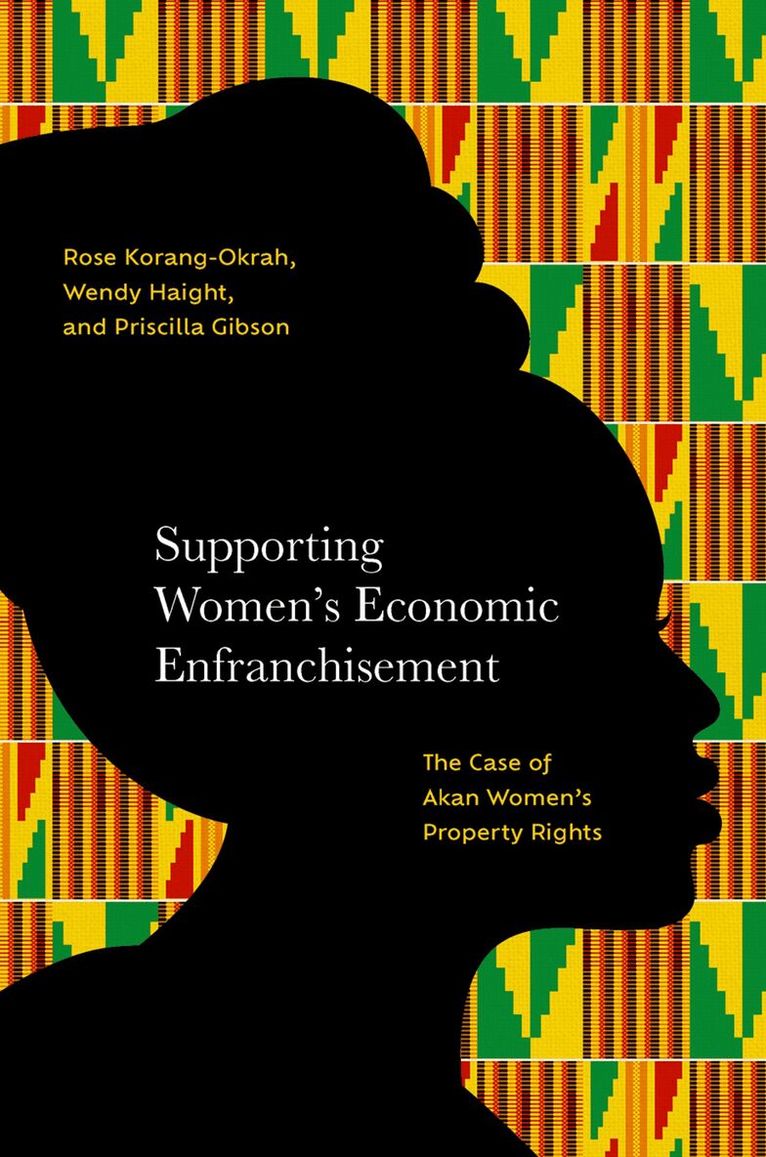
    Supporting Women's Economic Enfranchisement

    The Case of Akan Women's Property Rights

    AvRose Korang-Okrah,Wendy Haight

    Inbunden, Engelska, 2025

    891 kr

    Beställningsvara. Skickas inom 5-8 vardagar. Fri frakt över 249 kr.

    Beskrivning

    This book addresses an international human rights issue: women's economic enfranchisement, specifically, their equal access to property using Akan widows from Ghana as a case study. The insidious effects of European colonialism contribute to the devaluation of Akan women beginning with gender roles imposed in childhood and continuing through inheritance practices that leave widows destitute. A close examination of Akan widows in their everyday, sociocultural contexts through ethnographic methods reveals the impact of property rights violations not only on the economic conditions of women and their children but also their psychosocial, spiritual, and moral well-being. Despite progressive national laws, many Akan widows lose access to the homes and farms they shared with their husbands, leaving them and their children destitute. According to customary law, those properties belong not to individuals, but to the husband's maternal family line of which his wife and children are not a part. Yet the Akan people are not without compassion, and Akan women without resilience. Some community leaders and in-laws do assist the widow and her children. In addition, some Akan widows do resist, persevere, and even thrive. Some gain peace through spiritual practices, and stability through innovative economic ventures with other widows and allies including international social workers. By deepening our understanding of the impact of property rights violations on women's lives as well as the ways in which some communities support them, and they actively resist such domination, we can extend the range of possible remedies to those who remain mired in challenges and in need of support.

    Produktinformation

    • Utgivningsdatum:2025-10-09
    • Mått:165 x 237 x 14 mm
    • Vikt:367 g
    • Format:Inbunden
    • Språk:Engelska
    • Antal sidor:160
    • Förlag:OUP USA
    • ISBN:9780197687963

    Utforska kategorier

    • Sociologi inom Samhälle och politik
    • Sociala grupper och identitet inom Samhälle och politik
    • Socialt arbete och välfärd inom Samhälle och politik

    Mer om författaren

    Rose Korang-Okrah received her BA in Social Work and Psychology with First Class Honors from the University of Ghana. She received her Master in Social Work from Washington University in St Louis, MO and her PhD. in Social work from the University of Illinois at Urbana-Champaign. She served as an Assistant Professor at Western Kentucky University, and Missouri State University. Her research and professional activities focus on women rights, their access to property, and girls' education. In Ghana, she served as a Principal Superintendent in Teaching and a Specialist Mathematics Teacher, and a Diocesan Women and Development Coordinator in Ghana. Wendy Haight graduated Phi Beta Kappa from Reed College with a BA in Psychology, and from the University of Chicago with a PhD in Psychology. She served for 16 years as a professor at the University of Illinois School of Social Work, and 13 years as a Professor and Gamble-Skogmo Chair at the University of Minnesota School of Social Work. Herresearch is broadly concerned with the welfare of children and families. She primarily uses comparative, ethnographic methods to better understand and then address complex social issues. She has published approximately 80 articles in peer-reviewed journals and 13 scholarly books.Priscilla Gibson, a Professor in the School of Social Work at the University of Minnesota, is a 2020 Fulbright Scholar in Namibia and Licensed Independent Clinical Social Worker. She teaches social work with individuals, families and groups; diversity and social justice; and international social work in Ghana. She explores African American grandmothers as intergenerational caregivers, the ally model of social justice, African Americans and out-of-school suspensions, character virtues in homeless youth, parenting in families with low-incomes, health and healing of women of color at predominantly white institutions and international social work education in Ghana, Namibia and Moldova.

    Innehållsförteckning

    • Prologue Part 1. The global Human Rights Issue of Women's Property Rights 1. Introduction 2. Women's Property Rights Violations Through the Lens of Transnational African Feminism Part 2. The Case of Akan Widows 3. The Case of Akan Widows in Ghana: Sociocultural-historical Contexts 4. Our Social Work Ethnography 5. The Economic Experiences of Akan Widows 6. The Psychosocial, Spiritual and Moral Experiences of Akan Widows 7. Akan Widows' Responses to Psychosocial, Spiritual, and Moral Injury 8. Community-generated Solutions to Women's Loss of Property Rights 9. Women's Communal Agency: The St. Monicas Group Part 3. Lessons Learned 10. Some Reflections and Implications