• Fri frakt över 249 kr
  • •
  • Snabba leveranser
  • •
  • Billiga böcker
Kundservice

Du är på sajten för privatpersoner.

Företag, bibliotek eller offentlig verksamhet?

Du handlar på classic.bokus.com, där alla dina funktioner finns intakta.
Till classic.bokus.com
Bokus logotyp. Gå till startsidan.
  • Erbjudanden
  • Nyheter
  • Student
  • Topplistor
  • Barn & ungdom
  • Bokus Play
  • E-böcker
  • Pocketböcker
  • Spel & pussel

10% rabatt på allt med kod: NYSTART10 →

Sidfot

Mina sidor

    Hjälp

    • Kundservice
    • Vanliga frågor och svar
    • Frakt och leverans
    • Retur vid ångerrätt
    • Reklamera vara
    • Betalning
    • Köpvillkor
    • Allmänna villkor
    • Information om webbplatsens tillgänglighet

    Om Bokus

    • Om oss
    • Pressrum
    • För studenter
    • För företag
    • För bibliotek och offentlig verksamhet
    • För leverantörer
    • Hållbarhet

    Populärt

    • Aktuella erbjudanden
    • Presentkort
    • Studentlitteratur
    • Nya böcker
    • Topplistor
    • Signerade böcker
    • Engelska böcker

    Inspiration

    • Boktips
    • BookTok
    • Populära bokserier
    • Barnbokskaraktärer
    • Populära författare
    Logotyp för Bokus
    Följ oss på Facebook (extern länk)Följ oss på Instagram (extern länk)Följ oss på YouTube (extern länk)Följ oss på TikTok (extern länk)
    bokus @ CookiesAnpassa cookiesIntegritetspolicyKöpvillkor
    Till Citymail hemsida (extern länk)Till Budbee hemsida (extern länk)Till Postnord hemsida (extern länk)Till Schenker hemsida (extern länk)Till Early Bird hemsida (extern länk)Till Walleys hemsida (extern länk)
    1. Historia och arkeologi
    2. Historia
    3. Europas historia

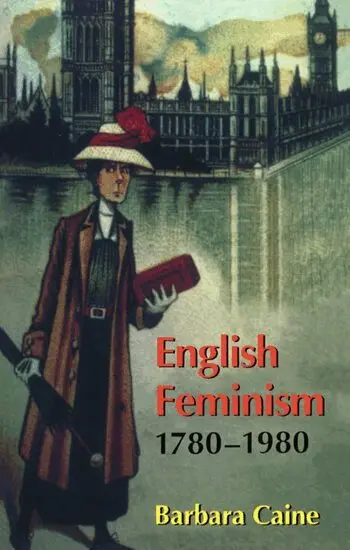
    English Feminism, 1780-1980

    AvBarbara Caine

    Häftad, Engelska, 1997

    1 112 kr

    Beställningsvara. Skickas inom 5-8 vardagar. Fri frakt över 249 kr.

    Fler format och utgåvor

    Inbunden

    934 kr

    Beskrivning

    Barbara Caine's fascinating analysis of feminism in England examines the relationship between feminist thought and actions, and wider social and cultural change over tow centuries. Professor Caine investigates the complex question surrounding the concept of a feminist 'tradition', and shows how much the feminism of any particular period related to the years preceding or following it. Though feminism may have lacked the kind of legitimating tradition evident in other forms of political thought, the ghost of Mary Wollstonecraft was something which all nineteenth- and twentieth-century feminists had to come to terms with. Her story was a constant reminder of the connection between the demand for political and legal rights, and its conflation with the issues of personal and sexual rebellion. Like Wollstonecraft, every woman pioneer into the public arena faced assaults on her honour as well as on her intellectual position. The author also addresses the language of feminism: the introduction and changing meanings of the term 'feminist';the importance of literary representations of women; and the question of how one defines feminism, and establishes boundaries between feminism and the 'woman question'. She ends with a discussion of the new emphasis, post-1980s, on the need to think about 'feminisms' in the plural, rather than any single kind of feminism. analysis of feminist organizations, debates, and campaigns shows a keen sense of the relationship between feminist thought and actions, and wider social and cultural change. The result is a fascinating study with a new perspective on feminists and feminist traditions, which can be used both as an introductory text and as an interpretative work. Professor Caine examines the complex questions surrounding the concept of a feminist 'tradition', and shows how much the feminism of any particular period related to the years preceding or following it. Though feminism may have lacked the kind of legitimating tradition evident in other forms of political thought, the ghost of Mary Wollstonecraft is seen here as something which all nineteenth- and twentieth-century feminists had to come to terms with. Her story was a constant reminder of the connection between the demand for political and legal rights, and its conflation with the issues of personal and sexual rebellion. Like Mary Wollstonecraft, every woman pioneer into the public arena was faced with assaults on her honour as well as on her intellectual position. Professor Caine also addresses the language of feminism: the introduction and changing meanings of the term `feminist'; the importance of literary representations of women; and the question of how one defines feminism, and establishes boundaries between feminism and the `woman question'. She ends with a discussion of the new emphasis, post-1980s, on the need to think about `feminisms' in the plural, rather than any single kind of feminism.

    Produktinformation

    • Utgivningsdatum:1997-07-10
    • Mått:137 x 215 x 20 mm
    • Vikt:455 g
    • Format:Häftad
    • Språk:Engelska
    • Antal sidor:354
    • Förlag:OUP OXFORD
    • ISBN:9780198204343

    Utforska kategorier

    • Europas historia inom Historia och arkeologi
    • Genusvetenskap inom Samhälle och politik

    Recensioner i media

    As with his earlier life of Hartington, Jackson's biography is a welcome and most useful addition to our understanding of a significant political figure, whose legislative legacy is still very much around us./Allen Warren/EHR February 1999, vol.CXIV No 455.

    Innehållsförteckning

    • CHRONOLOGY ; INTRODUCTION ; 1. Feminism and the Rights of Women Social change and sexual difference in the late eighteenth century Mary Wollstonecraft and the origins of modern Feminism Feminism and the Woman question ; 2. Feminism and the Women Question in the early Nineteenth Century Men in feminism: William Thompson and the Unitarian radicals The tragic tale of Caroline Norton Harriet Martineau and the slow development of feminist consciousness Feminism, Evangelicalism, and 'Women's sphere' ; 3. Mid-Victorian Feminism The Langham Place circle and the ghost of Mary Wollstonecraft Feminism, liberalism, and the problem of sexual oppression Feminist campaigns and feminist strategies Nation and empire in Victorian feminism ; 4. The New Woman and the Militant Feminism and the new woman Feminism, the labour movement, and working-class women Militancy Feminism and imperialism ; 5. Feminism and the Woman Citizen in the Inter-War Years The legacy of the War A feminist programme Training women for citizenship Feminist questions and party politics From politics to culture: feminist theory in the 1920s and 1930s Feminism and internationalism ; 6. The Post-War World The impact of war Feminist organizations and the feminist agenda The woman question in the 1950s and 1960s ; AFTERWORD: FROM FEMINISM TO FEMINISMS ; NOTES ; SELECT BIBLIOGRAPHY ; INDEX