• Fri frakt över 249 kr
  • •
  • Snabba leveranser
  • •
  • Billiga böcker
Kundservice

Du är på sajten för privatpersoner.

Företag, bibliotek eller offentlig verksamhet?

Du handlar på classic.bokus.com, där alla dina funktioner finns intakta.
Till classic.bokus.com
Bokus logotyp. Gå till startsidan.
  • Erbjudanden
  • Nyheter
  • Student
  • Topplistor
  • Barn & ungdom
  • Bokus Play
  • E-böcker
  • Pocketböcker
  • Spel & pussel

10% rabatt på allt med kod: NYSTART10 →

Sidfot

Mina sidor

    Hjälp

    • Kundservice
    • Vanliga frågor och svar
    • Frakt och leverans
    • Retur vid ångerrätt
    • Reklamera vara
    • Betalning
    • Köpvillkor
    • Allmänna villkor
    • Information om webbplatsens tillgänglighet

    Om Bokus

    • Om oss
    • Pressrum
    • För studenter
    • För företag
    • För bibliotek och offentlig verksamhet
    • För leverantörer
    • Hållbarhet

    Populärt

    • Aktuella erbjudanden
    • Presentkort
    • Studentlitteratur
    • Nya böcker
    • Topplistor
    • Signerade böcker
    • Engelska böcker

    Inspiration

    • Boktips
    • BookTok
    • Populära bokserier
    • Barnbokskaraktärer
    • Populära författare
    Logotyp för Bokus
    Följ oss på Facebook (extern länk)Följ oss på Instagram (extern länk)Följ oss på YouTube (extern länk)Följ oss på TikTok (extern länk)
    bokus @ CookiesAnpassa cookiesIntegritetspolicyKöpvillkor
    Till Citymail hemsida (extern länk)Till Budbee hemsida (extern länk)Till Postnord hemsida (extern länk)Till Schenker hemsida (extern länk)Till Early Bird hemsida (extern länk)Till Walleys hemsida (extern länk)
    1. Ekonomi och Ledarskap
    2. Nationalekonomi
    3. Ekonomisk historia

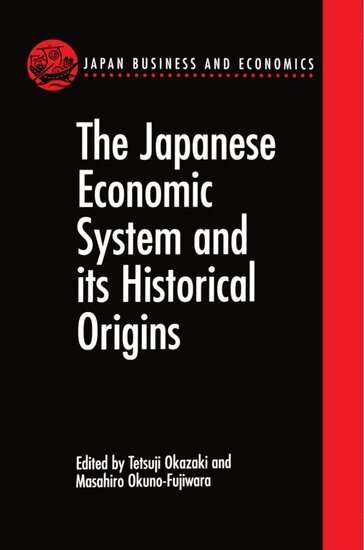
    The Japanese Economic System and its Historical Origins

    AvSusan Herbert,Masahiro Okuno-Fujiwara

    Inbunden, Engelska, 1999

    Del i serien Japan Business and Economics Series

    4 037 kr

    Beställningsvara. Skickas inom 5-8 vardagar. Fri frakt över 249 kr.

    Beskrivning

    Japan's rise from the ashes of defeat in the Second World War to its position now as one of the world's foremost economies has long been recognized as one of the most startling turnarounds of the 20th Century. With economic reform again at the top of the global agenda with the fall of the Soviet bloc and the continuing struggle of the developing nations, the lessons of Japan's success have never been more valuable. This volume looks closely at the origins of the current Japanese economic system, focusing particularly on the contrast between the war period of 1930-1945 and the preceding situation. The contributors argue that Japan had an `Anglo-Saxon model' economy until the 1930s, and that the special features of the Japanese system -- good labour relations; employee-based corporate governance; the main banks' financial system; and the principle of `administrative guidance' -- were all deliberately created during militarization. Although there are many post-war factors that have led to the present-day Japanese situation -- the Dodge Plan, high post-war inflation, new technology, massive shifts in the labour force, deregulation from the 1960s onwards -- without the reforms introduced between 1930 and 1945 there would be no `Japanese system'.

    Produktinformation

    • Utgivningsdatum:1999-08-12
    • Mått:164 x 241 x 21 mm
    • Vikt:600 g
    • Format:Inbunden
    • Språk:Engelska
    • Serie:Japan Business and Economics Series
    • Antal sidor:304
    • Förlag:Clarendon Press
    • ISBN:9780198289012
    • Översättare:Susan Herbert

    Utforska kategorier

    • Ekonomisk historia inom Ekonomi och Ledarskap
    • Nationalekonomi inom Ekonomi och Ledarskap

    Recensioner i media

    This remains a most significant work, essential reading for those who wish to understand the workings of the present-day Japanese economy. It may be added that the translation is excellent, and the book can be read with pleasure as well as profit. Malcolm Falkus, Business History

    Innehållsförteckning

    • Preface to the English Edition ; 1. Japan's Present-day Economic System and its Historical Origins ; 2. The Financial System and its Regulations ; 3. The Main Bank System ; 4. Corporate Governance ; 5. 'Japanese-style' Labour Relations ; 6. The Functions of Industrial Associations ; 7. The 'Japanese Model' Fiscal System ; 8. The Food Control System and Nokyo ; 9. Japan's Present-day Economic System: Its Structure and Potential for Reform