Japan Business and Economics Series – serie
Visar alla böcker i serien Japan Business and Economics Series. Handla med fri frakt och snabb leverans.
16 produkter
16 produkter
Inbunden, Engelska, 1997
1 297 kr
Skickas inom 5-8 vardagar
This book offers a close-up look at a factory in Japan that is typical of what the author calls `Knowledge Works'. Like so many Japanese factories, this one - the Yanagicho works of the Toshiba Corporation - is highly productive, efficient, and flexible. While the factory is ordinary looking on the outside, its workers are anything but ordinary as they strive to improve the way they work and the quality of the products they produce. The key to this is the continuous creation and application of knowledge throughout the factory, from workers on the shop floor, to research and development engineers, to top management. The author explains how Japanese culture and religion prepare workers for their role in this process of creating and disseminating knowledge.
Inbunden, Engelska, 1995
2 315 kr
Skickas inom 5-8 vardagar
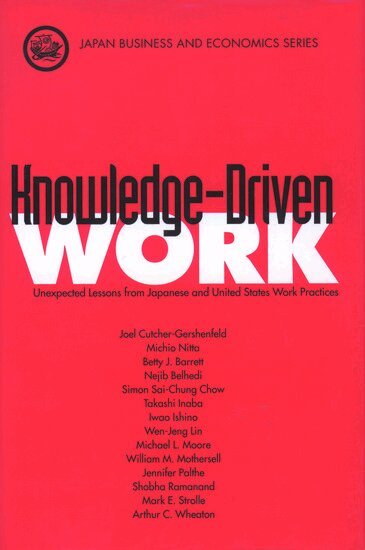
The editors provide a range of empirical studies on how Japanese and US firms manage critical aspects of technology development and deployment. Almost all of the research has not been previously published.
Inbunden, Engelska, 1998
1 059 kr
Skickas inom 5-8 vardagar
The daily work experiences of people in almost any part of the world are shaped by workplace innovations. Despite the vast diffusion of work practices, little is known about what it means for a company in the region to identify what it sees as the best practice and then introduce these practices in another culture which are less visible than the global exchange of products and services, but more significant. This book provides us with a closeup of eight Japanese affiliated manufacturing facilities operating in the United States and the beginnings of a reverse diffusion of innovation back to Japan. The key finding in this book is that massive global diffusion of work practices rests on something very fragile. This is the process by which individuals and groups of people come to new understandings that enable them to adopt new work practices. It is a process termed "virtual knowledge", which can be found at that critical time when understandings are still in formation. Also , the book reveals how some organizations have anticipated and channeled virtual knowledge that is constantly emerging from different groups in the organization. This turns out to be the core building block for continuous improvement in operations and is central to the process of diffusion. The process is part of a much larger process of global diffusion from Japan, the United States and other nations to all parts of the world.
Inbunden, Engelska, 1999
1 917 kr
Skickas inom 5-8 vardagar
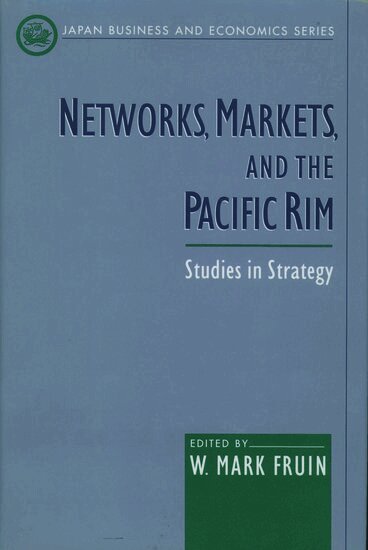
This volume explores the wide diversity in the kinds of networks that have been established between firms in Japan and the Pacific Rim. Editor W. Mark Fruin shows how networks in Japan and Korea are more prescribed and standardized than those found in the United States. For example, Toyota's satellite organizational system is more flexible, open-ended, and market-conforming than General Motors divisional organization. But less market-conforming networks can also arise. In China, for example, networks have arisen because of the unpredictable nature of markets. The contributors to this volume utilize new ideas and data to formulate an understanding of the importance of networks to the success of Asian firms. The book's postmodern approach--seeking not a single model but rather a variety of models of equally probable validity--makes it a unique resource for scholars and professionals in the field.
Inbunden, Engelska, 1999
2 182 kr
Skickas inom 5-8 vardagar
Over the last two decades, Japanese firms have challenged U.S. dominance in many manufacturing industries. This challenge has increasingly come in the form of transplant operations, and recognition has spread that their success owes a great deal to superior manufacturing management. Despite the ups and downs of the business cycle in Japan, there remains a core of world-class Japanese companies that have developed manufacturing management systems that companies throughout the world strive to emulate.In this edited volume, a team of eminent scholars uses case studies and large-scale surveys to explain in depth the process of transferring and transforming the best Japanese Management Systems (JMS) by both Japanese- and U.S.-owned firms. While the most successful of the Japanese manufacturing transplants rely, to varying degrees, on home country management techniques, they have had to adapt them to fit U.S. conditions. Similarly, the growing number of U.S. firms that are adopting these techniques to strengthen their own positions face a considerable challenge in transforming them to fit local conditions. A new environment necessarily compels the transformation of JMS. But despite the hurdles firms face, the evidence presented here and elsewhere strongly indicates that key aspects of JMS are remarkably transferable and successful in the United States.Combining scientific data with clear and engaging prose,Remade in America is a rich analytical resource for manufacturing professionals, as well as scholars and students of management and business.
Inbunden, Engelska, 1999
2 138 kr
Skickas inom 5-8 vardagar
This book brings together research on the spread of Japanese multinational firms around the world. The authors' research includes firms operating in the United States, Germany, Spain, Mexico, Italy, as well as countries in Southeast Asia. The continuing success of these firms provides a model for other countries and firms to understand and emulate. The contributors in this book demonstrate how Japanese multinationals manage the people in their overseas operations and have wide-ranging implications for multinational performance as well as the performance of the local economies in which they operate. It is a learning experience for the Japanese managers when they find a cultural conflict with local workers and have to find ways to overcome this conflict in order for the local affiliate to succeed. Finally, the authors draw conclusions that can be applied to multinational firms in other countries that are expanding into different cultures.
Inbunden, Engelska, 2000
566 kr
Skickas inom 3-6 vardagar
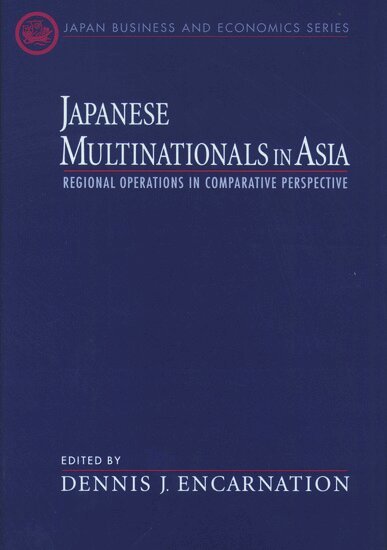
This collection explores the expansion of Japanese multinational firms into Asia, a process which parallelled the region's growth as a major economic region. The contributors discuss a wide range of topics, including the reasons for moving manufacturing to other countries, the flow of trade between Japan and these countries, technology transfer within firms, the impact of Japanese management practices in other Asian countries, and competition between Japanese and American firms in Asia.
Inbunden, Engelska, 1996
2 757 kr
Skickas inom 5-8 vardagar
Japan was the first major non-western nation to take on board the Western technological and organizational advances of the century after the fist industrial revolution. It subsequently proved fully able to exploit and contribute to the broad, sustained technological advances that began in the twentieth century, as science became harnessed to technology. Japan's economic development remains a model for many technologically less advanced countries which have not yet mastered modern technology to organizational forms; and a knowledge of Japanese technological and economic history can contribute importantly to our understanding of economic growth in the modern era.This book studies the industrial development of Japan since the mid-nineteenth century, with particular emphasis on how the various industries built technological capabilities. The Japanese were extraordinarily creative in seraching out and learning to use modern technologies, and the authors investigate the emergence of entrepreneurs who began new and risky businesses, how the business organizations evolved to cope with changing technological conditions, and how the managers, engineers and workers acquired organizational and technological skills through technology importation, learning-by-doing, and their own R&D activities.The book investigates the interaction between private entrepreneural activities and public policy, through a general examination of economic and industrial development, a study of the evolution of management systems, and six industrial case studies: textiles, iron and steel, electrical and communications equipment, automobiles, shipbuilding and aircraft, and pharmaceuticals. the authors show how the Japanese government has played an important supportive role in the continuing innovation, without being a substitute for aggressive business enterprise constantly venturing into unfamiliar terrains.
Inbunden, Engelska, 1999
2 536 kr
Skickas inom 5-8 vardagar
Japan's rise from the ashes of defeat in the Second World War to its position now as one of the world's foremost economies has long been recognized as one of the most startling turnarounds of the 20th Century. With economic reform again at the top of the global agenda with the fall of the Soviet bloc and the continuing struggle of the developing nations, the lessons of Japan's success have never been more valuable. This volume looks closely at the origins of the current Japanese economic system, focusing particularly on the contrast between the war period of 1930-1945 and the preceding situation. The contributors argue that Japan had an `Anglo-Saxon model' economy until the 1930s, and that the special features of the Japanese system -- good labour relations; employee-based corporate governance; the main banks' financial system; and the principle of `administrative guidance' -- were all deliberately created during militarization. Although there are many post-war factors that have led to the present-day Japanese situation -- the Dodge Plan, high post-war inflation, new technology, massive shifts in the labour force, deregulation from the 1960s onwards -- without the reforms introduced between 1930 and 1945 there would be no `Japanese system'.
Inbunden, Engelska, 1999
966 kr
Skickas inom 7-10 vardagar
Computers, telecommunications equipment, semiconductorsthe products and technologies of the information and communications industry (IC)have transformed our world. Most of these products were initially developed in Western countries, but by the early 1990s some of the world's largest companies in the field were Japanese. This book explains the resurgence of Japan's IC giants, their global status, and their strengths and weaknesses.Empirical scrutiny of their evolution is complemented by the author's own theory of the most appropriate mehtod for studying the dynamics of industrial change. The author argues that in order to understand the evolution of IC companies and industries, it is necessary to create a theory of the firm capable of encompassing the development of real firms in the real world in real time. This approach stresses the importance of the beliefs that are constructed in the firm under conditions of 'interpretive ambiguity', which guide the firm's decisions and its reactions to new technologies. Lengthy analyses of NEC and NTT (by far the world's largest company in terms of market value; its future currently under government scrutiny), and of the computing, switching, and optical fibre industries, illustrate these concepts. Based on over 600 interviews over eight years with Japanese leaders, this book provides important new material on the past, present, and future of Japanese industry.
Inbunden, Engelska, 1997
1 446 kr
Skickas inom 3-6 vardagar
In this age of high technology, Japan's success in continuous improvement and innovation in key industries, ranging from steel and automobiles to electronics, has been spectacular, and the unique institutional arrangements that have supported this success have attracted wide attention. Yet, with only a few exceptions, the discussion of Japan's innovation system has tended to be anecdotal. It is the consequent need for a more solid analysis based on fact that this book fills.The chapters in this book investigate Japan's current innovation system through empirical, mostly quantitative, research. These chapters cover a wide range of subjects, including technology importation, industrial standards, product development, R&D personnel management, overseas R&D, and higher education. In addition, detailed industry studies cover the automobile, electrical machinery, semiconductor, and steel sectors. The authors, the leading Japanese scholars on these subjects, reveal the rich and complex nature of the Japanese innovation system, and describe in detail its strengths and weaknesses.
Inbunden, Engelska, 2000
2 801 kr
Skickas inom 5-8 vardagar
The Japanese government is becoming less involved in shaping industrial policy–but what does this imply for the openness of Japanese markets to foreign competition? In an extensive study of 'post-development' Japan, Ulrike Schaede argues that, contrary to what many have suggested, the reduced role of government regulation may not result in more open markets. Instead, as has happened throughout Japanese history, deregulation and the recession of the 1990s have once again led Japanese trade associations to assume important regulatory functions of their own. They do this through 'self-regulation'–setting and enforcing the rules of trade for their industries, independent from the government. As a result, many Japanese markets are now effectively governed by incumbent firms, in particular in terms of structuring the distribution system. As the record of postwar antitrust enforcement reveals, Japan's antitrust system considers most activities of self-regulation, other than outright price-fixing, as legal. Using interviews and a unique database of trade association activities, this book concludes that increasing self-regulation renders both government deregulation programmes and international trade negotiations ineffective in opening Japanese markets. The implications of self-regulation for Japanese industry are mixed: while internationally competitive firms can use self-regulation to reduce competition at home in order to compete more forcefully abroad, some domestic industries, such as the financial sector, may suffer from increased self-protection.
Inbunden, Engelska, 2000
1 973 kr
Skickas inom 7-10 vardagar
For much of the past half-century, Japan's economic success has stimulated the interest of scholars from around the world. In the last decade, and particularly in the last two years, however, it is Japan's economic difficulties which have attracted the most attention. The very institutions whose efficacy was earlier praised are now often criticised as being the core of Japan's economic problems. This volume brings together the research of many of the world's leading specialists on the Japanese economy to assess how Japan's distinctive economic institutions have operated in the past and how their evolution in the face of changing domestic and international circumstance s will shape the prospects for the Japanese economy in the 21st century. Particular attention is paid to the evolution of Japan's financial system and the changing character of Japanese firm governance, and to the changing role that government and the legal system play in Japan's economy. The authors find among many other important conclusions that far-reaching regulatory reform will be needed so that a new rules-based system allowing greater scope for dispersed private initiative can emerge to restructure and regrow the Japanese economy.
Häftad, Engelska, 2019
728 kr
Skickas inom 3-6 vardagar
Japan was the first major non-western nation to take on board the Western technological and organizational advances of the century after the fist industrial revolution. It subsequently proved fully able to exploit and contribute to the broad, sustained technological advances that began in the twentieth century, as science became harnessed to technology. Japan's economic development remains a model for many technologically less advanced countries which have not yet mastered modern technology to organizational forms; and a knowledge of Japanese technological and economic history can contribute importantly to our understanding of economic growth in the modern era.This book studies the industrial development of Japan since the mid-nineteenth century, with particular emphasis on how the various industries built technological capabilities. The Japanese were extraordinarily creative in searching out and learning to use modern technologies, and the authors investigate the emergence of entrepreneurs who began new and risky businesses, how the business organizations evolved to cope with changing technological conditions, and how the managers, engineers and workers acquired organizational and technological skills through technology importation, learning-by-doing, and their own R&D activities.The book investigates the interaction between private entrepreneural activities and public policy, through a general examination of economic and industrial development, a study of the evolution of management systems, and six industrial case studies: textiles, iron and steel, electrical and communications equipment, automobiles, shipbuilding and aircraft, and pharmaceuticals. The authors show how the Japanese government has played an important supportive role in the continuing innovation, without being a substitute for aggressive business enterprise constantly venturing into unfamiliar terrains.
Häftad, Engelska, 2000
848 kr
Skickas inom 5-8 vardagar
This is a book about Washington Consensus capitalism and the controversies its encroachment causes in Japan and Germany. Many people in both those countries share the assumptions dominant today in Britain and America-that managers should be intent solely on creating shareholder value and that shareholders' financial logic alone should determine who buys what company on the stock exchange. That way efficiency (and hence global welfare) will be maximized.The Japanese and German advocates of full-bloodied market capitalism are not having it all their own way, however. In both countries there are articulate defenders of what they consider to be a better way of life, informed by a more human, more social-solidary, set of values. Dore traces the fascinating debates which ensue on corporate governance, on worker rights, on supplier relations, on cartels and anti-trust, on pensions and welfare. He also analyses actual changes in economic behaviour-an essential means of sorting out a lot of the muddle and double-talk not just in the internal debates themselves, but even more in the foreign reporting of them.These accounts of the battle for the national soul in Japan and Germany constitute one of the finest contributions to the 'diversity of capitalism' debate. Dore's account should be read by anyone who is interested to know whether, for all the talk of globalization, that diversity is going to survive.
Inbunden, Engelska, 2000
2 033 kr
Skickas inom 5-8 vardagar
This is a book about Washington Consensus capitalism and the controversies its encroachment causes in Japan and Germany. Many people in both those countries share the assumptions dominant today in Britain and America-that managers should be intent solely on creating shareholder value and that shareholders' financial logic alone should determine who buys what company on the stock exchange. That way efficiency (and hence global welfare) will be maximized.The Japanese and German advocates of full-bloodied market capitalism are not having it all their own way, however. In both countries there are articulate defenders of what they consider to be a better way of life, informed by a more human, more social-solidary, set of values. Dore traces the fascinating debates which ensue on corporate governance, on worker rights, on supplier relations, on cartels and anti-trust, on pensions and welfare. He also analyses actual changes in economic behaviour-an essential means of sorting out a lot of the muddle and double-talk not just in the internal debates themselves, but even more in the foreign reporting of them.These accounts of the battle for the national soul in Japan and Germany constitute one of the finest contributions to the 'diversity of capitalism' debate. Dore's account should be read by anyone who is interested to know whether, for all the talk of globalization, that diversity is going to survive.