• Fri frakt över 249 kr
  • •
  • Snabba leveranser
  • •
  • Billiga böcker
Kundservice

Du är på sajten för privatpersoner.

Företag, bibliotek eller offentlig verksamhet?

Du handlar på classic.bokus.com, där alla dina funktioner finns intakta.
Till classic.bokus.com
Bokus logotyp. Gå till startsidan.
  • Erbjudanden
  • Nyheter
  • Student
  • Topplistor
  • Barn & ungdom
  • Bokus Play
  • E-böcker
  • Pocketböcker
  • Spel & pussel

10% rabatt på allt med kod NYSTART10 →

Sidfot

Mina sidor

    Hjälp

    • Kundservice
    • Vanliga frågor och svar
    • Frakt och leverans
    • Retur vid ångerrätt
    • Reklamera vara
    • Betalning
    • Köpvillkor
    • Allmänna villkor
    • Information om webbplatsens tillgänglighet

    Om Bokus

    • Om oss
    • Pressrum
    • För studenter
    • För företag
    • För bibliotek och offentlig verksamhet
    • För leverantörer
    • Hållbarhet

    Populärt

    • Aktuella erbjudanden
    • Presentkort
    • Studentlitteratur
    • Nya böcker
    • Topplistor
    • Signerade böcker
    • Engelska böcker

    Inspiration

    • Boktips
    • BookTok
    • Populära bokserier
    • Barnbokskaraktärer
    • Populära författare
    Logotyp för Bokus
    Följ oss på Facebook (extern länk)Följ oss på Instagram (extern länk)Följ oss på YouTube (extern länk)Följ oss på TikTok (extern länk)
    bokus @ CookiesAnpassa cookiesIntegritetspolicyKöpvillkor
    Till Citymail hemsida (extern länk)Till Budbee hemsida (extern länk)Till Postnord hemsida (extern länk)Till Schenker hemsida (extern länk)Till Early Bird hemsida (extern länk)Till Walleys hemsida (extern länk)
    1. Naturvetenskap och teknik
    2. Matematik och naturvetenskap
    3. Naturvetenskap:allmänt
    4. Naturvetenskapens historia

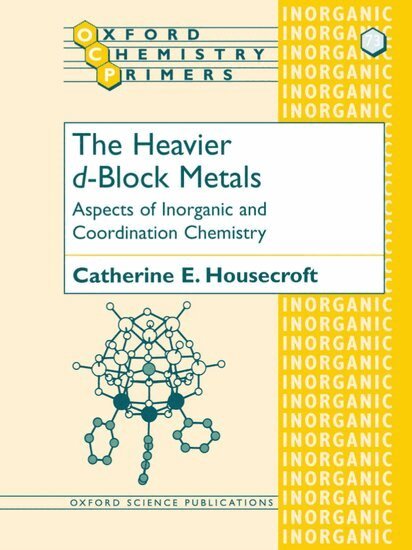
    The Heavier d-Block Metals

    Aspects of Inorganic and Coordination Chemistry

    AvCatherine E. Housecroft

    Häftad, Engelska, 1999

    Del 73 i serien Oxford Chemistry Primers

    443 kr

    Beställningsvara. Skickas inom 3-6 vardagar. Fri frakt över 249 kr.

    Beskrivning

    This book addresses the chemistry of the second and third row d-block metals, assuming a knowledge of the chemistry of the first row metals. Chapter 1 looks at the metals and summarizes occurrence, physical properties and uses. Chapter 2 considers periodic trends in properties. Chapter 3 considers aqueous solution chemistry, species present (with comparisons of the first row metal ions) and redox properties. Chapter 4 surveys structure: the range of coordination numbers shown by second and third row metals is often a topic for discussion in University courses. Chapter 5 looks at electronic spectra and magnetic properties, making comparisons with the first row the main objective of the chapter. Detailed mathematical treatments are not given. Chapter 6 considers metal-metal bonding, and the classes of compound that contain triple and quadruple bonds; the role of bridging ligands is introduced. Chapter 7 looks at selected clusters with a pi donar ligands (e.g. metal halo species) in which metal-metal bonding is important. Chapter 8 introduces the area of polyoxometallates, closing with a short discussion of the wide range of applications. The book contains many references to encourage wider reading by the student; in addition to textbooks of relevance, the author has included many recent literature citations, and a section called "Metals in Action" which gives citations which show the heavier metals at work in, for example, catalytic converters and molecular wires.

    Produktinformation

    • Utgivningsdatum:1999-02-04
    • Mått:188 x 245 x 6 mm
    • Vikt:225 g
    • Format:Häftad
    • Språk:Engelska
    • Serie:Oxford Chemistry Primers
    • Antal sidor:96
    • Förlag:OUP OXFORD
    • ISBN:9780198501039

    Utforska kategorier

    • Naturvetenskapens historia inom Naturvetenskap och teknik
    • Populärvetenskap inom Naturvetenskap och teknik

    Recensioner i media

    This slender book is aimed at undergraduate students who have just been introduced to the inorganic and coordination chemistry of the second and third row d-block metals. It is carefully structured, clearly written, well illustrated, and provides up-to-date references from current literature...providing a much-needed introduction to the underlying chemistry of the heavier d-block metals, while touching a wide range of topics. It should be of great benefit to all with an interest in the heavier d-block metals./Alvin A. Holder/Chemistry in Britain July.