• Fri frakt över 249 kr
  • •
  • Snabba leveranser
  • •
  • Billiga böcker
Kundservice

Du är på sajten för privatpersoner.

Företag, bibliotek eller offentlig verksamhet?

Du handlar på classic.bokus.com, där alla dina funktioner finns intakta.
Till classic.bokus.com
Bokus logotyp. Gå till startsidan.
  • Erbjudanden
  • Nyheter
  • Student
  • Topplistor
  • Barn & ungdom
  • Bokus Play
  • E-böcker
  • Pocketböcker
  • Spel & pussel

Må bättre, för mindre! Upp till 50% rabatt på hälsoböcker

Sidfot

Mina sidor

    Hjälp

    • Kundservice
    • Vanliga frågor och svar
    • Frakt och leverans
    • Retur vid ångerrätt
    • Reklamera vara
    • Betalning
    • Köpvillkor
    • Allmänna villkor
    • Information om webbplatsens tillgänglighet

    Om Bokus

    • Om oss
    • Pressrum
    • För studenter
    • För företag
    • För bibliotek och offentlig verksamhet
    • För leverantörer
    • Hållbarhet

    Populärt

    • Aktuella erbjudanden
    • Presentkort
    • Studentlitteratur
    • Nya böcker
    • Topplistor
    • Signerade böcker
    • Engelska böcker

    Inspiration

    • Boktips
    • BookTok
    • Populära bokserier
    • Barnbokskaraktärer
    • Populära författare
    Logotyp för Bokus
    Följ oss på Facebook (extern länk)Följ oss på Instagram (extern länk)Följ oss på YouTube (extern länk)Följ oss på TikTok (extern länk)
    bokus @ CookiesAnpassa cookiesIntegritetspolicyKöpvillkor
    Till Citymail hemsida (extern länk)Till Budbee hemsida (extern länk)Till Postnord hemsida (extern länk)Till Schenker hemsida (extern länk)Till Early Bird hemsida (extern länk)Till Walleys hemsida (extern länk)
    1. Medicin
    2. Omvårdnad och medicinska stödfunktioner
    3. Rehabilitering

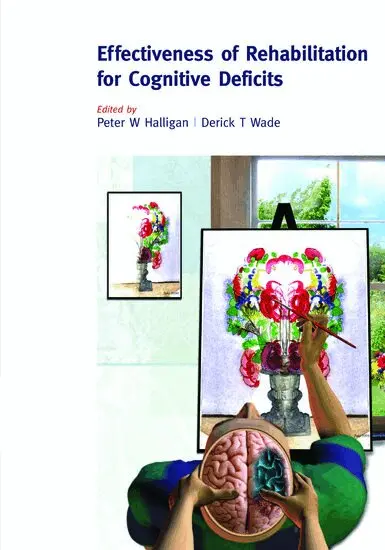
    The Effectiveness of Rehabilitation for Cognitive Deficits

    AvPeter W. Halligan,Derick T. Wade

    Häftad, Engelska, 2005

    1 917 kr

    Beställningsvara. Skickas inom 7-10 vardagar. Fri frakt över 249 kr.

    Beskrivning

    Many patients with brain damage are left with a range of neuropsychological deficits that impair normal cognitive process. It is generally recognised that these less obvious cognitive deficits (including memory, language, perception, attention and executive disorders) militate against full recovery often to a greater extent than more traditional medical deficits (e.g. paralysis, sensory loss, etc). Recognition of this has helped fuel the exponential growth in cognitive neuropsychology and neuroscience over the past 30 years. In turn, this theoretical approach has been used to guide and inform the development of cognitive therapies designed to remediate cognitive impairments and their functional consequences.Cognitive rehabilitation has over the last decade grown to become an established and influential therapeutic approach. There is now a considerable body of knowledge describing the principles and theoretical basis for analysing and directing treatments to selective cognitive deficits. Despite this, the clinical effectiveness and extent to which cognitive theory can inform therapeutic treatment has been questioned. It is timely, therefore, to evaluate and discuss the type and quality of evidence used in support of cognitive rehabilitation.In this book, some of the most influential clinicians and cognitive neuroscientists in the world critically review and discuss the effectiveness of rehabilitation methods currently used to treat patients with cognitive impairments following acquired brain damage. It provides a much needed critique and consensus about what should constitute best practice. The book will be valuable for all those who have to deal with the neuropsychological and neurological effects of brain damage, including, neuropsychologists, neuropsychiatrists, neurologists, experimental pscyhologists, and neuroscientists.

    Produktinformation

    • Utgivningsdatum:2005-09-29
    • Mått:168 x 240 x 23 mm
    • Vikt:733 g
    • Format:Häftad
    • Språk:Engelska
    • Antal sidor:414
    • Förlag:OUP OXFORD
    • ISBN:9780198526544

    Utforska kategorier

    • Rehabilitering inom Medicin
    • Biovetenskap inom Naturvetenskap och teknik
    • Kognitiv psykologi inom Psykologi och pedagogik

    Recensioner i media

    This is an excellent book on cognitive rehabilitation, providing a critical analysis of these treatments in a balanced and relatively unbiased manner. The authors are leading scientists and clinicians in the field and their expertise comes across in their precise and thoughtful chapters. This is probably the most comprehensive review on effectiveness of rehabilitation for cognitive deficits available and definitely worth owning for professionals and students alike.

    Innehållsförteckning

    • 1. Introduction ; HISTORICAL AND CONCEPTUAL ISSUES ; 2. A history of cognitive rehabilitation ; 3. Cognitive rehabilitation and its relationship to cognitive-neuropsychological rehabilitation ; 4. Fundamentals of cognitive rehabilitation ; 5. Applying the WHO ICF framework to the rehabilitation of patients with cognitive deficits ; 6. Methodological issues in evaluating the effectiveness of cognitive rehabilitation ; ATTENTIONAL DISORDERS ; 7. Attentional behaviour: varieties, deficits and theoretical accounts ; 8. Testing speed and control: the assessment of attentional impairments ; 9. Treating attentional impairments: review with a particular focus on naturalistic action rehabilitation ; 10. Can disabilities from attentional impairments be effectively treated? ; MEMORY DISORDERS ; 11. The neuroanatomy of memory ; 12. The assessment of memory ; 13. Can memory impairment be effectively treated? ; 14. The effective treatment of memory-related disabilities ; SPOKEN LANGUAGE DISORDERS ; 15. Language: cognitive models and functional anatomy ; 16. Tried, tested and trusted? Language assessment for rehabilitation ; 17. Language deficits: the efficacy of impairment-based treatments ; 18. Can speech and language therapy affect activity and participation levels? A review of the literature ; EXECUTIVE DISORDERS ; 19. Theories of frontal lobe executive function - clinical applications ; 20. Assessment of executive dysfunction ; 21. Can executive impairments be effectively treated? ; 22. Rehabilitation of executive deficits: effective treatment of related disabilities ; COGNITIVE REHABILITATION THEORY ; 23. For a theory of cognitive rehabilitation: progress in the decade of the brain ; 24. The neural basis for a theory of cognitive rehabilitation ; PATHOLOGY-BASED OUTCOMES ; 25. Cognitive rehabilitation outcomes for traumatic brain injury ; 26. Outcome of cognitive rehabilitation in clinical stroke services ; 27. Cognitive rehabilitation in early-stage dementia: evidence, practice and future directions