• Fri frakt över 249 kr
  • •
  • Snabba leveranser
  • •
  • Billiga böcker
Kundservice

Du är på sajten för privatpersoner.

Företag, bibliotek eller offentlig verksamhet?

Du handlar på classic.bokus.com, där alla dina funktioner finns intakta.
Till classic.bokus.com
Bokus logotyp. Gå till startsidan.
  • Erbjudanden
  • Student
  • Topplistor
  • Barn & ungdom
  • Bokus Play
  • E-böcker
  • Ljudböcker
  • Pocketböcker
  • Spel och pussel

Pocketfynda! Hundratals böcker för 49 kr/st →

Sidfot

Mina sidor

    Hjälp

    • Kundservice
    • Vanliga frågor och svar
    • Frakt och leverans
    • Retur vid ångerrätt
    • Reklamera vara
    • Betalning
    • Köpvillkor
    • Allmänna villkor
    • Information om webbplatsens tillgänglighet

    Om Bokus

    • Om oss
    • Pressrum
    • För studenter
    • För företag
    • För bibliotek och offentlig verksamhet
    • För leverantörer
    • Hållbarhet

    Populärt

    • Aktuella erbjudanden
    • Presentkort
    • Studentlitteratur
    • Nya böcker
    • Topplistor
    • Signerade böcker
    • Engelska böcker

    Inspiration

    • Boktips
    • BookTok
    • Barnbokskaraktärer
    • Populära författare
    Logotyp för Bokus
    Följ oss på Facebook (extern länk)Följ oss på Instagram (extern länk)Följ oss på YouTube (extern länk)Följ oss på TikTok (extern länk)
    bokus @ CookiesAnpassa cookiesIntegritetspolicyKöpvillkor
    Till Citymail hemsida (extern länk)Till Budbee hemsida (extern länk)Till Postnord hemsida (extern länk)Till Schenker hemsida (extern länk)Till Early Bird hemsida (extern länk)Till Walleys hemsida (extern länk)
    1. Filosofi och religion
    2. Filosofi
    3. Filosofiska discipliner

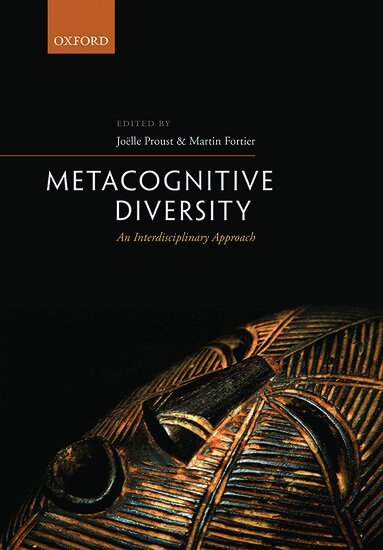
    Metacognitive Diversity

    An Interdisciplinary Approach

    AvJoëlle Proust,Martin Fortier

    Inbunden, Engelska, 2018

    1 928 kr

    Beställningsvara. Skickas inom 5-8 vardagar. Fri frakt över 249 kr.

    Beskrivning

    Metacognition refers to our awareness of our own mental processes, such as perceiving, remembering, learning, and problem solving. It is a fascinating area of research for psychologists, neuroscientists, anthropologists, sociologists and philosophers.This book explores the variability of metacognitive skills across cultures, since a person's decision to allocate effort, motivation to learn, sense of being right or wrong in perceptions, memories, and other cognitive tasks depends on specific transmitted goals, norms, and values. Across nineteen chapters, a group of leading authors analyze the variable and universal features associated with these dimensions, drawing on cutting-edge evidence.Additionally, new domains of metacognitive variability are considered in this volume, including those generated by metacognition-oriented embodied practices (present in rituals and religious worship), and culture-specific lay theories about subjective uncertainty and knowledge regarding natural or supernatural entities. It also documents universal metacognitive features, such as children's earlier sensitivity to their own ignorance than to that of others, people's intuitive understanding of what counts as knowledge, and speakers' sensitivity to informational sources (independently of the way the information is linguistically expressed).The book is important reading for students and scholars in cognitive and cultural psychology, anthopology, developmental and social psychology, linguistics, and philosophy.

    Produktinformation

    • Utgivningsdatum:2018-04-05
    • Mått:177 x 253 x 31 mm
    • Vikt:940 g
    • Format:Inbunden
    • Språk:Engelska
    • Antal sidor:456
    • Förlag:OUP OXFORD
    • ISBN:9780198789710

    Utforska kategorier

    • Filosofiska discipliner inom Filosofi och religion
    • Kognitiv psykologi inom Psykologi och pedagogik
    • Språkvetenskap och lingvistik inom Språk och ordböcker

    Mer om författaren

    Joëlle Proust is a French philosopher working at Institut Jean-Nicod, Ecole Normale Supérieure, Paris and Emeritus Director of Research at the Centre National de la Recherche Scientifique. She has conducted research at the CNRS since 1976 about the history and the philosophy of logic, the philosophy of human and animal cognition, agency, personal identity and metacognition. Thanks to an advanced grant by the European Research Council (2011-2016), Joëlle has conducted collaborative research with developmental psychologists, neuroscientists and cognitive anthropologists on the empirical and conceptual aspects of metacognitive diversity, in order to explore whether children and adults from Western Europe, Japan and non-industrialized Mesoamerican cultures differ in the ways they control and evaluate their own cognitive activity.Martin Fortier is a doctoral student at Institut Jean-Nicod, Ecole des Hautes Etudes en Sciences Sociales and Ecole Normale Supérieure, PSL Research University, Paris. Situated at the intersection of cognitive science, anthropology, and philosophy of mind, his research explores the interplay between cultural and neurobiological processes in hallucinogenic experiences-especially in the context of Amazonian shamanism-and animistic thinking, reasoning and categorization in Lowland South America. His fieldwork is located among Shipibo communities of the Ucayali River, Peru.

    Recensioner i media

    Joëlle Proust and Martin Fortiers 2018 edited volume, Metacognitive Diversity: An Interdisciplinary Approach, proves to be what it says on the tin, with an extensive collection of papers examining the cultural influences that produce diversity in metacognition and mind-reading. Metacognitive Diversity is an impressive work, as the advanced praise testifies in its early pages, many by well-known names in the field. But the praise is warranted, both in the content and in the execution of the book. The papers situate the reader in an overview of the tendrils of metacognition, and effectively show the reach and breadth that its influence is felt across different areas of our lives, from politics to cultural taste to religious practise, including reconciling conflicting or redundant explanatory sources of how we understand the world.

    Innehållsförteckning

    • 1: Joëlle Proust and Martin Fortier: Metacognitive diversity across culture: An introduction I. Introducing metacognition 2: Norbert Schwarz: Of fluency, beauty, and truth: Inferences from metacognitive experiences 3: Rolf Reber and Ara Norenzayan: Shared fluency theory of social cohesiveness: How the metacognitive feeling of processing fluency contributes to group processes 4: Bahador Bahrami: Making the most of individual differences in joint decisions II. How does metacognition develop: Cross-cultural studies 5: Paul Harris: Revisiting privileged access 6: Sunae Kim, Ameneh Shahaeian, and Joëlle Proust: Developmental diversity in mindreading and metacognition 7: Athanasios Chasiotis: The developmental role of experience-based metacognition for cultural diversity in executive function, motivation and mindreading III. Metacognition in communication 8: Anna Papafragou and Ercenur Ünal: The relation between language and mental state reasoning 9: Janis Nuckolls and Tod Swanson: Respectable uncertainty and pathetic truth in Amazonian Quichua speaking culture 10: Olivier Le Guen: Managing epistemicity among the Yucatec Mayas (Mexico) IV. Metacognitive regulation and self-concept 11: Veronica X. Yan and Daphna Oyserman: The world as we see it: The culture-identity-metacognition interface 12: Ulrich Kühnen and Marieke van Egmond: Learning: A cultural construct 13: Giovanni Bennardo: Cultural models in Tongan metacognition V. Metacognition within religious practices 14: Tanya Luhrmann: Prayer as a metacognitive activity 15: Uffe Schjødt and Jeppe Jensen: Depletion and deprivation: Social functional pathways to a shared metacognition 16: Martin Fortier: Sense of reality, metacognition and culture in schizophrenic and drug-induced hallucinations: An interdisciplinary approach VI. Do epistemic norms vary across cultures? 17: Stephen Stich: Knowledge, intuition and culture 18: Jonathan Mair: Metacognitive variety, from Inner Mongolian Buddhism to post-truth 19: Cristine Legare and Andrew Shtulman: Explanatory pluralism across cultures and development