• Fri frakt över 249 kr
  • •
  • Snabba leveranser
  • •
  • Billiga böcker
Kundservice

Du är på sajten för privatpersoner.

Företag, bibliotek eller offentlig verksamhet?

Du handlar på classic.bokus.com, där alla dina funktioner finns intakta.
Till classic.bokus.com
Bokus logotyp. Gå till startsidan.
  • Erbjudanden
  • Nyheter
  • Student
  • Topplistor
  • Barn & ungdom
  • Bokus Play
  • E-böcker
  • Pocketböcker
  • Spel & pussel

10% rabatt på allt med kod: NYSTART10 →

Sidfot

Mina sidor

    Hjälp

    • Kundservice
    • Vanliga frågor och svar
    • Frakt och leverans
    • Retur vid ångerrätt
    • Reklamera vara
    • Betalning
    • Köpvillkor
    • Allmänna villkor
    • Information om webbplatsens tillgänglighet

    Om Bokus

    • Om oss
    • Pressrum
    • För studenter
    • För företag
    • För bibliotek och offentlig verksamhet
    • För leverantörer
    • Hållbarhet

    Populärt

    • Aktuella erbjudanden
    • Presentkort
    • Studentlitteratur
    • Nya böcker
    • Topplistor
    • Signerade böcker
    • Engelska böcker

    Inspiration

    • Boktips
    • BookTok
    • Populära bokserier
    • Barnbokskaraktärer
    • Populära författare
    Logotyp för Bokus
    Följ oss på Facebook (extern länk)Följ oss på Instagram (extern länk)Följ oss på YouTube (extern länk)Följ oss på TikTok (extern länk)
    bokus @ CookiesAnpassa cookiesIntegritetspolicyKöpvillkor
    Till Citymail hemsida (extern länk)Till Budbee hemsida (extern länk)Till Postnord hemsida (extern länk)Till Schenker hemsida (extern länk)Till Early Bird hemsida (extern länk)Till Walleys hemsida (extern länk)
    1. Skönlitteratur
    2. Litteraturvetenskap
    3. Litteraturvetenskap

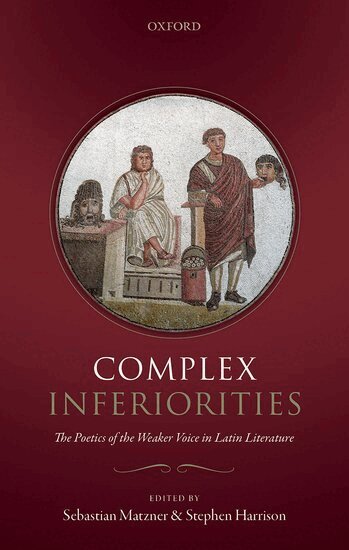
    Complex Inferiorities

    The Poetics of the Weaker Voice in Latin Literature

    AvSebastian Matzner,Stephen Harrison

    Inbunden, Engelska, 2018

    2 260 kr

    Beställningsvara. Skickas inom 3-6 vardagar. Fri frakt över 249 kr.

    Beskrivning

    This volume investigates an important and surprisingly widespread phenomenon in Latin literature, which has to date received little sustained discussion: the deliberate assumption of a weaker voice by speakers who in fact hold sufficient status not to be forced into this position. Though often associated with the markers of imperial hegemony and elite speech, Latin literature evinces a remarkably broad range of strategies designed to enable the adoption of a markedly disempowered voice- from topoi such as recusatio (professing a lack of ability to write in status-conforming, superior genres) and rhetorical devices such as prosopopoeia (artfully and strategically adopting a persona to garner favour, even when this means temporarily forfeiting one's higher status and discursive privileges), to the long-silenced female heroines of Ovid's Heroides and satire's irreverent take on the great and the good by framing its narratives as being articulated 'from below'. Even large-scale cultural self-positionings fall within this scope, be they expressions of Roman cultural inferiority vis-à-vis classical Greece or the tensions that arise between humble (yet spiritually superior) Christian writers and their grand, canonical, and classical (yet pagan) predecessors.The intersecting case studies offered in Complex Inferiorities examine this phenomenon in a wide range of genres, periods, and authors. By demonstrating that re-negotiating alleged weakness constitutes a central activity in Latin literature, this volume reveals the extent of the literary and cultural-political possibilities opened up by assuming and speaking in voices of weakness and inferiority. Authored by experts in their fields, the individual chapters explore the crucial role of the 'weaker voice' in establishing, perpetuating, and challenging hierarchies and values in a wide range of contexts- from poetics and choices of genre, to social status and intra- and intercultural relations- thereby offering invaluable insights not only for the study of classics, but for literary and cultural studies across the humanities.

    Produktinformation

    • Utgivningsdatum:2018-11-13
    • Mått:148 x 224 x 25 mm
    • Vikt:538 g
    • Format:Inbunden
    • Språk:Engelska
    • Antal sidor:336
    • Förlag:OUP OXFORD
    • ISBN:9780198814061

    Utforska kategorier

    • Litteraturvetenskap inom Skönlitteratur
    • Litteraturteori inom Skönlitteratur
    • Kulturvetenskap inom Samhälle och politik

    Mer om författaren

    Sebastian Matzner is Senior Lecturer in Comparative Literature at King's College London. His research focuses on interactions between ancient and modern literature and thought, especially in the fields of poetics and rhetoric, literary and critical theory, history of sexualities, LGBTQ studies, and traditions of classicism. He has published several articles and book chapters in these fields and is the author of Rethinking Metonymy: Literary Theory and Poetic Practice from Pindar to Jakobson (OUP, 2016) as well as co-editor of a forthcoming OUP volume entitled Metalepsis: Ancient Texts, New Perspectives (with Gail Trimble).Stephen Harrison is Professor of Latin Literature at the University of Oxford, and Fellow and Tutor in Classics at Corpus Christi College. His main research and teaching interests are in Latin literature and its reception. He has written monographs on Vergil, Horace, and Apuleius, and has edited, co-edited, or co-authored more than twenty books on Vergil, Horace, the Roman novel, Classics and literary theory, and Latin literature in general, as well as on the reception of classical literature. His recent publications include Victorian Horace: Classics and Class (Bloomsbury, 2017) and a commentary on Horace Odes 2 (CUP, 2017).

    Recensioner i media

    [T]his volume represents a series of essays that are closely connected by the theme, but also widely diverse. It has a lot to offer in terms of ideas and approaches that might be applied beyond the texts directly considered within

    Innehållsförteckning

    • Frontmatter Note on Abbreviations List of Contributors 0: Sebastian Matzner: Introduction: Latin Literature's Complex Inferiorities 1: William Fitzgerald: Claiming Inferiority: Weakness into Strength 2: Sebastian Matzner: How Do You Solve a Problem like Horace? On Roman Philhellenism and Postcolonial Critique 3: Amy Richlin: Blackface and Drag in the Palliata 4: Jean-Claude Julhe: Social Inferiority and Poetic Inferiority - Martial's Revenge in his Epigrams: A Commentary on Martial 5.13 5: Tom Geue: Drawing Blanks: The Pale Shades of 'Phaedrus' and 'Juvenal' 6: Victoria Rimell: The Creative Superiority of Self-Reproach: Horace's Ars Poetica 7: Ellen O'Gorman: 'The Noise, and the People': Popular clamor and Political Discourse in Latin Historiography 8: Dunstan Lowe: Loud and Proud: The Voice of the praeco in Roman Love-Elegy 9: Stephen Harrison: Hidden Voices: Homoerotic Colour in Horace's Odes 10: G. O. Hutchinson: On Not Being Beautiful 11: Vassiliki Panoussi: From Adultery to Incest: Messalina and Agrippina as Sexual Aggressors in Tacitus' Annals 12: Shadi Bartsch: The Aeneid as 'Weaker Text' and Fulgentius' Radical Hermeneutics 13: Philip Hardie: Cowherds and Saints: Paulinus of Nola Carmen 18 Endmatter References General Index Index Locorum