• Fri frakt över 249 kr
  • •
  • Snabba leveranser
  • •
  • Billiga böcker
Kundservice

Du är på sajten för privatpersoner.

Företag, bibliotek eller offentlig verksamhet?

Du handlar på classic.bokus.com, där alla dina funktioner finns intakta.
Till classic.bokus.com
Bokus logotyp. Gå till startsidan.
  • Erbjudanden
  • Nyheter
  • Student
  • Topplistor
  • Barn & ungdom
  • Bokus Play
  • E-böcker
  • Pocketböcker
  • Spel & pussel

10% rabatt på allt med kod: NYSTART10 →

Sidfot

Mina sidor

    Hjälp

    • Kundservice
    • Vanliga frågor och svar
    • Frakt och leverans
    • Retur vid ångerrätt
    • Reklamera vara
    • Betalning
    • Köpvillkor
    • Allmänna villkor
    • Information om webbplatsens tillgänglighet

    Om Bokus

    • Om oss
    • Pressrum
    • För studenter
    • För företag
    • För bibliotek och offentlig verksamhet
    • För leverantörer
    • Hållbarhet

    Populärt

    • Aktuella erbjudanden
    • Presentkort
    • Studentlitteratur
    • Nya böcker
    • Topplistor
    • Signerade böcker
    • Engelska böcker

    Inspiration

    • Boktips
    • BookTok
    • Populära bokserier
    • Barnbokskaraktärer
    • Populära författare
    Logotyp för Bokus
    Följ oss på Facebook (extern länk)Följ oss på Instagram (extern länk)Följ oss på YouTube (extern länk)Följ oss på TikTok (extern länk)
    bokus @ CookiesAnpassa cookiesIntegritetspolicyKöpvillkor
    Till Citymail hemsida (extern länk)Till Budbee hemsida (extern länk)Till Postnord hemsida (extern länk)Till Schenker hemsida (extern länk)Till Early Bird hemsida (extern länk)Till Walleys hemsida (extern länk)
    1. Samhälle och politik
    2. Politik och statsskick
    3. Statsskick och politiska processer

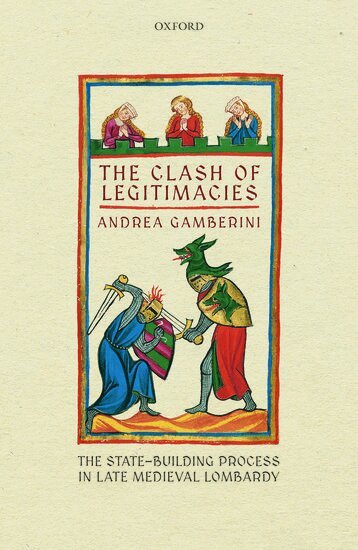
    The Clash of Legitimacies

    The State-Building Process in Late Medieval Lombardy

    AvAndrea Gamberini

    Inbunden, Engelska, 2018

    Del i serien Oxford Studies in Medieval European History

    1 500 kr

    Beställningsvara. Skickas inom 5-8 vardagar. Fri frakt över 249 kr.

    Beskrivning

    The Clash of Legitimacies makes an innovative contribution to the history of the state-building process in late medieval Lombardy (during the 13th to 15th centuries), by illuminating myriad conflicts attending the legitimacy of power and authority at different levels of society. Through the analysis of the rhetorical forms and linguistic repertoires deployed by the many protagonists (not only the prince, but also the cities, communities, peasants, and political factions) to express their own ideals of shared political life, this volume reveals the depth of the conflicts in which opposing political actors were not only inspired by competing material interests - as in the traditional interpretation to be found in previous historiography - but also often were guided by differing concepts of authority.From this comes a largely new image of the late medieval and early Renaissance state, one without a monopoly of force - as has been shown in many studies since the 1970s - and one that did not even have the monopoly of legitimacy. The limitations of attempts by governors to present the political principles that inspired their acts as shared and universally recognized are revealed by a historical analysis firmly intent on investigating the existence, in particular territorial or social ambits, of other political cultures which based obedience to authority on different, and frequently original, ideals.

    Produktinformation

    • Utgivningsdatum:2018-11-01
    • Mått:163 x 238 x 21 mm
    • Vikt:538 g
    • Format:Inbunden
    • Språk:Engelska
    • Serie:Oxford Studies in Medieval European History
    • Antal sidor:256
    • Förlag:OUP OXFORD
    • ISBN:9780198824312

    Utforska kategorier

    • Statsskick och politiska processer inom Samhälle och politik
    • Medeltiden inom Historia och arkeologi

    Mer om författaren

    Andrea Gamberini studied at the University of Milan, where he currently teaches as Professor of Medieval History. His research interests focus on Late Medieval Italy and follow four main strands: political history (with special attention to the state-building process), ecclesiastical history (mainly the episcopate), political languages between the 11th and 15th centuries, and social mobility in the Later Middle Ages.During his career, Andrea has received several accolades and grants. He was the Fowler Hamilton Visiting Research Fellow at Christ Church, Oxford, in 2012-2013; a Visiting Professor at Kyoto University in 2010; a nominated fellow at IASH, University of Edinburgh in 2016; and a Visiting Fellow at Clare Hall, Cambridge, in 2012, after which he was elected Life Member.

    Innehållsförteckning

    • Introduction Part I: Towards the commune as state 1: Northern Italy in the central Middle Ages. Some historical background 2: The city commune and the assumption of a public role 3: Experimentation and conceptualisation in the field of urban expansion and the construction of territory 4: The political cultures of the city and the territory: some early affinities 5: Some cornerstones of city and communal ideology 6: Between unitas and aequalitas: the ideology of representation 7: The ideologues of communal political culture 8: The experience of personal government between the factions and the Popolo: the persistence of the commune 9: Towards conflict. The political and juridical culture of the commune becomes hegemonic 10: The political cultures of the contado: aristocratic pre-eminence and the subordination of the rural dweller 11: Rural communes and the culture of practices Part II: Towards the regional state 1: New scenarios, old questions 2: The rise of Visconti power, between legitimation from below and a longing for majesty 3: The ideology of the regional state 4: Law as a field of tension 5: The duke and the culture of individual distinction 6: The territorial aristocracies: pressure from below, organisation from above 7: The foundations of seigneurial power in the countryside 8: Guelphs and Ghibellines: another idea of legitimacy 9: 'Pacta servanda sunt'. The political culture of contractualism Concluding notes Bibliography