• Fri frakt över 249 kr
  • •
  • Snabba leveranser
  • •
  • Billiga böcker
Kundservice

Du är på sajten för privatpersoner.

Företag, bibliotek eller offentlig verksamhet?

Du handlar på classic.bokus.com, där alla dina funktioner finns intakta.
Till classic.bokus.com
Bokus logotyp. Gå till startsidan.
  • Erbjudanden
  • Nyheter
  • Student
  • Topplistor
  • Barn & ungdom
  • Bokus Play
  • E-böcker
  • Pocketböcker
  • Spel & pussel

10% rabatt på allt med kod: NYSTART10 →

Sidfot

Mina sidor

    Hjälp

    • Kundservice
    • Vanliga frågor och svar
    • Frakt och leverans
    • Retur vid ångerrätt
    • Reklamera vara
    • Betalning
    • Köpvillkor
    • Allmänna villkor
    • Information om webbplatsens tillgänglighet

    Om Bokus

    • Om oss
    • Pressrum
    • För studenter
    • För företag
    • För bibliotek och offentlig verksamhet
    • För leverantörer
    • Hållbarhet

    Populärt

    • Aktuella erbjudanden
    • Presentkort
    • Studentlitteratur
    • Nya böcker
    • Topplistor
    • Signerade böcker
    • Engelska böcker

    Inspiration

    • Boktips
    • BookTok
    • Populära bokserier
    • Barnbokskaraktärer
    • Populära författare
    Logotyp för Bokus
    Följ oss på Facebook (extern länk)Följ oss på Instagram (extern länk)Följ oss på YouTube (extern länk)Följ oss på TikTok (extern länk)
    bokus @ CookiesAnpassa cookiesIntegritetspolicyKöpvillkor
    Till Citymail hemsida (extern länk)Till Budbee hemsida (extern länk)Till Postnord hemsida (extern länk)Till Schenker hemsida (extern länk)Till Early Bird hemsida (extern länk)Till Walleys hemsida (extern länk)
    1. Naturvetenskap och teknik
    2. Geovetenskap
    3. Miljövetenskap och miljöpolitik

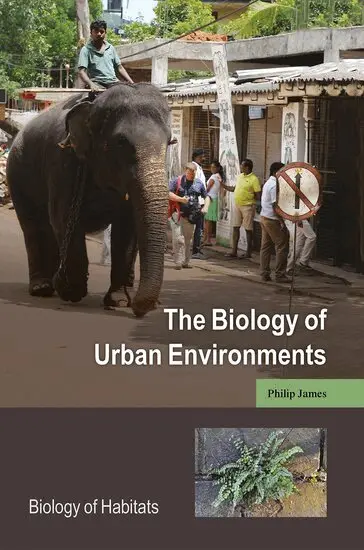
    The Biology of Urban Environments

    AvPhilip James

    Häftad, Engelska, 2018

    Del i serien Biology of Habitats Series

    836 kr

    Skickas . Fri frakt över 249 kr.

    Fler format och utgåvor

    Inbunden

    1 965 kr

    Beskrivning

    How do plants, animals, and humans manage to survive and adapt to the urban environment? This book provides a comprehensive coverage of biological matters related to urban environments presenting both the conceptual and theoretical underpinnings, and practical examples required to understand and address the challenges presented by this novel environment. The Biology of Urban Environments focusses on urban denizens: species (both domesticated and non-domesticated) that live for all or part of their life cycle in towns and cities. The biology of household plants and companion animals is discussed alongside that of species that have become feral or have not been domesticated. Temporal and spatial distribution patterns are set out and generalizations are made while exceptions are also discussed. The various strategies used and the genotypic, phenotypic, and behavioural adaptions of plants and animals in the face of the challenges presented by urban environments are explained. The final two chapters contain a discussion of the impacts of urban environments on human biology and suggestions on how this understanding might be used to address the increasing human health burden associated with illnesses that are characteristic of urbanites in the early twenty-first century.

    Produktinformation

    • Utgivningsdatum:2018-07-26
    • Mått:157 x 203 x 14 mm
    • Vikt:546 g
    • Format:Häftad
    • Språk:Engelska
    • Serie:Biology of Habitats Series
    • Antal sidor:320
    • Förlag:OUP OXFORD
    • ISBN:9780198827245

    Utforska kategorier

    • Miljövetenskap och miljöpolitik inom Naturvetenskap och teknik
    • Zoologi inom Naturvetenskap och teknik
    • Människans biologi inom Naturvetenskap och teknik

    Mer om författaren

    Philip James is Professor of Ecology in the School of Environment and Life Sciences at the University of Salford. In addition to his post at the University of Salford, Philip has honorary positions at the Universities of Manchester and Cambridge. Prior to The Biology of Urban Environments Philip has previously co-authored two books on Urban Ecology and has published the results of his own, and collaborative research, in journal articles. Philip is a Fellow of the Royal society of Biology and a Fellow of the Chartered Institute of Ecology and Environmental Management.

    Innehållsförteckning

    • 1: What is the urban environment and what is biology? Part I The urban environment 2: The built environment 3: The physical environment 4: The natural environment - habitats and communities Part II Diversity and distribution 5: Diversity of species 6: Relationships 7: Temporal patterns 8: Spatial patterns Part III Adapting to urban living 9: Strategies 10: Physiological and behavioural changes - how do they live Part IV People and nature 11: Human urban biology 12: A new relationship