• Fri frakt över 249 kr
  • •
  • Snabba leveranser
  • •
  • Billiga böcker
Kundservice

Du är på sajten för privatpersoner.

Företag, bibliotek eller offentlig verksamhet?

Du handlar på classic.bokus.com, där alla dina funktioner finns intakta.
Till classic.bokus.com
Bokus logotyp. Gå till startsidan.
  • Erbjudanden
  • Nyheter
  • Student
  • Topplistor
  • Barn & ungdom
  • Bokus Play
  • E-böcker
  • Pocketböcker
  • Spel & pussel

10% rabatt på allt med kod: NYSTART10 →

Sidfot

Mina sidor

    Hjälp

    • Kundservice
    • Vanliga frågor och svar
    • Frakt och leverans
    • Retur vid ångerrätt
    • Reklamera vara
    • Betalning
    • Köpvillkor
    • Allmänna villkor
    • Information om webbplatsens tillgänglighet

    Om Bokus

    • Om oss
    • Pressrum
    • För studenter
    • För företag
    • För bibliotek och offentlig verksamhet
    • För leverantörer
    • Hållbarhet

    Populärt

    • Aktuella erbjudanden
    • Presentkort
    • Studentlitteratur
    • Nya böcker
    • Topplistor
    • Signerade böcker
    • Engelska böcker

    Inspiration

    • Boktips
    • BookTok
    • Populära bokserier
    • Barnbokskaraktärer
    • Populära författare
    Logotyp för Bokus
    Följ oss på Facebook (extern länk)Följ oss på Instagram (extern länk)Följ oss på YouTube (extern länk)Följ oss på TikTok (extern länk)
    bokus @ CookiesAnpassa cookiesIntegritetspolicyKöpvillkor
    Till Citymail hemsida (extern länk)Till Budbee hemsida (extern länk)Till Postnord hemsida (extern länk)Till Schenker hemsida (extern länk)Till Early Bird hemsida (extern länk)Till Walleys hemsida (extern länk)
    1. Naturvetenskap och teknik
    2. Geovetenskap
    3. Geovetenskap

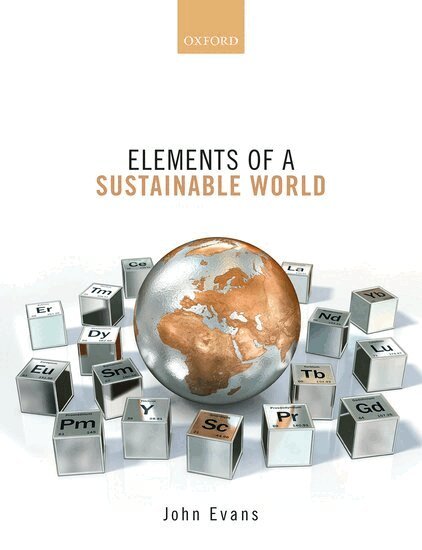
    Elements of a Sustainable World

    AvJohn Evans

    Häftad, Engelska, 2020

    593 kr

    Beställningsvara. Skickas inom 5-8 vardagar. Fri frakt över 249 kr.

    Fler format och utgåvor

    E-bok

    489 kr

    Inbunden

    1 686 kr

    Beskrivning

    We have 118 known chemical elements as our palette in our context of sustaining our world. Our context is considered in terms of the four spheres of the ancient world: Earth, Air, Fire and Water. This book shows how chemical principles can be used to understand the pressures on our world, spanning from greenhouse emissions through freshwater supplies to energy generation and storage. The supply of the chemical elements is key to their contribution to alleviating these pressures. Most synthetic and radioactive elements are not available in sufficient supply to contribute in this. Some solutions, such as wind turbines, batteries, fuel cells and automotive exhaust remediation pose questions about sustainable supplies of critical elements. With an eye on the target of the IPCC of capping the temperature anomaly to 1.5 oC (RCP2.6), options for carbon capture and storage, and the generation of energy and element supply from the sea are assessed. The consequences of the escape of plastics and pharmaceuticals into the wider environment for water integrity are also considered. This book is designed around providing a one semester course for students who have entered at least the second level of university chemistry. It provides explanations and entries to current environmental issues. For students of environmental science, it provides an understanding of the chemical principles underpinning the causes and possible solutions to these issues. Each chapter has a set appropriate study questions. A study guide is available for the book.

    Produktinformation

    • Utgivningsdatum:2020-09-18
    • Mått:189 x 248 x 15 mm
    • Vikt:692 g
    • Format:Häftad
    • Språk:Engelska
    • Antal sidor:336
    • Förlag:OUP OXFORD
    • ISBN:9780198827849

    Utforska kategorier

    • Geovetenskap inom Naturvetenskap och teknik
    • Miljövetenskap och miljöpolitik inom Naturvetenskap och teknik
    • Fysik inom Naturvetenskap och teknik

    Mer om författaren

    John Evans holds a BSc (Imperial College) and PhD (University of Cambridge) in Chemistry. Following further periods of research at Princeton University and Cambridge he moved to the University of Southampton in 1976 as a Royal Society Pickering Research Fellow. He became Professor of Inorganic Chemistry in 1990. There he has served as Head of Teaching, Head of Department and Dean of Science. He was also Science Program Advisor at the Diamond Light Source

    Innehållsförteckning

    • 1 Planet Earth 1.1: Planetary resources 1.2: Differential pressure on land, freshwater and oceans 1.3: Effects of CO2 increases 1.4: Solar energy supply 1.5: Solar radiation spectrum 1.6: Absorption of the energy emission from Earth 1.7: Radiative Forcing 1.8: Atmospheric lifetime 1.9: Global Warming Potential 1.10: The energy balance 1.11: A sustainable approach 1.12: Questions Palette of the Elements 2.1: Natural abundance of the elements 2.2: Mineral availability 2.3: Element Transmutation 2.4: Element supply 2.5: Elemental Properties 2.6: Element extraction: solubility 2.7: Oxidation State Stability 2.8: Terms and States 2.9: Embodied energy, carbon and water 2.10: Questions Earth: Minerals to Materials 3.1: s elements 3.2: p-elements 3.3: d-elements 3.4: f -elements 3.5: Structural Materials 3.6: Questions Air 4.1: The volatile elements 4.2: Atmospheric components 4.3: Atmospheric solution: wind turbines 4.4: Question Fire 5.1: Petrochemicals from carbon oxides 5.2: Polymers 5.3: Chemicals from biomass alternatives 5.4: Solar energy conversion 5.5: Nuclear energy conversion 5.6: Hydrogen as a fuel 5.7: Batteries and supercapacitors 5.8: Questions Water 6.1: Properties of water 6.2: Distribution of water 6.3: Distribution of elements in water 6.4: Water in processing 6.5: Desalination of water 6.6: Seawater as a source of elements 6.7: Water remediation from heavy metals and organics 6.8: Other organic contaminants of water 6.9: Questions Prospects for Planet Earth 7.1: Chapter 1: Planet Earth 7.2: Chapters 2 and 3: Palette of the Elements and Earth 7.3: Chapter 4: Air 7.4: Chapter 5: Fire 7.5: Chapter 6: Water 7.6: Questions Study Guide Overview Chapter 1: Planet Earth Chapter 2: Palette of the Elements Chapter 3: Earth Chapter 4: Air Chapter 5: Fire Chapter 6: Water Chapter 7: Prospects