• Fri frakt över 249 kr
  • •
  • Snabba leveranser
  • •
  • Billiga böcker
Kundservice

Du är på sajten för privatpersoner.

Företag, bibliotek eller offentlig verksamhet?

Du handlar på classic.bokus.com, där alla dina funktioner finns intakta.
Till classic.bokus.com
Bokus logotyp. Gå till startsidan.
  • Erbjudanden
  • Nyheter
  • Student
  • Topplistor
  • Barn & ungdom
  • Bokus Play
  • E-böcker
  • Pocketböcker
  • Spel & pussel

10% rabatt på allt med kod NYSTART10 →

Sidfot

Mina sidor

    Hjälp

    • Kundservice
    • Vanliga frågor och svar
    • Frakt och leverans
    • Retur vid ångerrätt
    • Reklamera vara
    • Betalning
    • Köpvillkor
    • Allmänna villkor
    • Information om webbplatsens tillgänglighet

    Om Bokus

    • Om oss
    • Pressrum
    • För studenter
    • För företag
    • För bibliotek och offentlig verksamhet
    • För leverantörer
    • Hållbarhet

    Populärt

    • Aktuella erbjudanden
    • Presentkort
    • Studentlitteratur
    • Nya böcker
    • Topplistor
    • Signerade böcker
    • Engelska böcker

    Inspiration

    • Boktips
    • BookTok
    • Populära bokserier
    • Barnbokskaraktärer
    • Populära författare
    Logotyp för Bokus
    Följ oss på Facebook (extern länk)Följ oss på Instagram (extern länk)Följ oss på YouTube (extern länk)Följ oss på TikTok (extern länk)
    bokus @ CookiesAnpassa cookiesIntegritetspolicyKöpvillkor
    Till Citymail hemsida (extern länk)Till Budbee hemsida (extern länk)Till Postnord hemsida (extern länk)Till Schenker hemsida (extern länk)Till Early Bird hemsida (extern länk)Till Walleys hemsida (extern länk)
    1. Ekonomi och Ledarskap
    2. Nationalekonomi
    3. Mikroekonomi

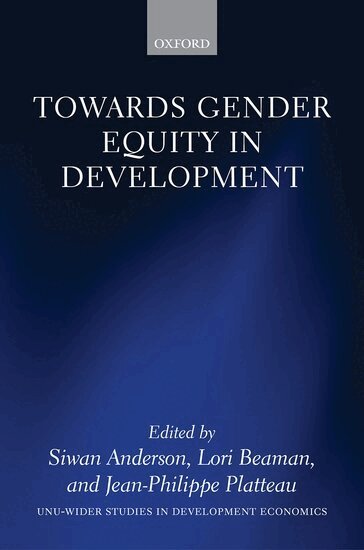
    Towards Gender Equity in Development

    AvSiwan Anderson,Lori Beaman

    Inbunden, Engelska, 2018

    Del i serien WIDER Studies in Development Economics

    1 967 kr

    Beställningsvara. Skickas inom 5-8 vardagar. Fri frakt över 249 kr.

    Beskrivning

    As a result of widespread mistreatment and overt discrimination, women in the developing world often lack autonomy. Towards Gender Equity in Development brings together leading scholars working on gender issues to explore key sources of female empowerment and discuss the current challenges and opportunities for the future.Exploring three key domains, this book adopts a clear multi-disciplinary approach to present different perspectives from gender-focused economics and social research. It covers marriage and women's relative bargaining position within the household; the options available to women outside of marriage and in the context of their community; and overarching discriminatory laws and cultural norms. It engages with questions of how marriage, divorce, and remarriage practices have evolved and with what effects for women; how female empowerment can benefit from improving options and economic and collective action opportunities; and how the government can act as a lawmaker to contribute to modifying norms and practices that disadvantage women.

    Produktinformation

    • Utgivningsdatum:2018-11-01
    • Mått:164 x 237 x 30 mm
    • Vikt:822 g
    • Format:Inbunden
    • Språk:Engelska
    • Serie:WIDER Studies in Development Economics
    • Antal sidor:448
    • Förlag:OUP OXFORD
    • ISBN:9780198829591

    Utforska kategorier

    • Mikroekonomi inom Ekonomi och Ledarskap
    • Internationell ekonomi inom Ekonomi och Ledarskap
    • Genusvetenskap inom Samhälle och politik

    Mer om författaren

    Siwan Anderson is a Professor at the Vancouver School of Economics at the University of British Columbia in Canada. Her research focuses on gender and local level political institutions. She is currently associate editor of the Journal of Development Economics, the Review of Economics and Statistics, and the Journal of Globalization and Development. She is a fellow of the Canadian Institute for Advanced Research (CIFAR) and the Bureau for Research and Economic Analysis of Development (BREAD). She is a research associate of the Center for Effective Global Action (CEGA) at Berkeley and of the Theoretical Research in Development Economics (ThReD) consortium. Her research has been published in the American Economic Review, Journal of Political Economy, Quarterly Journal of Economics, and the Review of Economic Studies, among others.Lori Beaman is an Associate Professor of Economics at Northwestern University. A development economist working on microeconomic issues, Lori's research interests are centered on two themes: social networks and gender. Her work has evaluated the impact of a political affirmative action program on gender bias in rural India; how social networks affect labour market opportunities among women in Malawi; and how to encourage African farmers to adopt profitable agricultural technologies, particularly women farmers. Her work has been published in Science, the American Economic Review, the Review of Economic Studies, and the Quarterly Journal of Economics among others. After serving as a Peace Corps volunteer in Mali for two years, she received her PhD in Economics in 2007 from Yale University.Jean-Philippe Platteau is a Professor at the University of Namur, Belgium. He is the author of several books, including Islam Instrumentalized: Religion and Politics in Historical Perspective (Cambridge University Press, 2017). He has published widely in both development and general economics journals. Most of his work has been concerned with the understanding of institutions in economic development, and the processes of institutional change. The role of informal institutions and the influence of non economic factors and other frontier issues at the interface between economics and sociology have been a central focus of his work. Examples are: family structures, informal insurance and micro-insurance, customs and social norms, religion, and collective action problems.

    Innehållsförteckning

    • 1: Siwan Anderson, Lori Beaman, and Jean-Philippe Platteau: Introduction Part I: Marriage 2: Sylvie Lambert, Dominique van de Walle, and Paola Villar: Marital trajectories and women's wellbeing in Senegal 3: Rebecca L. Thornton and Hans-Peter Kohler: Making marriages last: trust is good, but credible information is better 4: Jean-Marie Baland and Roberta Ziparo: Intra-household bargaining in poor countries 5: Selim Gulesci: Forced migration and attitudes towards domestic violence: Evidence from Turkey 6: Sara Lowes and Nathan Nunn: Bride price and the wellbeing of women Part II: Outside Options 7: Lars Ivar Oppedal Berge, Kjetil Bjorvatn, Amina Mohamed Maalim, Vincent Somville, and Bertil Tungodden: Reducing early pregnancy in low-income countries: A literature review and new evidence 8: Francisco Campos, Markus Goldstein, Laura McGorman, Ana Maria Munoz Boudet, and Obert Pimhidzai: Breaking the metal ceiling: Female entrepreneurs who succeed in male-dominated sectors 9: Ina Ganguli, Ricardo Hausmann, and Martina Viarengo: Career dynamics and gender gaps among employees in the microfinance sector 10: James Fearon and Macartan Humphreys: Why do women co-operate more in women's groups? 11: Xavier Giné, Salma Khalid, and Ghazala Mansuri: The impact of social mobilization on health service delivery and health outcomes: Evidence from rural Pakistan Part III: Laws and Cultural Norms 12: Jocelyn Viterna, José Santos Guardado Bautista, Silvia Ivette Juarez Barrios, and Alba Evelyn Cortez: Governance and the reversal of women's rights: The case of abortion in El Salvador 13: John R. Bowen: Gender, Islam, and law 14: Nancy Qian: The effect of China's One Child Policy on sex selection, family size, and the school enrolment of daughters 15: Jean-Philippe Platteau, Giulia Camilotti, and Emmanuelle Auriol: Eradicating women-hurting customs: What role for social engineering? 16: Shareen Joshi, Nishtha Kochhar, and Vijayendra Rao: Are caste categories misleading? The relationship between gender and jati in three Indian states 17: Siwan Anderson and Debraj Ray: Excess female mortality in Africa