• Fri frakt över 249 kr
  • •
  • Snabba leveranser
  • •
  • Billiga böcker
Kundservice

Du är på sajten för privatpersoner.

Företag, bibliotek eller offentlig verksamhet?

Du handlar på classic.bokus.com, där alla dina funktioner finns intakta.
Till classic.bokus.com
Bokus logotyp. Gå till startsidan.
  • Erbjudanden
  • Nyheter
  • Student
  • Topplistor
  • Barn & ungdom
  • Bokus Play
  • E-böcker
  • Pocketböcker
  • Spel & pussel

Må bättre, för mindre! Upp till 50% rabatt på hälsoböcker

Sidfot

Mina sidor

    Hjälp

    • Kundservice
    • Vanliga frågor och svar
    • Frakt och leverans
    • Retur vid ångerrätt
    • Reklamera vara
    • Betalning
    • Köpvillkor
    • Allmänna villkor
    • Information om webbplatsens tillgänglighet

    Om Bokus

    • Om oss
    • Pressrum
    • För studenter
    • För företag
    • För bibliotek och offentlig verksamhet
    • För leverantörer
    • Hållbarhet

    Populärt

    • Aktuella erbjudanden
    • Presentkort
    • Studentlitteratur
    • Nya böcker
    • Topplistor
    • Signerade böcker
    • Engelska böcker

    Inspiration

    • Boktips
    • BookTok
    • Populära bokserier
    • Barnbokskaraktärer
    • Populära författare
    Logotyp för Bokus
    Följ oss på Facebook (extern länk)Följ oss på Instagram (extern länk)Följ oss på YouTube (extern länk)Följ oss på TikTok (extern länk)
    bokus @ CookiesAnpassa cookiesIntegritetspolicyKöpvillkor
    Till Citymail hemsida (extern länk)Till Budbee hemsida (extern länk)Till Postnord hemsida (extern länk)Till Schenker hemsida (extern länk)Till Early Bird hemsida (extern länk)Till Walleys hemsida (extern länk)
    1. Data och IT
    2. Systemvetenskap och AI

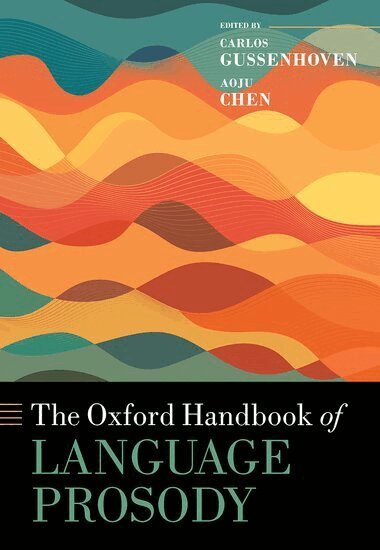
    The Oxford Handbook of Language Prosody

    AvCarlos Gussenhoven,Aoju Chen

    Inbunden, Engelska, 2020

    Del i serien Oxford Handbooks

    2 810 kr

    Beställningsvara. Skickas inom 5-8 vardagar. Fri frakt över 249 kr.

    Beskrivning

    This handbook presents detailed accounts of current research in all aspects of language prosody, written by leading experts from different disciplines. The last four decades have seen major theoretical and empirical breakthroughs in the field, many of them informed by interdisciplinary approaches, as reflected in this volume. Following an introductory section covering the fundamentals of language prosody research, Parts II and III trace out the position of prosody in linguistic structure and explore prosody in speech perception and production. Part IV provides overviews of prosodic systems across the world, with case studies from Africa, Asia, Europe, Australia and the Pacific, and the Americas. The chapters in Parts V, VI, and VII investigate prosody in communication, in language processing, and in language acquisition, while Part VIII examines prosody in technology and the arts. The volume's comprehensive coverage and multidisciplinary perspectives will make it an invaluable resource for all researchers, students, and practitioners interested in prosody.

    Produktinformation

    • Utgivningsdatum:2020-12-31
    • Mått:175 x 249 x 56 mm
    • Vikt:1 634 g
    • Format:Inbunden
    • Språk:Engelska
    • Serie:Oxford Handbooks
    • Antal sidor:960
    • Förlag:OUP OXFORD
    • ISBN:9780198832232

    Utforska kategorier

    • Systemvetenskap och AI inom Data och IT
    • Språkvetenskap och lingvistik inom Språk och ordböcker

    Mer om författaren

    Carlos Gussenhoven is Professor of General and Experimental Phonology at Radboud University, Nijmegen, where he held a personal chair from 1996 to 2011. He has held positions at UC Berkeley, Queen Mary University of London, and National Chiao Tung University, as well as well as guest professorships at the University of Konstanz and Nanjing University. His many publications include Understanding Phonology (4th ed, with Haike Jacobs; Routledge 2017) and The Phonology of Tone and Intonation (CUP, 2004).Aoju Chen is Professor of Language Development in Relation to Socialisation and Identity at Utrecht University. She has worked extensively on the production, perception, and processing of prosodic meaning and acquisition of prosody in a first and second language from a cross-linguistic perspective. More recently, she has extended her work to research on the social impact of developing language abilities in a first or second language. She is currently an associate editor of Laboratory Phonology and an elected board member of the ISCA Special Interest Group on Speech Prosody (SPoSIG).

    Recensioner i media

    An innovative and ground-breaking work ... this handbook is a monumental achievement which I imagine will be a well-thumbed resource for scholars and students interested in prosody and especially the prosody of lesser studies lanuages. The editors are to be highly congratulated for producing such a copious and informative work.

    Innehållsförteckning

    • 1: Carlos Gussenhoven and Aoju Chen: Introduction Part I: Fundamentals of Language Prosody 2: Taehong Cho and Doris Mücke: Articulatory measures of prosody 3: Oliver Niebuhr, Henning Reetz, Jonathan Barnes, and Alan C.L. Yu: Fundamental aspects in the perception of f0 Part II: Prosody and Linguistic Structure 4: Larry M. Hyman and William R. Leben: Tone systems 5: Matthew K. Gordon and Harry van der Hulst: Word-stress systems 6: Amalia Arvaniti and Janet Fletcher: The Autosegmental-Metrical theory of intonation phonology 7: John J. McCarthy: Prosodic morphology 8: Wendy Sandler, Diane Lillo-Martin, Svetlana Dachkovsky, and Ronice Müller de Quadros: Sign language prosody Part III: Prosody in Speech Production 9: Jonathan Barnes, Hansjörg Mixdorff, and Oliver Niebuhr: Phonetic variation in tone and intonation systems 10: Vincent J. van Heuven and Alice Turk: Phonetic correlates of word and sentence stress 11: Laurence White and Zofia Malisz: Speech rhythm and timing Part IV: Prosody across the World 12: Larry M. Hyman, Hannah Sande, Florian Lionnet, Nicholas Rolle, and Emily Clem: Sub-Saharan Africa 13: Sam Hellmuth and Mary Pearce: North Africa and the Middle East 14: Anastasia Karlsson, Güliz Güneş, Hamed Rahmani, and Sun-Ah Jun: South West and Central Asia 15: Maciej Karpiński, Bistra Andreeva, Eva Liina Asu, Anna Daugavet, Štefan Benuš, and Katalin Mády: Central and Eastern Europe 16: Mariapaola D'Imperio, Barbara Gili Fivela, Mary Baltazani, Brechtje Post, and Alexandra Vella: Southern Europe 17: Sónia Frota, Pilar Prieto, and Gorka Elordieta: Iberia 18: Tomas Riad and Jörg Peters: Northwestern Europe 19: Martine Grice, James Sneed German, and Paul Warren: Varieties of English 20: Kristján Árnason, Anja Arnhold, Ailbhe Ní Chasaide, Nicole Dehé, Amelie Dorn, and Osahito Miyaoka: The North Atlantic and the Arctic 21: Aditi Lahiri and Holly J. Kennard: The Indian Subcontinent 22: Jie Zhang, San Duanmu, and Yiya Chen: China and Siberia 23: Marc Brunelle, James Kirby, Alexis Michaud, and Justin Watkins: Mainland Southeast Asia 24: Sun-Ah Jun and Haruo Kubozono: Asian Pacific Rim 25: Nikolaus P. Himmelmann and Daniel Kaufman: Austronesia 26: Brett Baker, Janet Fletcher, and Mark Donohue: Australia and New Guinea 27: Gabriela Caballero and Matthew K. Gordon: North America 28: Christian DiCanio and Ryan Bennett: Mesoamerica 29: Thiago Costa Chacon and Fernando O. de Carvalho: South America Part V: Prosody in Communication 30: Matthijs Westera, Daniel Goodhue, and Carlos Gussenhoven: Meanings of tones and tunes 31: Frank Kügler and Sasha Calhoun: Prosodic encoding of information structure: A typological perspective 32: Julia Hirschberg, Štefan Benuš, Agustín Gravano, and Rivka Levitan: Prosody in discourse and speaker state 33: Marc Swerts and Emiel Krahmer: Visual prosody across cultures 34: Diana Van Lancker Sidtis and Seung-yun Yang: Pathological prosody: overview, assessment, and treatment Part VI: Prosody and Language Processing 35: Joseph C.Y. Lau, Zilong Xie, Bharath Chandrasekaran, and Patrick C.M. Wong: Cortical and subcortical processing of linguistic pitch patterns 36: James M. McQueen and Laura C. Dilley: Prosody and spoken-word recognition 37: Stefanie Shattuck-Hufnagel: The role of phrase-level prosody in speech production planning Part VII: Prosody and Language Acquisition 38: Paula Fikkert, Liquan Liu, and Mitsuhiko Ota: The acquisition of word prosody 39: Aoju Chen, Núria Esteve-Gibert, Pilar Prieto, and Melissa A. Redford: Development in phrase-level prosody from infancy to late childhood 40: Judit Gervain, Anne Christophe, and Reiko Mazuka: Prosodic bootstrapping 41: Melanie Soderstrom and Heather Bortfeld: Prosody in infant- and child-directed speech 42: Rhea Paul, Elizabeth Schoen Simmons, and James Mahshie: Prosody in children with atypical development 43: Allard Jongman and Annie Tremblay: Word prosody in L2 44: Jürgen Trouvain and Bettina Braun: Sentence prosody in a second language 45: Dorothy M. Chun and John M. Levis: Prosody in L2 teaching: methodologies and effectiveness Part VIII Prosody in Technology and the Arts 46: Anton Batliner and Bernd Möbius: Prosody in automatic speech processing 47: Andrew Rosenberg and Mark Hasegawa-Johnson: Automatic prosody labeling and assessment 48: Paul Kiparsky: Stress, meter, and text-setting 49: D. Robert Ladd and James Kirby: Tone-melody matching in tone language singing References Index of languages Index of subjects