• Fri frakt över 249 kr
  • •
  • Snabba leveranser
  • •
  • Billiga böcker
Kundservice

Du är på sajten för privatpersoner.

Företag, bibliotek eller offentlig verksamhet?

Du handlar på classic.bokus.com, där alla dina funktioner finns intakta.
Till classic.bokus.com
Bokus logotyp. Gå till startsidan.
  • Erbjudanden
  • Nyheter
  • Student
  • Topplistor
  • Barn & ungdom
  • Bokus Play
  • E-böcker
  • Pocketböcker
  • Spel & pussel

10% rabatt på allt med kod: NYSTART10 →

Sidfot

Mina sidor

    Hjälp

    • Kundservice
    • Vanliga frågor och svar
    • Frakt och leverans
    • Retur vid ångerrätt
    • Reklamera vara
    • Betalning
    • Köpvillkor
    • Allmänna villkor
    • Information om webbplatsens tillgänglighet

    Om Bokus

    • Om oss
    • Pressrum
    • För studenter
    • För företag
    • För bibliotek och offentlig verksamhet
    • För leverantörer
    • Hållbarhet

    Populärt

    • Aktuella erbjudanden
    • Presentkort
    • Studentlitteratur
    • Nya böcker
    • Topplistor
    • Signerade böcker
    • Engelska böcker

    Inspiration

    • Boktips
    • BookTok
    • Populära bokserier
    • Barnbokskaraktärer
    • Populära författare
    Logotyp för Bokus
    Följ oss på Facebook (extern länk)Följ oss på Instagram (extern länk)Följ oss på YouTube (extern länk)Följ oss på TikTok (extern länk)
    bokus @ CookiesAnpassa cookiesIntegritetspolicyKöpvillkor
    Till Citymail hemsida (extern länk)Till Budbee hemsida (extern länk)Till Postnord hemsida (extern länk)Till Schenker hemsida (extern länk)Till Early Bird hemsida (extern länk)Till Walleys hemsida (extern länk)
    1. Djur och Natur
    2. Djurböcker
    3. Vilda djur
    4. Fjärilar, insekter, spindlar

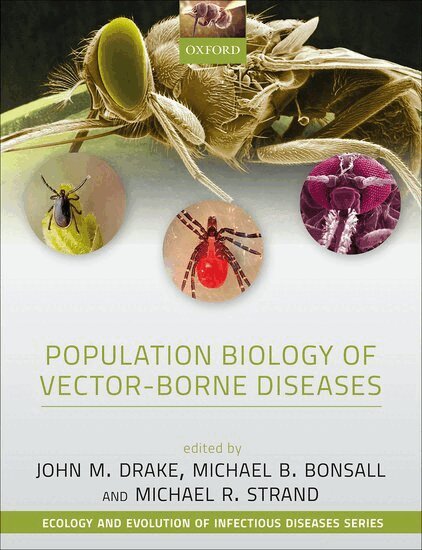
    Population Biology of Vector-Borne Diseases

    AvJohn M. Drake,Michael Bonsall

    Inbunden, Engelska, 2020

    Del i serien Ecology and Evolution of Infectious Diseases

    1 795 kr

    Beställningsvara. Skickas inom 7-10 vardagar. Fri frakt över 249 kr.

    Beskrivning

    Population Biology of Vector-Borne Diseases is the first comprehensive survey of this rapidly developing field. The chapter topics provide an up-to-date presentation of classical concepts, reviews of emerging trends, synthesis of existing knowledge, and a prospective agenda for future research. The contributions offer authoritative and international perspectives from leading thinkers in the field. The dynamics of vector-borne diseases are far more intrinsically ecological compared with their directly transmitted equivalents. The environmental dependence of ectotherm vectors means that vector-borne pathogens are acutely sensitive to changing environmental conditions. Although perennially important vector-borne diseases such as malaria and dengue have deeply informed our understanding of vector-borne diseases, recent emerging viruses such as West Nile virus, Chikungunya virus, and Zika virus have generated new scientific questions and practical problems. The study of vector-borne disease has been a particularly rich source of ecological questions, while ecological theory has provided the conceptual tools for thinking about their evolution, transmission, and spatial extent. Population Biology of Vector-Borne Diseases is an advanced textbook suitable for graduate level students taking courses in vector biology, population ecology, evolutionary ecology, disease ecology, medical entomology, viral ecology/evolution, and parasitology, as well as providing a key reference for researchers across these fields.

    Produktinformation

    • Utgivningsdatum:2020-12-31
    • Mått:195 x 253 x 19 mm
    • Vikt:820 g
    • Format:Inbunden
    • Språk:Engelska
    • Serie:Ecology and Evolution of Infectious Diseases
    • Antal sidor:304
    • Förlag:OUP OXFORD
    • ISBN:9780198853244

    Utforska kategorier

    • Fjärilar, insekter, spindlar inom Djur och Natur
    • Insekter inom Naturvetenskap och teknik
    • Biologi inom Naturvetenskap och teknik

    Mer om författaren

    John M. Drake is Associate Dean of Academic Affairs, Distinguished Research Professor of Ecology, and founding Director of the Center for the Ecology of Infectious Diseases at the University of Georgia, USA.Michael Bonsall is Professor of Mathematical Biology at the Department of Zoology, University of Oxford, UK. He heads the Mathematical Ecology Research Group at the department, which undertakes cross-disciplinary research using mathematical approaches to explore novel and rewarding problems in ecology, evolution, health and economics.Michael Strand is Professor at the Department of Entomology, University of Georgia USA. His research laboratory in the department investigates many areas under the broad umbrella of Insect Physiology.

    Recensioner i media

    The authors, specialists in their field, created a perfect balance between basic concepts and higher level eco-epidemiological connections. Thus, the book will be understood not only by researchers working with VBDs, but also by graduate students or public health specialists.

    Innehållsförteckning

    • 1: John M. Drake, Michael Bonsall and Michael Strand: Introduction: current topics in the population biology of infectious diseases Section I: Theory of Population Biology 2: Robert C. Reiner Jr. and David L Smith: Heterogeneity, stochasticity and complexity in the dynamics and control of mosquito-borne pathogens 3: T. Alex Perkins, Guido España, Sean M. Moore, Rachel J. Oidtman, Swarnali Sharma, Brajendra Singh, Amir S. Siraj, K. James Soda, Morgan Smith, Magdalene K. Walters and Edwin Michael: Seven challenges for spatial analyses of vector-borne diseases 4: Stephen A Lauer, Alexandria C Brown and Nicholas G Reich: Infectious disease forecasting for public health 5: John M. Drake, Krisztian Magori, Kevin Knoblich, Sarah E. Bowden and Waheed I. Bajwa: Force of infection and variation in outbreak size in a multi-species host-pathogen system: West Nile Virus in New York City Section II: Empirical Ecology 6: Marta S. Shocket, Christopher B. Anderson, Jamie M. Caldwell, Marissa L. Childs, Lisa I. Couper, Songhee Han, Mallory J. Harris, Meghan E. Howard, Morgan P. Kain, Andrew J. MacDonald, Nicole Nova, and Erin A. Mordecai: Environmental drivers of vector-borne diseases 7: Simon Gubbins: Population biology of Culicoides-borne viruses of livestock in Europe 8: Maria A. Diuk-Wasser, Maria Pilar Fernandez and Stephen Davis: Ecological interactions influencing the emergence, abundance and human exposure to tick-borne pathogens 9: Michelle V. Evans, Philip M. Newberry and Courtney C Murdock: Carry-over effects of the larval environment in mosquito-borne disease systems 10: Sinead English, Antoine M. G. Barreaux, Michael B. Bonsall, John W. Hargrove, Matt J. Keeling, Kat S. Rock and Glyn A. Vale: Incorporating vector ecology and life history into disease transmission models: insights from tsetse (Glossina spp.) Section III: Ecological Interactions 11: Christine M Reitmayer, Michelle V. Evans, Kerri L. Miazgowicz, Philip M. Newberry, Nicole Solano, Blanka Tesla and Courtney C. Murdock: Mosquito- virus interactions 12: Michael Z. Levy: Kindling, logs and coals: the dynamics of Trypanosoma cruzi, the etiological agent of Chagas Disease, in Arequipa, Peru 13: Kerri L. Coon and Michael R. Strand: Gut microbiome assembly and function in mosquitoes Section IV: Applications 14: Sadie J. Ryan, Catherine A. Lippi, Kevin L. Bardosh, Erika F. Frydenlund, Holly D. Gaff, Naveed Heydari, Anthony J. Wilson and Anna M. Stewart-Ibarra: Direct and indirect social drivers and impacts of vector borne diseases 15: Michael Bonsall: Vector control, optimal control and vector-borne disease dynamics