• Fri frakt över 249 kr
  • •
  • Snabba leveranser
  • •
  • Billiga böcker
Kundservice

Du är på sajten för privatpersoner.

Företag, bibliotek eller offentlig verksamhet?

Du handlar på classic.bokus.com, där alla dina funktioner finns intakta.
Till classic.bokus.com
Bokus logotyp. Gå till startsidan.
  • Erbjudanden
  • Nyheter
  • Student
  • Topplistor
  • Barn & ungdom
  • Bokus Play
  • E-böcker
  • Pocketböcker
  • Spel & pussel

10% studentrabatt med kod TERM26

Sidfot

Mina sidor

    Hjälp

    • Kundservice
    • Vanliga frågor och svar
    • Frakt och leverans
    • Retur vid ångerrätt
    • Reklamera vara
    • Betalning
    • Köpvillkor
    • Allmänna villkor
    • Information om webbplatsens tillgänglighet

    Om Bokus

    • Om oss
    • Pressrum
    • För studenter
    • För företag
    • För bibliotek och offentlig verksamhet
    • För leverantörer
    • Hållbarhet

    Populärt

    • Aktuella erbjudanden
    • Presentkort
    • Studentlitteratur
    • Nya böcker
    • Topplistor
    • Signerade böcker
    • Engelska böcker

    Inspiration

    • Boktips
    • BookTok
    • Populära bokserier
    • Barnbokskaraktärer
    • Populära författare
    Logotyp för Bokus
    Följ oss på Facebook (extern länk)Följ oss på Instagram (extern länk)Följ oss på YouTube (extern länk)Följ oss på TikTok (extern länk)
    bokus @ CookiesAnpassa cookiesIntegritetspolicyKöpvillkor
    Till Citymail hemsida (extern länk)Till Budbee hemsida (extern länk)Till Postnord hemsida (extern länk)Till Schenker hemsida (extern länk)Till Early Bird hemsida (extern länk)Till Walleys hemsida (extern länk)
    1. Historia och arkeologi
    2. Historia
    3. Forntidens historia

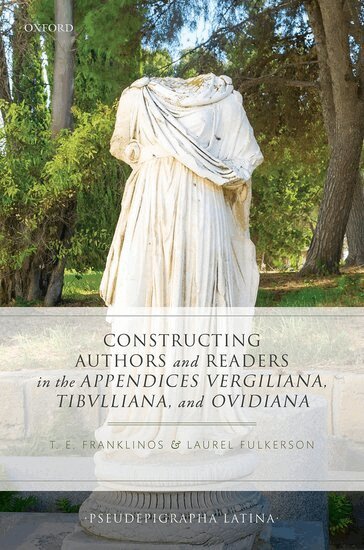
    Constructing Authors and Readers in the Appendices Vergiliana, Tibulliana, and Ouidiana

    AvTristan E. Franklinos,Tristan E. Franklinos

    Inbunden, Engelska, 2020

    Del i serien Pseudepigrapha Latina

    2 340 kr

    Beställningsvara. Skickas inom 3-6 vardagar. Fri frakt över 249 kr.

    Beskrivning

    The Augustan period in Rome was a golden age for poetry, and also the age in which the cult of the author began in the west. By examining some early poetic understandings of what it might have meant to be Vergil, Ovid, and Tibullus, Constructing Authors and Readers in the Appendices Vergiliana, Tibulliana, and Ouidiana explores what those authors meant to near-contemporaries, and what the construction of authorship they were a part of meant to the later western tradition. Constructing Authors and Readers in the Appendices Vergiliana, Tibulliana, and Ouidiana takes its starting point from the Appendices attached to three major Augustan poets, exploring how their different conditions of production, and the differences between their authorising authors, result in different notions of what an appendical text 'ought' to contain. So, for instance, Vergil's biography leaves ample room for 'juvenilia', while Ovid's does not; the Tibullan appendix explicitly engages with a wider poetic community. Moving beyond questions of forgery and deception, some chapters ask how we would be able to know the difference between texts of genuine and of disputed authorship, given that most of the stylistic features that distinguish authors are replicable. Other chapters make the case for re-evaluation of poems that have been neglected or disparaged, and still others make sense of individual works in their likely context of composition. The volume is the first to treat in conjunction the majority of the appendical works ascribed to Vergil, Ovid, and Tibullus, and to draw connections across corpora.

    Produktinformation

    • Utgivningsdatum:2020-09-01
    • Mått:163 x 240 x 25 mm
    • Vikt:662 g
    • Format:Inbunden
    • Språk:Engelska
    • Serie:Pseudepigrapha Latina
    • Antal sidor:326
    • Förlag:OUP OXFORD
    • ISBN:9780198864417

    Utforska kategorier

    • Forntidens historia inom Historia och arkeologi
    • Litteraturvetenskap inom Skönlitteratur
    • Litteraturteori inom Skönlitteratur

    Mer om författaren

    Tristan Franklinos studied at the Universities of St Andrews and Oxford, and has taught at the latter since completing his doctorate. He is a British Academy Postdoctoral Fellow in Classics, and a Junior Research Fellow at Trinity College, Oxford.Laurel Fulkerson has written several books on Latin poetry and on the emotions in antiquity, including A Literary Commentary on the Elegies of the Appendix Tibulliana; No Regrets: Remorse in Classical Antiquity; and The Ovidian Heroine as Author: Reading, Writing, and Community in the Heroides. She currently serves as the Associate Vice President for Research at the Florida State University.

    Recensioner i media

    Certainly, this volume will contribute to broadening the canon of Latin writers and Roman poetry books. The scholarly community is grateful to the editors and the contributors for having drawn attention to these 'minor' texts and having provided such fine pieces of scholarship.

    Innehållsförteckning

    • Authoring, reading, and exploring anAppendix: some introductory thoughts, T. E. Franklinos and Laurel Fulkerson 1: Scylla's lament in the Ciris and the Latin literary tradition, Antony Augoustakis 2: The mythical antecedents of the Ciris, Laurel Fulkerson 3: Author and audience in Catalepton, Joseph Farrell 4: Construing the author as a Catullan reader in the pure iambicCatalepton(6, 10, 12), T. E. Franklinos 5: Catalepton 9 and Valgius Rufus, Boris Kayachev 6: Echoing Virgil and Narcissus: structure and interpretation of the Culex, Andrew Laird 7: Volcanic wonder: a starry-eyed view of the Aetna, Gareth Williams 8: Teaching the death of elegy: the Lygdamus elegies ([Tib.] 3.1-6), Giuseppe La Bua 9: Tibullan impersonation and Callimachean influence in the Messalla panegyric ([Tib.] 3.7), Robert Maltby 10: The authorship of Tibullus 3.9: methods and criteria, Jacqueline Fabre-Serris 11: The authorship of Sulpicia, Ian Fielding 12: The Halieutica ascribed to Ovid: issues of authenticity, reception and supplementation, Stephen J. Harrison 13: Plumbing the Ovidian Halieutica, Katharina Volk 14: The Consolatio ad Liuiam and literary history, S. J. Heyworth 15: The Lovers and the Rebel: reading the double Heroides as an exilic text, Kre%simir Vukovi'c 16: The Nux attributed to Ovid and its Renaissance readers: the case of Erasmus, Matthew McGowan