Tristan E. Franklinos - Böcker
Visar alla böcker från författaren Tristan E. Franklinos. Handla med fri frakt och snabb leverans.
2 produkter
2 produkter
Constructing Authors and Readers in the Appendices Vergiliana, Tibulliana, and Ouidiana
Inbunden, Engelska, 2020
2 249 kr
Skickas inom 3-6 vardagar
The Augustan period in Rome was a golden age for poetry, and also the age in which the cult of the author began in the west. By examining some early poetic understandings of what it might have meant to be Vergil, Ovid, and Tibullus, Constructing Authors and Readers in the Appendices Vergiliana, Tibulliana, and Ouidiana explores what those authors meant to near-contemporaries, and what the construction of authorship they were a part of meant to the later western tradition. Constructing Authors and Readers in the Appendices Vergiliana, Tibulliana, and Ouidiana takes its starting point from the Appendices attached to three major Augustan poets, exploring how their different conditions of production, and the differences between their authorising authors, result in different notions of what an appendical text 'ought' to contain. So, for instance, Vergil's biography leaves ample room for 'juvenilia', while Ovid's does not; the Tibullan appendix explicitly engages with a wider poetic community. Moving beyond questions of forgery and deception, some chapters ask how we would be able to know the difference between texts of genuine and of disputed authorship, given that most of the stylistic features that distinguish authors are replicable. Other chapters make the case for re-evaluation of poems that have been neglected or disparaged, and still others make sense of individual works in their likely context of composition. The volume is the first to treat in conjunction the majority of the appendical works ascribed to Vergil, Ovid, and Tibullus, and to draw connections across corpora.
Del 21 - Studies in Medieval and Renaissance Music
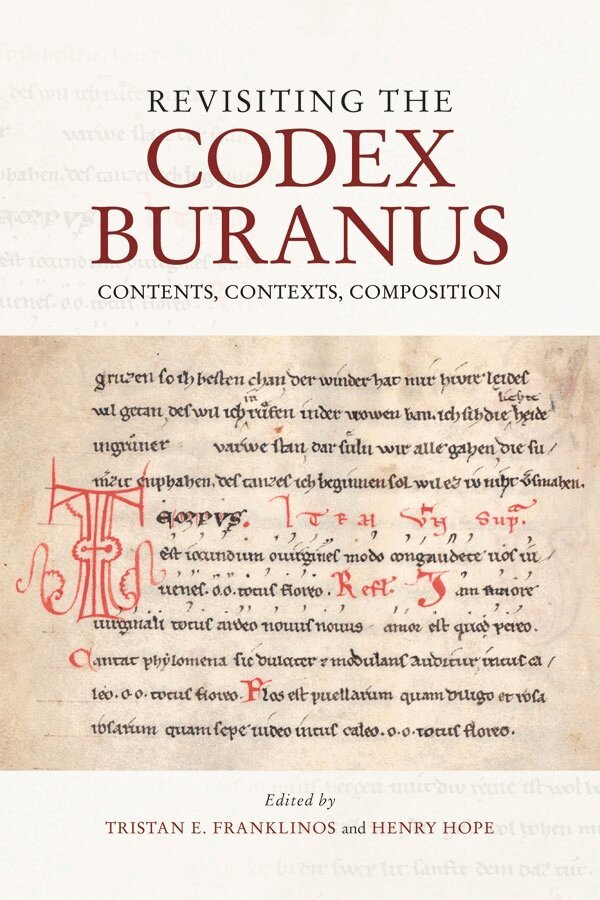
Revisiting the Codex Buranus
Contents, Contexts, Composition
Inbunden, Engelska, 2020
1 617 kr
Skickas inom 10-15 vardagar
The Codex Buranus, compiled, in all likelihood, in South Tyrol in the first half of the thirteenth century, has fascinated modern scholars and performers ever since its rediscovery in 1803. Its diverse range of texts (some famously featuring in Carl Orff's Carmina Burana) and music gives testimony to the intensely vibrant, plurilingual, and multicultural milieu in which the Codex Buranus was compiled, but poses a challenge to modern users. Perhaps more so than many other medieval manuscripts, it is an artefact which demands, and benefits from, an interdisciplinary approach.The chapters here, from scholars in a variety of fields, enable the less well-known aspects of the Codex Buranus; textual, musical, and artistic; to receive greater scrutiny, and bring new perspectives to bear on the more thoroughly explored parts of the manuscript. Making accessible existing discourse and encouraging fresh debates on the codex, the essays advocate fresh modes of engagement with its contents, contexts, and composition. They also examine questions of its reception history and audience.