• Fri frakt över 249 kr
  • •
  • Snabba leveranser
  • •
  • Billiga böcker
Kundservice

Du är på sajten för privatpersoner.

Företag, bibliotek eller offentlig verksamhet?

Du handlar på classic.bokus.com, där alla dina funktioner finns intakta.
Till classic.bokus.com
Bokus logotyp. Gå till startsidan.
  • Erbjudanden
  • Nyheter
  • Student
  • Topplistor
  • Barn & ungdom
  • Bokus Play
  • E-böcker
  • Pocketböcker
  • Spel & pussel

10% rabatt på allt med kod: NYSTART10 →

Sidfot

Mina sidor

    Hjälp

    • Kundservice
    • Vanliga frågor och svar
    • Frakt och leverans
    • Retur vid ångerrätt
    • Reklamera vara
    • Betalning
    • Köpvillkor
    • Allmänna villkor
    • Information om webbplatsens tillgänglighet

    Om Bokus

    • Om oss
    • Pressrum
    • För studenter
    • För företag
    • För bibliotek och offentlig verksamhet
    • För leverantörer
    • Hållbarhet

    Populärt

    • Aktuella erbjudanden
    • Presentkort
    • Studentlitteratur
    • Nya böcker
    • Topplistor
    • Signerade böcker
    • Engelska böcker

    Inspiration

    • Boktips
    • BookTok
    • Populära bokserier
    • Barnbokskaraktärer
    • Populära författare
    Logotyp för Bokus
    Följ oss på Facebook (extern länk)Följ oss på Instagram (extern länk)Följ oss på YouTube (extern länk)Följ oss på TikTok (extern länk)
    bokus @ CookiesAnpassa cookiesIntegritetspolicyKöpvillkor
    Till Citymail hemsida (extern länk)Till Budbee hemsida (extern länk)Till Postnord hemsida (extern länk)Till Schenker hemsida (extern länk)Till Early Bird hemsida (extern länk)Till Walleys hemsida (extern länk)
    1. Data och IT
    2. Systemvetenskap och AI
    3. Artificiell intelligens

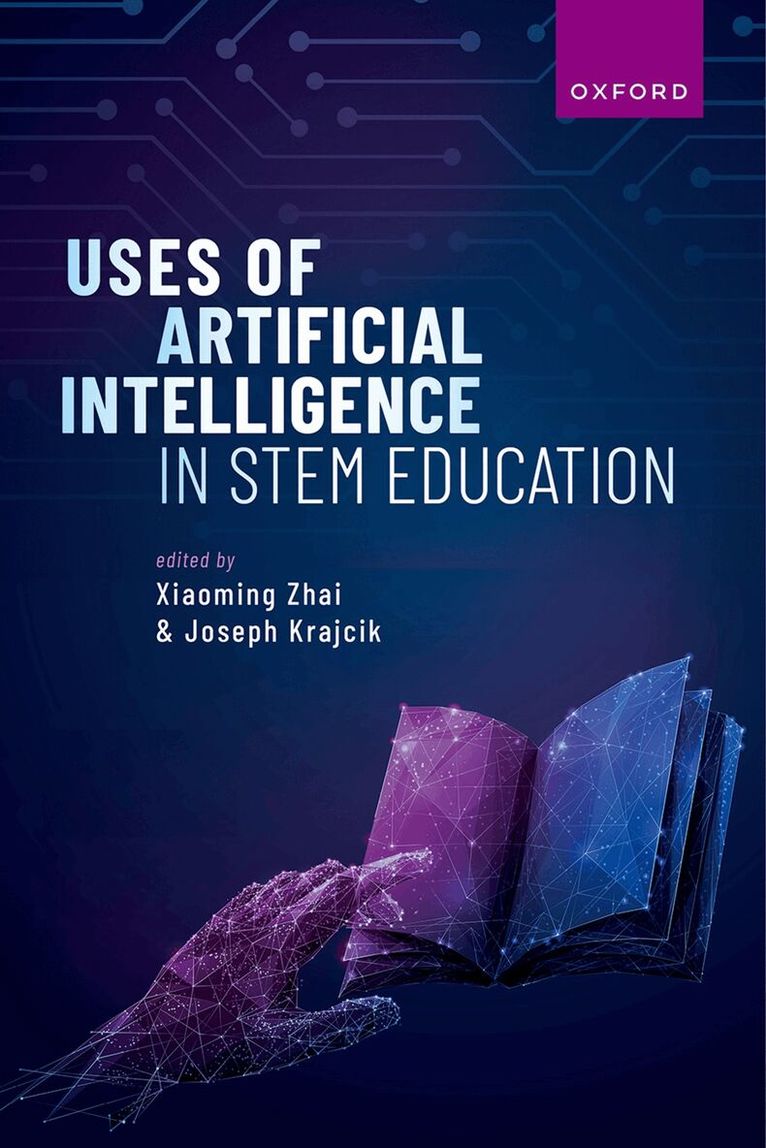
    Uses of Artificial Intelligence in STEM Education

    AvXiaoming Zhai,Joseph Krajcik

    Inbunden, Engelska, 2024

    1 684 kr

    Beställningsvara. Skickas inom 5-8 vardagar. Fri frakt över 249 kr.

    Beskrivning

    In the age of rapid technological advancements, the integration of Artificial Intelligence (AI), machine learning (ML), and large language models (LLMs) in Science, Technology, Engineering, and Mathematics (STEM) education has emerged as a transformative force, reshaping pedagogical approaches and assessment methodologies. Uses of AI in STEM Education, comprising 25 chapters, delves deep into the multifaceted realm of AI-driven STEM education. It begins by exploring the challenges and opportunities of AI-based STEM education, emphasizing the intricate balance between human tasks and technological tools. As the chapters unfold, readers learn about innovative AI applications, from automated scoring systems in biology, chemistry, physics, mathematics, and engineering to intelligent tutors and adaptive learning. The book also touches upon the nuances of AI in supporting diverse learners, including students with learning disabilities, and the ethical considerations surrounding AI's growing influence in educational settings. It showcases the transformative potential of AI in reshaping STEM education, emphasizing the need for adaptive pedagogical strategies that cater to diverse learning needs in an AI-centric world. The chapters further delve into the practical applications of AI, from scoring teacher observations and analyzing classroom videos using neural networks to the broader implications of AI for STEM assessment practices. Concluding with reflections on the new paradigm of AI-based STEM education, this book serves as a comprehensive guide for educators, researchers, and policymakers, offering insights into the future of STEM education in an AI-driven world.

    Produktinformation

    • Utgivningsdatum:2024-10-24
    • Mått:160 x 240 x 30 mm
    • Vikt:1 140 g
    • Format:Inbunden
    • Språk:Engelska
    • Antal sidor:624
    • Förlag:OUP OXFORD
    • ISBN:9780198882077

    Utforska kategorier

    • Artificiell intelligens inom Data och IT
    • Utbildningsstrategier och utbildningspolitik inom Psykologi och pedagogik

    Mer om författaren

    Xiaoming Zhai is an Associate Professor in Science Education & Artificial Intelligence, serving as Director of the AI4STEM Education Center at the University of Georgia. He is interested in applying cutting-edge technologies such as AI to advance science teaching and learning, particularly assessment practices. He is lead investigator on federal-funded projects and his research has been published in top-tier journals. He has collaborated widely with researchers from the USA, Canada, Germany, Norway, China, Ghana, and India, and serves as a global leader in his area of research. Dr. Zhai chaired the NSF-funded 2022 International Conference for AI-based Assessment in STEM and serves as Founding Chair of the National Association of Research in Science Teaching's RAISE (Research in AI-involved Science Education) group.Joseph Krajcik currently serves as Director of the CREATE for STEM Institute at Michigan State University. CREATE for STEM (Collaborative Research for Education, Assessment and Teaching Environments for Science, Technology, Engineering, and Mathematics) is a joint institute between the Colleges of Natural Science and Education that seeks to improve the teaching and learning of science and mathematics from kindergarten to college through innovation and research. During his career, Professor Krajcik has focused on working with science teachers to reform science teaching practices to promote students' engagement in and learning of science through the design, development, and testing of project-based science learning environments.

    Recensioner i media

    Accelerating AI capabilities is introducing both the opportunity and the requirement to reimagine education. Artfully blending discussions of technology and education, Uses of Artificial Intelligence in STEM Education is a seminal collection exploring the profound impact that AI will have on learning, instruction, and assessment. With themes of ethics, fairness, and inclusiveness woven throughout the book, this is a must-read for anyone wanting to understand how AI will fundamentally reshape the educational landscape

    Innehållsförteckning

    • Preface 1: Xiaoming Zhai and Joseph Krajcik: Introduction: AI-based STEM Education: Challenges and Opportunities AI in STEM Assessment 2: James W. Pellegrino: A New Era for STEM Assessment: Considerations of Assessment, Technology, and Artificial Intelligence 3: Ross H. Nehm: AI in Biology Education Assessment: How Automation Can Drive Educational Transformation 4: Marcia C. Linn and Libby Gerard: Assessing and Guiding Student Science Learning with Pedagogically Informed Natural Language Processing 5: Changzhao Wang, Xiaoming Zhai, and Ji Shen: Applying Machine Learning to Assess Paper-Pencil Drawn Models of Optics 6: Mei-Hung Chiu and Mao-Ren Zeng: Automated Scoring in Chinese Language for Science Assessments 7: Megan Shiroda, Jennifer Doherty, and Kevin C. Haudek: Exploring Attributes of Successful Machine Learning Assessments for Scoring of Undergraduate Constructed Response Assessment Items 8: Lei Liu, Dante Cisterna, Devon Kinsey, Yi Qi, Kenneth Steimel: AI-based Diagnosis of Student Reasoning Patterns in NGSS Assessments AI Tools for Transforming STEM Learning 9: Anna Herdliska and Xiaoming Zhai: Artificial Intelligence-Based Scientific Inquiry 10: Hee-Sun Lee, Gey-Hong Gweon, and Amy Pallant: Supporting Simulation-mediated Scientific Inquiry through Automated Feedback 11: Marcus Kubsch, Adrian Grimm, Knut Neumann, Hendrik Drachsler, Nikol Rummel: Using Evidence Centered Design to Develop an Automated System for Tracking Students> ' Physics Learning in a Digital Learning Environment 12: Janice D. Gobert, Haiying Li, Rachel Dickler, Christine Lott: Can AI-Based Scaffolding Support Students' Robust Learning of Authentic Science Practices? 13: Ehsan Latif, Xiaoming Zhai, Holly Amerman, Xinyu He: AI-SCORER: An Artificial Intelligence-Augmented Scoring and Instruction System 14: Lei Wang, Cong Wang, Quan Wang, Jiutong Luo, Xijuan Li: Smart Learning PartnerDLDLChinese Core Competency-oriented Adaptive Learning System AI-based STEM Instruction and Teacher Professional Development 15: Lehong Shi, Ikseon Choi: A Systematic Review on Artificial Intelligence in Supporting Teaching Practice: Application Types, Pedagogical Roles, and Technological Characteristics 16: Peng He, Namsoo Shin, Xiaoming Zhai, Joseph Krajcik: A Design Framework for Integrating Artificial Intelligence to Support Teachers' Timely Use of Knowledge-in-Use Assessments 17: 1. Abhijit Suresh, William R. Penuel, Jennifer K. Jacobs, Ali Raza, James H. Martin, Tamara Sumner: Using AI Tools to Provide Teachers with Fully Automated, Personalized Feedback on Their Classroom Discourse Patterns 18: Lydia Bradford: Use of Machine Learning to Score Teacher Observations 19: David Buschhüter, Marisa Pfläging, Andreas Borowski: Widening the Focus of Science Assessment via Structural Topic Modeling: An Example of Nature of Science Assessment 20: Jonathan K. Foster, Matthew Korban, Peter Youngs, Ginger S. Watson, Scott T. Acton: 1. Classification of Instructional Activities in Classroom Videos Using Neural Networks Ethics, Fairness, and Inclusiveness of AI-based STEM Education 21: Sahrish Panjwani-Charania, Xiaoming Zhai: AI for Students with Learning Disabilities: A Systematic Review 22: Selin Akgun, Joseph Krajcik: 1. Artificial Intelligence (AI) as the Growing Actor in Education: Raising Critical Consciousness Towards Power and Ethics of AI in K-12 STEM Classrooms 23: Wanli Xing, Chenglu Li: Fair Artificial Intelligence to Support STEM Education: A Hitchhiker's Guide 24: Marvin Roski, Anett Hoppe, Andreas Nehring: Supporting Inclusive Science Learning through Machine Learning: The AIISE Framework 25: Xiaoming Zhai & Joseph Krajcik: Pseudo Artificial Intelligence Bias Conclusion 26: Xiaoming Zhai: Conclusions and Foresight on AI-based STEM Education: A New Paradigm