• Fri frakt över 249 kr
  • •
  • Snabba leveranser
  • •
  • Billiga böcker
Kundservice

Du är på sajten för privatpersoner.

Företag, bibliotek eller offentlig verksamhet?

Du handlar på classic.bokus.com, där alla dina funktioner finns intakta.
Till classic.bokus.com
Bokus logotyp. Gå till startsidan.
  • Erbjudanden
  • Nyheter
  • Student
  • Topplistor
  • Barn & ungdom
  • Bokus Play
  • E-böcker
  • Pocketböcker
  • Spel & pussel

10% studentrabatt med kod TERM26

Sidfot

Mina sidor

    Hjälp

    • Kundservice
    • Vanliga frågor och svar
    • Frakt och leverans
    • Retur vid ångerrätt
    • Reklamera vara
    • Betalning
    • Köpvillkor
    • Allmänna villkor
    • Information om webbplatsens tillgänglighet

    Om Bokus

    • Om oss
    • Pressrum
    • För studenter
    • För företag
    • För bibliotek och offentlig verksamhet
    • För leverantörer
    • Hållbarhet

    Populärt

    • Aktuella erbjudanden
    • Presentkort
    • Studentlitteratur
    • Nya böcker
    • Topplistor
    • Signerade böcker
    • Engelska böcker

    Inspiration

    • Boktips
    • BookTok
    • Populära bokserier
    • Barnbokskaraktärer
    • Populära författare
    Logotyp för Bokus
    Följ oss på Facebook (extern länk)Följ oss på Instagram (extern länk)Följ oss på YouTube (extern länk)Följ oss på TikTok (extern länk)
    bokus @ CookiesAnpassa cookiesIntegritetspolicyKöpvillkor
    Till Citymail hemsida (extern länk)Till Budbee hemsida (extern länk)Till Postnord hemsida (extern länk)Till Schenker hemsida (extern länk)Till Early Bird hemsida (extern länk)Till Walleys hemsida (extern länk)
    1. Ekonomi och Ledarskap
    2. Nationalekonomi
    3. Internationell ekonomi

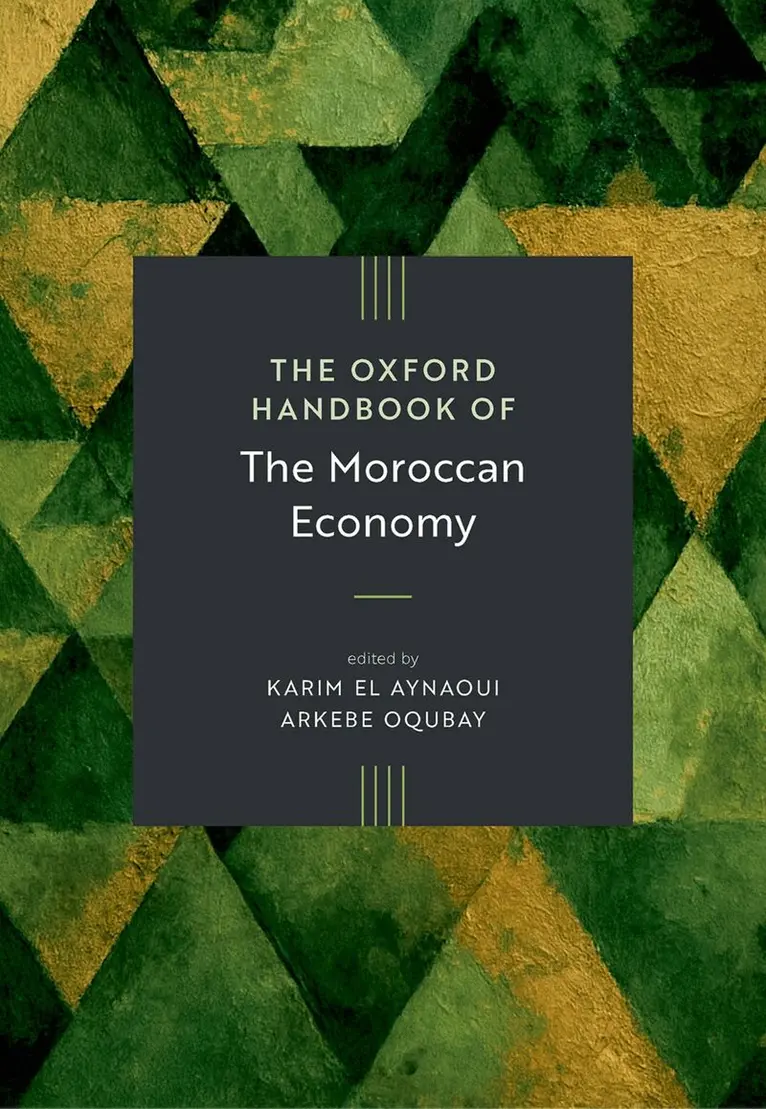
    The Oxford Handbook of the Moroccan Economy

    AvKarim El Aynaoui,Arkebe Oqubay

    Inbunden, Engelska, 2026

    Del i serien Oxford Handbooks

    2 445 kr

    Beställningsvara. Skickas inom 5-8 vardagar. Fri frakt över 249 kr.

    Beskrivning

    This is an open access title. It is available to read and download as a free PDF version on Oxford Academic and is made available under a Creative Commons Attribution-Non Commercial-No Derivatives 4.0 International licence.The Oxford Handbook of the Moroccan Economy provides the most authoritative and comprehensive analysis of the country's economy to date. Authored by over 50 leading academic scholars and policy practitioners, this volume is comprised of 35 chapters with rigorous empirical evidence and insights bolstered by long-term engagement in the nation. The Handbook offers a vital overview of Morocco's economic development and the policy options available for the future.The Handbook explores Morocco's progress towards economic diversification, structural transformation, and the development of industrial and economic policies. It covers original reviews of sectors including automotive, aeronautics, handicrafts, tourism, and logistics. Furthermore, it emphasises addressing key issues such as the middle-income trap and promoting economic transformation, offering valuable lessons for low- and middle-income countries across Africa and beyond.Morocco is often recognised as one of Africa's economic bright spots. This volume analyses its economic growth from 2000 to 2025, set against the wider historical context of post-independence development, political changes, and cultural heritage. The Handbook encompasses a diverse range of systematic analytical perspectives, making it an indispensable resource for anyone interested in the Moroccan economy.

    Produktinformation

    • Utgivningsdatum:2026-04-21
    • Mått:180 x 250 x 50 mm
    • Vikt:1 492 g
    • Format:Inbunden
    • Språk:Engelska
    • Serie:Oxford Handbooks
    • Antal sidor:784
    • Förlag:OUP OXFORD
    • ISBN:9780198953708

    Utforska kategorier

    • Internationell ekonomi inom Ekonomi och Ledarskap
    • Ekonomisk politik inom Ekonomi och Ledarskap

    Mer om författaren

    Karim El Aynaoui is Executive President of the Policy Center for the New South. He is also Executive Vice-President of Mohammed VI Polytechnic University and Dean of its Humanities, Economics, and Social Sciences Cluster. He worked in senior roles at the Central Bank of Morocco and the World Bank. He is a member of the Malabo Montpellier Panel, the Scientific Council of the Moroccan Capital Market Authority, the International Board of Leonardo Med-Or Foundation, the Advisory Council of the School of Global Affairs and Public Policy of the American University of Cairo, Morocco's Chapter of the Confrérie des Compagnons de Gutenberg, and a global member of the Trilateral Commission. He is advisor to the CEO and Chairman of OCP Group, a board member of OCP Foundation, and Commendatore of the Order of Merit of the Italian Republic.Arkebe Oqubay is a British Academy Global Professor at SOAS University of London. He was a Senior Minister, and a Special Advisor to three Prime Ministers of Ethiopia. He is the former Mayor of Addis Ababa and led the boards of key public enterprises, including Ethiopian Airlines. He gives policy advice to, and consults for, African governments and international organisations. The NewAfrican recognised Arkebe as one of the 100 Most Influential Africans of 2016. His books with Oxford include Made in Africa, How Nations Learn (with Ohno), China-Africa and an Economic Transformation (with Lin), five Oxford Handbooks in economics, and more. He is Professor of Practice at the University of Johannesburg, Honorary Professor at the University of Cape Town, and Distinguished Professor at Fudan University and Nanyang Technological University. He is an ODI Distinguished Fellow and a UNU-WIDER Honorary Research Fellow.

    Innehållsförteckning

    • Part I. Context and history 1: Karim El Aynaoui and Arkebe Oqubay: Introduction 2: Fathallah Oualalou: Economic history of Morocco 3: I. William Zartman: Political economy in Morocco Part II. Macroeconomy and financing 4: Faiçal Hossaini and Oumayma Bourhriba: Monetary policy and the Moroccan economy 5: Idriss El Abbassi, Said Tounsi, and Aziz Ragbi: Fiscal policy in Morocco 6: Badr Mandri: The external sector of the Moroccan economy 7: Mohammed Benmoussa: The financial and banking industry in Morocco 8: Kenza Benhima, Linah Shimi, and Yassine Slaoui: Firms' access to finance in Morocco Part III. Economic development 9: Mounia Boucetta: Morocco's economic diplomacy and development 10: Aziz Ajbilou: The demographic transition and the Moroccan economy 11: Abdelaaziz Ait Ali and Youssef El Jai: Development of private sector in Morocco 12: Mina Baliamoune-Lutz: International trade and the competitiveness of the Moroccan export sector 13: Eduardo A. Haddad and Mahmoud Arbouch: Regional economic development in Morocco 14: Khadija Karibi, Hassane Kharmich, and Khalid El Harrouni: Urban policy and transformation in Morocco 15: Karim El Aynaoui and Hinh T. Dinh: Growth and structural transformation in Morocco 16: Rim Berahab and Sabrine Emran: Climate change, environmental sustainability, and Moroccan green transition Part IV. Social development 17: Aomar Ibourk and Tayeb Ghazi: Morocco's education sector 18: Touhami Abdelkhalek and Dorothée Boccanfuso: Growth-poverty-monetary inequality nexus of Morocco 19: Aomar Ibourk, Karim El Aynaoui, and Tayeb Ghazi: Structure of the labour market and labour relations in Morocco 20: Hamza Saoudi and Adnane Lahzaoui: The informal sector in Morocco 21: Meriem Oudmane and Youssef Bouazizi: The health sector in Morocco 22: Nouzha Chekrouni: Gender dynamics and empowerment in Morocco 23: Ahmed Tritah: Moroccan migration dynamics Part V. Industrialization and services 24: Taoufik Abbad and Karim El Mokri: Composition and performance of the Moroccan manufacturing sector 25: Ilyes Boumahdi: Moroccan industrial policy 26: Henri-Louis Vedie: Phosphate and fertilizer industry in Morocco 27: Fahd Azaroual: Textile and apparel industry in Morocco 28: Mariem Liouaeddine, Zakaria Mansouri, and Mohammed Bijou: The handicraft sector in Morocco 29: Larabi Jaïdi: Moroccan automotive and aeronautics industries 30: Fatima Ezzahra Mengoub, Isabelle Tsakok, and Hassan Serghini: Transformation of agriculture in Morocco 31: Abdelkabir Kamili: The Moroccan fishing sector and sustainable development 32: Mahmoud Arbouch: Port services in Morocco 33: Mounssif Aderkaoui: The tourism industry in Morocco 34: Jaldi Abdessalam Saad and Bensaoud Raja: Development of the ICT sector and the digitization of Morocco