• Fri frakt över 249 kr
  • •
  • Snabba leveranser
  • •
  • Billiga böcker
Kundservice

Du är på sajten för privatpersoner.

Företag, bibliotek eller offentlig verksamhet?

Du handlar på classic.bokus.com, där alla dina funktioner finns intakta.
Till classic.bokus.com
Bokus logotyp. Gå till startsidan.
  • Erbjudanden
  • Nyheter
  • Student
  • Topplistor
  • Barn & ungdom
  • Bokus Play
  • E-böcker
  • Pocketböcker
  • Spel & pussel

10% rabatt på allt med kod NYSTART10 →

Sidfot

Mina sidor

    Hjälp

    • Kundservice
    • Vanliga frågor och svar
    • Frakt och leverans
    • Retur vid ångerrätt
    • Reklamera vara
    • Betalning
    • Köpvillkor
    • Allmänna villkor
    • Information om webbplatsens tillgänglighet

    Om Bokus

    • Om oss
    • Pressrum
    • För studenter
    • För företag
    • För bibliotek och offentlig verksamhet
    • För leverantörer
    • Hållbarhet

    Populärt

    • Aktuella erbjudanden
    • Presentkort
    • Studentlitteratur
    • Nya böcker
    • Topplistor
    • Signerade böcker
    • Engelska böcker

    Inspiration

    • Boktips
    • BookTok
    • Populära bokserier
    • Barnbokskaraktärer
    • Populära författare
    Logotyp för Bokus
    Följ oss på Facebook (extern länk)Följ oss på Instagram (extern länk)Följ oss på YouTube (extern länk)Följ oss på TikTok (extern länk)
    bokus @ CookiesAnpassa cookiesIntegritetspolicyKöpvillkor
    Till Citymail hemsida (extern länk)Till Budbee hemsida (extern länk)Till Postnord hemsida (extern länk)Till Schenker hemsida (extern länk)Till Early Bird hemsida (extern länk)Till Walleys hemsida (extern länk)
    1. Naturvetenskap och teknik
    2. Matematik och naturvetenskap
    3. Matematik
    4. Matematisk statistik

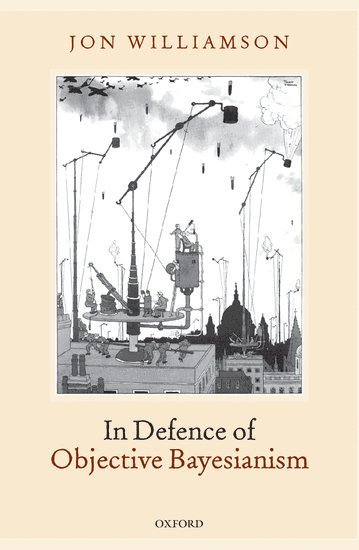
    In Defence of Objective Bayesianism

    AvJon Williamson

    Inbunden, Engelska, 2010

    1 895 kr

    Beställningsvara. Skickas inom 3-6 vardagar. Fri frakt över 249 kr.

    Fler format och utgåvor

    E-bok

    758 kr

    Beskrivning

    How strongly should you believe the various propositions that you can express?That is the key question facing Bayesian epistemology. Subjective Bayesians hold that it is largely (though not entirely) up to the agent as to which degrees of belief to adopt. Objective Bayesians, on the other hand, maintain that appropriate degrees of belief are largely (though not entirely) determined by the agent's evidence. This book states and defends a version of objective Bayesian epistemology. According to this version, objective Bayesianism is characterized by three norms: · Probability - degrees of belief should be probabilities· Calibration - they should be calibrated with evidence· Equivocation - they should otherwise equivocate between basic outcomesObjective Bayesianism has been challenged on a number of different fronts. For example, some claim it is poorly motivated, or fails to handle qualitative evidence, or yields counter-intuitive degrees of belief after updating, or suffers from a failure to learn from experience. It has also been accused of being computationally intractable, susceptible to paradox, language dependent, and of not being objective enough.Especially suitable for graduates or researchers in philosophy of science, foundations of statistics and artificial intelligence, the book argues that these criticisms can be met and that objective Bayesianism is a promising theory with an exciting agenda for further research.

    Produktinformation

    • Utgivningsdatum:2010-05-13
    • Mått:161 x 241 x 18 mm
    • Vikt:450 g
    • Format:Inbunden
    • Språk:Engelska
    • Antal sidor:192
    • Förlag:OUP OXFORD
    • ISBN:9780199228003

    Utforska kategorier

    • Matematisk statistik inom Naturvetenskap och teknik
    • Matematikens grunder inom Naturvetenskap och teknik
    • Artificiell intelligens inom Data och IT

    Mer om författaren

    Jon Williamson is Professor of Reasoning, Inference and Scientific Method in the philosophy department at the University of Kent. He works on causality, probability, logic and applications of formal reasoning within science, mathematics and artificial intelligence. Jon currently heads the philosophy department and is a director of the Centre for Reasoning at the University of Kent. He runs the Reasoning Club, a network of research centres, and edits The Reasoner, a monthly gazette on research in this area.

    Innehållsförteckning

    • Preface ; 1. Introduction ; 2. Objective Bayesianism ; 3. Motivation ; 4. Updating ; 5. Predicate Languages ; 6. Objective Bayesian Nets ; 7. Probabilistic Logic ; 8. Judgement Aggregation ; 9. Languages and Relativity ; 10. Objective Bayesianism in Perspective ; References ; Index