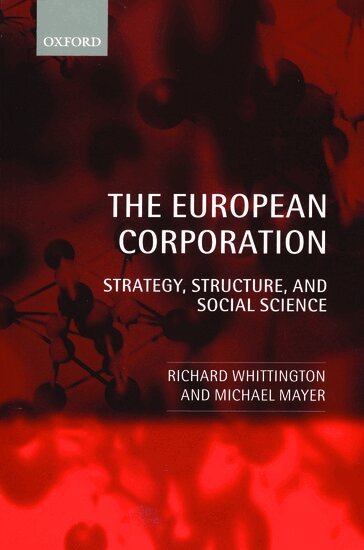
Häftad, Engelska, 2002
The European Corporation
Av Richard Whittington, Michael Mayer
940 kr
Beställningsvara. Skickas inom 5-8 vardagar. Fri frakt över 249 kr.
Beskrivning
This book traces the evolution of the large industrial corporation in France, Germany, and the United Kingdom from the 1950s to the 1990s. It combines long-run trends with illustrative case studies of leading companies and their managers to present a rich and complex picture of corporate change. In particular, the authors highlight the paradox of increasingly similar patterns of corporate strategy and structure across advanced industrial nations with continuing marked differences in corporate ownership, control, and managerial élites. Despite strong institutional contrasts between the leading European economies, and regardless of the decline of the American model of management, big business in Europe has continued to follow a strategic and structural model pioneered in the United States during the first half of the twentieth century and encapsulated long ago in Alfred Chandler's (1962) Strategy and Structure.This finding of similar patterns of corporate strategy and structure across Europe challenges recent relativist perspectives on organizations found in postmodern, culturalist, and institutionalist social science. Nevertheless, it does not endorse standard universalist accounts of convergence either. The book distinguishes between Chandlerism, with its original ideology of universalism, and the broader Chandlerian perspective, an enduring but evolving core of good sense about the corporation in certain kinds of advanced economies. Thus the authors show how the surprising success of conglomerate diversification and the increasing adoption of more 'networked' multidivisional structure simply extend the core principles of the Chandlerian perspective. They argue that the extent to which Chandlerian principles have held good across the advanced economies of Western Europe through the whole post-war period makes them a model for the kind of adaptive and bounded social scientific prescription appropriate to a changing and varied world. The book contributes to contemporary academic debates on relativism and universalism by proposing a middle-way based on a boundedly-generalizing social science. For policy-makers, it suggests the possibility of steady economic convergence independent of radical and external pressure and sensitive to other aspects of national social structures. For business decision-makers, it offers a more positive model of diversification, especially conglomerate diversification, as well as a new networked organization appropriate to the demands of today's knowledge economy.
Produktinformation
- Utgivningsdatum: 2002-05-09
- Mått: 156 x 233 x 15 mm
- Vikt: 415 g
- Format: Häftad
- Språk: Engelska
- Serie: OUP Oxford
- Antal sidor: 286
- Förlag: OUP OXFORD
- ISBN: 9780199251049
Utforska kategorier
Betyg & recensioner
0 recensioner
Inga recensioner tillgängliga.