• Fri frakt över 249 kr
  • •
  • Snabba leveranser
  • •
  • Billiga böcker
Kundservice

Du är på sajten för privatpersoner.

Företag, bibliotek eller offentlig verksamhet?

Du handlar på classic.bokus.com, där alla dina funktioner finns intakta.
Till classic.bokus.com
Bokus logotyp. Gå till startsidan.
  • Erbjudanden
  • Student
  • Topplistor
  • Barn & ungdom
  • Bokus Play
  • E-böcker
  • Ljudböcker
  • Pocketböcker
  • Spel & pussel

Upp till 25% på utvalda nyheter →

Sidfot

Mina sidor

    Hjälp

    • Kundservice
    • Vanliga frågor och svar
    • Frakt och leverans
    • Retur vid ångerrätt
    • Reklamera vara
    • Betalning
    • Köpvillkor
    • Allmänna villkor
    • Information om webbplatsens tillgänglighet

    Om Bokus

    • Om oss
    • Pressrum
    • För studenter
    • För företag
    • För bibliotek och offentlig verksamhet
    • För leverantörer
    • Hållbarhet

    Populärt

    • Aktuella erbjudanden
    • Presentkort
    • Studentlitteratur
    • Nya böcker
    • Topplistor
    • Signerade böcker
    • Engelska böcker

    Inspiration

    • Boktips
    • BookTok
    • Populära bokserier
    • Barnbokskaraktärer
    • Populära författare
    Logotyp för Bokus
    Följ oss på Facebook (extern länk)Följ oss på Instagram (extern länk)Följ oss på YouTube (extern länk)Följ oss på TikTok (extern länk)
    bokus @ CookiesAnpassa cookiesIntegritetspolicyKöpvillkor
    Till Citymail hemsida (extern länk)Till Budbee hemsida (extern länk)Till Postnord hemsida (extern länk)Till Schenker hemsida (extern länk)Till Early Bird hemsida (extern länk)Till Walleys hemsida (extern länk)
    1. Ekonomi och Ledarskap
    2. Nationalekonomi
    3. Internationell ekonomi

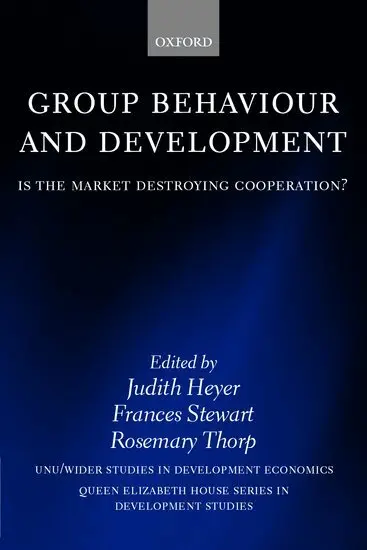
    Group Behaviour and Development

    Is the Market Destroying Cooperation?

    AvJudith Heyer,Frances Stewart

    Häftad, Engelska, 2002

    Del i serien WIDER Studies in Development Economics

    1 015 kr

    Beställningsvara. Skickas inom 5-8 vardagar. Fri frakt över 249 kr.

    Beskrivning

    This book focuses on group behaviour in developing countries. It includes studies of producer and community organizations, NGOs, and some public sector groups. Despite the fact that most economic decisions are taken by people acting within groups -- families, firms, neighbourhood or community associations, and networks of producers -- the analysis of group functioning has not received enough attention, particularly among economists. Some groups function well, from the perspectives of equity, efficiency, and well-being, while others do not. This book explores why. It covers groups that perform three types of function: overcoming market failures (e.g. producer organizations); improving the position of their members (e.g. Trade Unions), and distributing resources to the less well-off (e.g. NGOs and the public sector). It contrasts three modes of group behaviour: power and control; cooperation; and the use of material incentives. It explores what determines modes of behaviour of groups, and the consequences for efficiency, equity, and well-being. The book includes eleven case studies by different authors, including producers' associations in Brazil, farmers' organizations in Korea and Taiwan, community forestry groups in South Asia, organizations of sex-workers in Calcutta, and health NGOs in Uganda. Claims groups tended to be the most cooperative, cooperation fostering empowerment and self-esteem. Distributive or pro bono groups mostly operated according to power and control, while market failure groups often combined all three modes.The studies show the strong impact of norms in society as a whole on group behaviour. The recent shift towards a stronger role for market incentives has exerted powerful pressures on groups to use more material incentives, undermining the cooperation essential to sustain efficiency and equity. The universal presumption in favour of monetary incentives needs to be abandoned. Non-market behaviour needs to be valued and protected as well.

    Produktinformation

    • Utgivningsdatum:2002-09-19
    • Mått:156 x 234 x 21 mm
    • Vikt:557 g
    • Format:Häftad
    • Språk:Engelska
    • Serie:WIDER Studies in Development Economics
    • Antal sidor:384
    • Förlag:OUP OXFORD
    • ISBN:9780199256921

    Utforska kategorier

    • Internationell ekonomi inom Ekonomi och Ledarskap
    • Sociala grupper och identitet inom Samhälle och politik
    • Beteendeteori inom Psykologi och pedagogik

    Mer om författaren

    Judith Heyer has worked on different aspects of rural development in Kenya and in Tropical Africa. Her work on Kenya has included work on agricultural policy issues related to production and marketing, food policy, and poverty. She has also worked on villages in South India with a special interest in gender, caste, and class. She has been a Fellow and Tutor in Economics at Somerville, and University Lecturer at Oxford University since 1975. and before that lectured at the University of Nairobi, Kenya.Frances Stewart is Professor of Development Economics and Director of the International Development Centre, University of Oxford and a fellow of Somerville College. Her major research interests concern the impact of development processes on poor people. She has worked on appropriate technology, basic needs and the impact of adjustment policies on poverty. Recent work has focussed on the economic and social causes and consequences of large scale violent conflict, as well as on group behaviour.Rosemary Thorp has been the Lecturer in the Economics of Latin America at the University of Oxford since 1971. Before that she taught at the University of California, Berkeley. Her research has been in the field of economic history of Latin America and the macro economic management problems of that continent. She has worked extensively on Peru, Chile, and Colombia.

    Recensioner i media

    ... an exceptionally useful resource for practitioners and researchers interested in collective action issues.

    Innehållsförteckning

    • 1. Group Behaviour and Development ; 2. Dynamic Interactions Between the Macro-environment, Development Thinking, and Group Behaviour ; 3. Individual Motivation, its Nature, Determinants, and Consequences for Within-group Behaviour ; 4. Collective Action for Local-Level Effort Regulation: An Assessment of Recent Experiences in Senegalese Small-Scale Fisheries ; 5. Leaders and Intermediaries as Economic Development Agents in Producers' Associations ; 6. Group Behaviour and Development: A Comparison of Farmers' Organizations in South Korea and Taiwan ; 7. Has the Coffee Federation Become Redundant? Collective Action and the Market in Colombian Development ; 8. Producer Groups and the Decollectivization of the Mongolian Pastoral Economy ; 9. The Hidden Side of Group Behaviour: A Gender Analysis of Community Forestry in South Asia ; 10. Information Women's Groups in Rural Bangladesh: Group Operation and Outcomes ; 11. Sex Workers in Calcutta and the Dynamics of Collective Action: Political Activism, Community Identity, and Group Behaviour ; 12. Non-market Relationships in Health Care ; 13. Institutional Cultures and Regulatory Relationships in a Liberalizing Health Care System: A Tanzanian Case Study ; 14. The Case of Indigenous NGOs in Uganda's Health Sector ; 15. Conclusions