• Fri frakt över 249 kr
  • •
  • Snabba leveranser
  • •
  • Billiga böcker
Kundservice

Du är på sajten för privatpersoner.

Företag, bibliotek eller offentlig verksamhet?

Du handlar på classic.bokus.com, där alla dina funktioner finns intakta.
Till classic.bokus.com
Bokus logotyp. Gå till startsidan.
  • Erbjudanden
  • Nyheter
  • Student
  • Topplistor
  • Barn & ungdom
  • Bokus Play
  • E-böcker
  • Pocketböcker
  • Spel & pussel

10% rabatt på allt med kod: NYSTART10 →

Sidfot

Mina sidor

    Hjälp

    • Kundservice
    • Vanliga frågor och svar
    • Frakt och leverans
    • Retur vid ångerrätt
    • Reklamera vara
    • Betalning
    • Köpvillkor
    • Allmänna villkor
    • Information om webbplatsens tillgänglighet

    Om Bokus

    • Om oss
    • Pressrum
    • För studenter
    • För företag
    • För bibliotek och offentlig verksamhet
    • För leverantörer
    • Hållbarhet

    Populärt

    • Aktuella erbjudanden
    • Presentkort
    • Studentlitteratur
    • Nya böcker
    • Topplistor
    • Signerade böcker
    • Engelska böcker

    Inspiration

    • Boktips
    • BookTok
    • Populära bokserier
    • Barnbokskaraktärer
    • Populära författare
    Logotyp för Bokus
    Följ oss på Facebook (extern länk)Följ oss på Instagram (extern länk)Följ oss på YouTube (extern länk)Följ oss på TikTok (extern länk)
    bokus @ CookiesAnpassa cookiesIntegritetspolicyKöpvillkor
    Till Citymail hemsida (extern länk)Till Budbee hemsida (extern länk)Till Postnord hemsida (extern länk)Till Schenker hemsida (extern länk)Till Early Bird hemsida (extern länk)Till Walleys hemsida (extern länk)
    1. Samhälle och politik
    2. Politik och statsskick
    3. Politiska partier

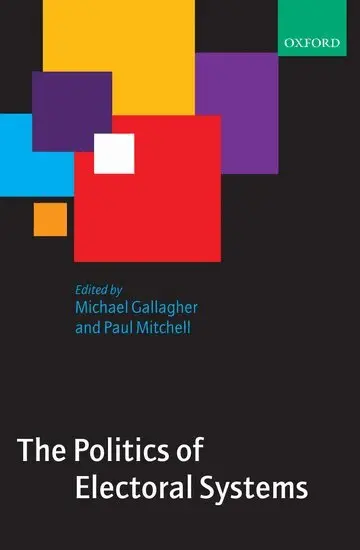
    The Politics of Electoral Systems

    AvMichael Gallagher,Paul Mitchell

    Inbunden, Engelska, 2005

    Del i serien OUP Oxford

    3 654 kr

    Beställningsvara. Skickas inom 5-8 vardagar. Fri frakt över 249 kr.

    Beskrivning

    Electoral systems matter. They are a crucial link in the chain connecting the preferences of citizens to the policy choices made by governments. They are chosen by political actors and, once in existence, have political consequences for those actors. They are an important object of study for anyone interested in the political process, and in this book we subject them to systematic analysis.In addition to some comparative chapters, the book contains full accounts of the operation of electoral systems in 22 countries: France, the UK, Germany, Italy, Israel, Spain, Austria, Belgium, Denmark, Finland, The Netherlands, Ireland, Hungary, Russia, Australia, Canada, India, the USA, Japan, New Zealand, Chile, and South Africa. The book provides detailed analyses of the operation of a diverse set of electoral systems in their national context. Each chapter explains how the electoral system really works in the given country, examining the strategic incentives the system provides to voters, candidates, and parties. All country chapters have a common format and structure. Successive sections analyse: the institutional context; how each electoral system was chosen historically; how the current electoral system operates (the rules, mechanics, and ballot structure); and the political consequences of the current system (the impact on the party system, the internal life of parties, and the impact on parliament and government formation). Each country chapter then contains a final section which focuses on the politicization of electoral institutions. In recent years many countries have changed their electoral systems, either entirely or in part so there is a strong focus on the processes of electoral reform, both historically and prospectively. The book concentrates on the real world 'politics', as well as the 'political science' of electoral systems.The book will be of interest to those concerned with the practical political business of electoral reform. The book contains a wealth of evidence about the performance of various kinds of proportional representation and of non-PR systems. This will be invaluable for anyone interested in the question: 'What would be the best electoral system for my country?'

    Produktinformation

    • Utgivningsdatum:2005-09-15
    • Mått:163 x 242 x 42 mm
    • Vikt:1 134 g
    • Format:Inbunden
    • Språk:Engelska
    • Serie:OUP Oxford
    • Antal sidor:688
    • Förlag:OUP OXFORD
    • ISBN:9780199257560

    Utforska kategorier

    • Politiska partier inom Samhälle och politik
    • Politiskt ledarskap inom Samhälle och politik
    • Politisk aktivism inom Samhälle och politik

    Recensioner i media

    'This is not just any book on the politics of electoral systems; it is probably the book on the politics of electoral systems ... The authors of these studies are all highly talented scholars, who usually know the comparative literature as well as their countries. In other words, they know what they are talking about, and they have been given reasonably generous space and good editorial guidance with which to do it. The result is truly impressive

    Innehållsförteckning

    • Foreword ; PART 1: INTRODUCTION: ELECTORAL SYSTEMS AND ELECTORAL SYSTEMS RESEARCH ; 1. Introduction to Electoral Systems ; 2. Comparative Electoral Systems Research: The Maturation of a Field and New Challenges Ahead ; 3. Why are There so many (or so few) Electoral Reforms? ; PART 2: SINGLE-MEMBER CONSTITUENCY SYSTEMS ; 4. Australia: The Alternative vote in a Compliant Political Culture ; 5. Canada: Sticking to First-past-the-Post, for the Time Being ; 6. France: Stacking the Deck ; 7. India: Two-Party Contests Within a Multi-Party System ; 8. United Kingdom: Plurality Rule Under Siege ; 9. United States of America: Perpetual Campaigning in the Absence of Competition ; PART 3: MIXED SYSTEMS ; 10. Germany: Stability and Strategy in a Mixed-Member Proportional System ; 11. Hungary: Holding Back the Tiers ; 12. Italy: A Case of Fragmented Bipolarism ; 13. Japan: Haltingly Toward a Two-Party System ; 14. New Zealand: The Consolidation of Reform? ; 15. Russia: The Authoritarian Adaptation of an Electoral System ; PART 4: CLOSED LIST SYSTEMS ; 16. Israel: The Politics of Extreme Proportionality ; 17. South Africa: One Party Dominance Despite Perfect Proportionality ; 18. Spain: Proportional Representation with Majoritarian Outcomes ; PART 5: PREFERENTIAL LIST SYSTEMS AND PR-STV ; 19. Austria: A Complex Electoral System with Subtle Effects ; 20. Belgium: Empowering Voters or Party Elites? ; 21. Chile: The Unexpected (and Expected) Consequences of Electoral Engineering ; 22. Denmark: Simplicity Embedded in Complexity (or Is it the Other Way Round?) ; 23. Finland: One Hundred Years of Quietude ; 24. The Netherlands: The Sanctity of Proportionality ; 25. Ireland: The Discreet Charm of PR-STV ; PART 6: CONCLUSION ; 26. Conclusion ; Appendix A - The Mechanics of Electoral Systems ; Appendix B - Indices of Fragmentation and Disproportionality ; Appendix C: Effective Threshold and Effective District Magnitude ; Appendix D: Values of Indices for 22 Countries at Most Recent Election ; Appendix E: Web Sites Related to Elections, Election Results, and Electoral Systems