• Fri frakt över 249 kr
  • •
  • Snabba leveranser
  • •
  • Billiga böcker
Kundservice

Du är på sajten för privatpersoner.

Företag, bibliotek eller offentlig verksamhet?

Du handlar på classic.bokus.com, där alla dina funktioner finns intakta.
Till classic.bokus.com
Bokus logotyp. Gå till startsidan.
  • Erbjudanden
  • Nyheter
  • Student
  • Topplistor
  • Barn & ungdom
  • Bokus Play
  • E-böcker
  • Pocketböcker
  • Spel & pussel

10% rabatt på allt med kod: NYSTART10 →

Sidfot

Mina sidor

    Hjälp

    • Kundservice
    • Vanliga frågor och svar
    • Frakt och leverans
    • Retur vid ångerrätt
    • Reklamera vara
    • Betalning
    • Köpvillkor
    • Allmänna villkor
    • Information om webbplatsens tillgänglighet

    Om Bokus

    • Om oss
    • Pressrum
    • För studenter
    • För företag
    • För bibliotek och offentlig verksamhet
    • För leverantörer
    • Hållbarhet

    Populärt

    • Aktuella erbjudanden
    • Presentkort
    • Studentlitteratur
    • Nya böcker
    • Topplistor
    • Signerade böcker
    • Engelska böcker

    Inspiration

    • Boktips
    • BookTok
    • Populära bokserier
    • Barnbokskaraktärer
    • Populära författare
    Logotyp för Bokus
    Följ oss på Facebook (extern länk)Följ oss på Instagram (extern länk)Följ oss på YouTube (extern länk)Följ oss på TikTok (extern länk)
    bokus @ CookiesAnpassa cookiesIntegritetspolicyKöpvillkor
    Till Citymail hemsida (extern länk)Till Budbee hemsida (extern länk)Till Postnord hemsida (extern länk)Till Schenker hemsida (extern länk)Till Early Bird hemsida (extern länk)Till Walleys hemsida (extern länk)
    1. Ekonomi och Ledarskap
    2. Nationalekonomi
    3. Internationell ekonomi

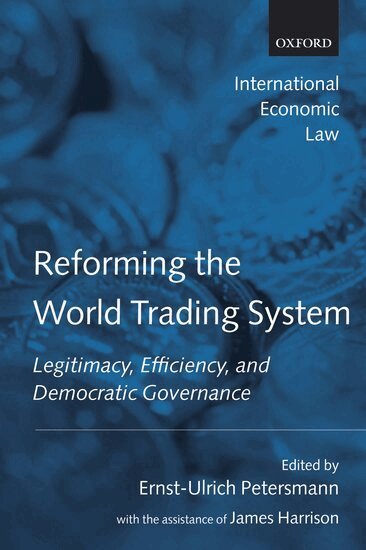
    Reforming the World Trading System

    Legitimacy, Efficiency, and Democratic Governance

    AvJames Harrison,Ernst-Ulrich Petersmann

    Häftad, Engelska, 2005

    Del i serien International Economic Law Series

    1 792 kr

    Beställningsvara. Skickas inom 5-8 vardagar. Fri frakt över 249 kr.

    Fler format och utgåvor

    Inbunden

    2 545 kr

    Beskrivning

    The 1994 agreement establishing the World Trade Organization (WTO) regulates over 95% of world trade amongst 148 member countries. The November 2001 Declaration of the Fourth Ministerial Conference of the WTO in Doha, Quatar, has launched the Doha Development Round of multilateral trade negotiations in the WTo on 21 topics aimed at far-reaching reforms of the world trading system. On August 1st 2004, the WTO General Council reached agreement on a detailed Doha Work program with the aim of concluding negotiations in 2006. This volume provides discussion and policy recommendations by leading WTO negotiators and policy-makers, and analysis by leading economists, political scientists and trade lawyers on the major subjects of the Doha Round negotiations. Over 30 contributors explore the complexity of the world trading system and of the WTO negotiations for its reform from diverse political, economic and legal perspectives.

    Produktinformation

    • Utgivningsdatum:2005-06-09
    • Mått:156 x 233 x 32 mm
    • Vikt:893 g
    • Format:Häftad
    • Språk:Engelska
    • Serie:International Economic Law Series
    • Antal sidor:592
    • Förlag:OUP OXFORD
    • ISBN:9780199282630

    Utforska kategorier

    • Internationell ekonomi inom Ekonomi och Ledarskap
    • Politisk aktivism inom Samhälle och politik
    • Folkrätt inom Juridik

    Mer om författaren

    Ernst-Ulrich Petersmann is Professor of Law at the European University Institute, Florence.

    Innehållsförteckning

    • Foreword ; Notes on Contributors ; List of Abbreviations ; I WTO NEGOTIATORS AND ACADEMICS ANALYZE THE DOHA DEVELOPMENT ROUND OF THE WTO ; Overview and Summary of the Book ; II THE DOHA DEVELOPMENT ROUND AND THE FUTURE OF THE WTO: POLICY PROPOSALS ; 1. The Doha Development Agenda: Political Challenges to the World Trading System - A Cosmopolitan Perspective ; 2. A Development Perspective on the WTO July 2004 General Council Decision ; 3. Cordell Hull, the Reciprocal Trade Agreement Act and the WTO ; III BUILDING-BLOCKS FOR CONCLUDING THE DOHA ROUND NEGOTIATIONS ON AGRICULTURE ; 4. How to Forge a Compromise in the Agricultural Negotiations? ; 5. The Agricultural Negotiations: The Road from Doha and How to Keep the Negotiations on a Positive Track ; 6. Strategic Use of WTO Dispute Settlement Proceedings for Advancing WTO Negotiations on Agricultural Subsidies ; IV THE DOHA ROUND NEGOTIATIONS ON SERVICES TRADE ; 7. Developing Country Proposals for the Liberalization of Movements of Natural Service Suppliers ; 8. Navigating Between the Poles: Unpacking the Debate on the Implications for Development of GATS Obligations Relating to Health and Education Services ; 9. Negotiations on Domestic Regulation and Trade in Services (Article VI GATS): A Legal Analysis of Selected Current Issues ; V LESS-DEVELOPED WTO MEMBERS IN THE DOHA ROUND NEGOTIATIONS ; 10. Operationalizing the Concept of Policy Space in the WTO: Beyond Special and Differential Treatment of Developing Countries ; 11. Can WTO Technical Assistance and Capacity-Building Serve Developing Countries? ; 12. Developing Countries Interests and Negotiation Positions on Protection of Geographical Indications and Traditional Knowledge ; VI ARE WTO RULES ADEQUATELY PROTECTING CONSUMER WELFARE? ; 13. Come Together? Producer Welfare, Consumer Welfare and WTO Rules ; 14. Non-Discrimination, Welfare Balances and WTO Rules: An Historical Perspective ; 15. Is There a Need for Additional WTO Competition Rules Promoting Non-Discriminatory Competition Laws and Competition Institutions in WTO Members? ; 16. Are the Competition Rules in the WTO TRIPS Agreement Adequate? ; 17. Investment and the Doha Development Agenda ; VII CHALLENGES TO THE POLITICAL LEGITIMACY OF THE WTO SYSTEM ; 18. The "Human Rights Approach to International Trade" Advocated by UN Human Rights Bodies and by the International Labour Organization: Is it Relevant for WTO Law and Policy? ; 19. Parliamentary Oversight of WTO Rule-Making: The Political, Normative and Practical Contexts ; 20. How Can Parliamentary Participation in WTO Rule-Making and Democratic Control Be Made More Effective in the WTO? A United States Congressional Perspective ; 21. How Can Parliamentary Participation in WTO Rule-Making and Democratic Control Be Made More Effective? The European Context ; 22. A Parliamentary Dimension to the WTO - More than Just a Vision? ; 23. A Few Thoughts on Legitimacy, Democracy and the WTO ; 24. The WTO and Cosmopolitics ; 25. Transparency, Public Debate and Participaton by NGOs in the WTO: A WTO Perspective ; VIII WTO DECISION-MAKING PROCEDURES, 'MEMBER-DRIVEN' RULE-MAKING AND WTO CONSENSUS PRACTICES: ARE THEY ADEQUATE? ; 26. Improving the Capacity of WTO Institutions to Fulfil their Mandate ; 27. Chairing a WTO Negotiation ; 28. Are WTO Decision-Making Procedures Adequate for Making, Revising and Implementing Worldwide and 'Plurilateral' Rules? ; 29. Is There a Need for Restructuring the Collaboration Among the WTO and UN Specialized Agencies so as to Harness their Complementarities? ; 30. Can the WTO Dispute Settlement System Deal with Competition Disputes?