• Fri frakt över 249 kr
  • •
  • Snabba leveranser
  • •
  • Billiga böcker
Kundservice

Du är på sajten för privatpersoner.

Företag, bibliotek eller offentlig verksamhet?

Du handlar på classic.bokus.com, där alla dina funktioner finns intakta.
Till classic.bokus.com
Bokus logotyp. Gå till startsidan.
  • Erbjudanden
  • Nyheter
  • Student
  • Topplistor
  • Barn & ungdom
  • Bokus Play
  • E-böcker
  • Pocketböcker
  • Spel & pussel

10% rabatt på allt med kod: NYSTART10 →

Sidfot

Mina sidor

    Hjälp

    • Kundservice
    • Vanliga frågor och svar
    • Frakt och leverans
    • Retur vid ångerrätt
    • Reklamera vara
    • Betalning
    • Köpvillkor
    • Allmänna villkor
    • Information om webbplatsens tillgänglighet

    Om Bokus

    • Om oss
    • Pressrum
    • För studenter
    • För företag
    • För bibliotek och offentlig verksamhet
    • För leverantörer
    • Hållbarhet

    Populärt

    • Aktuella erbjudanden
    • Presentkort
    • Studentlitteratur
    • Nya böcker
    • Topplistor
    • Signerade böcker
    • Engelska böcker

    Inspiration

    • Boktips
    • BookTok
    • Populära bokserier
    • Barnbokskaraktärer
    • Populära författare
    Logotyp för Bokus
    Följ oss på Facebook (extern länk)Följ oss på Instagram (extern länk)Följ oss på YouTube (extern länk)Följ oss på TikTok (extern länk)
    bokus @ CookiesAnpassa cookiesIntegritetspolicyKöpvillkor
    Till Citymail hemsida (extern länk)Till Budbee hemsida (extern länk)Till Postnord hemsida (extern länk)Till Schenker hemsida (extern länk)Till Early Bird hemsida (extern länk)Till Walleys hemsida (extern länk)
    1. Samhälle och politik
    2. Samhälle och kultur
    3. Kultur och medier
    4. Kulturvetenskap

    The Culture of History

    English Uses of the Past 1800-1953

    AvBillie Melman

    Inbunden, Engelska, 2006

    3 895 kr

    Beställningsvara. Skickas inom 5-8 vardagar. Fri frakt över 249 kr.

    Beskrivning

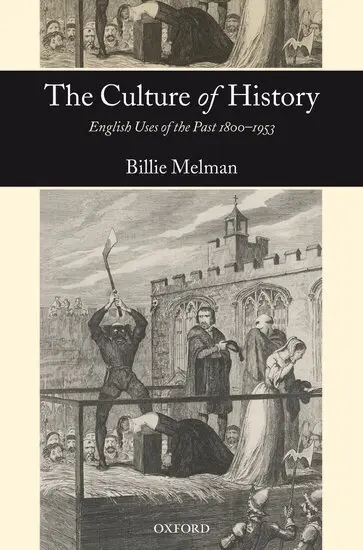
    In this original and widely researched book, Billie Melman explores the culture of history during the age of modernity. Her book is about the production of English pasts, the multiplicity of their representations and the myriad ways in which the English looked at history (sometimes in the most literal sense of 'looking') and made use of it in a social and material urban world, and in their imagination. Covering the period between the Napoleonic Wars and the Coronation of 1953, Melman recoups the work of antiquarians, historians, novelists and publishers, wax modellers, cartoonists and illustrators, painters, playwrights and actors, reformers and educationalists, film stars and their fans, musicians and composers, opera-fans, and radio listeners. Avoiding a separation between 'high' and 'low' culture, Melman analyses nineteenth-century plebeian culture and twentieth-century mass-culture and their venues - like Madame Tussaud's Chamber of Horrors, panoramas, national monuments like the Tower of London, and films - as well as studying forms of 'minority' art - notably opera. She demonstrates how history was produced and how it circulated from texts, visual images, and sounds, to people and places and back to a variety of texts and images. While paying attention to individuals' making-do with culture, Melman considers constrictions of class, gender, the state, and the market-place on the consumption of history.Focusing on two privileged pasts, the Tudor monarchy and the French Revolution, the latter seen as an English event and as the framework for narrating and comprehending history, Melman shows that during the nineteenth century, the most popular, longest-enduring, and most highly commercialized images of the past represented it not as cosy and secure, but rather as dangerous, disorderly, and violent. The past was also imagined as an urban place, rather than as rural. In Melman's account, City not green Country, is the centre of a popular version of the past whose central Images are the dungeon, the gallows, and the guillotine.

    Produktinformation

    • Utgivningsdatum:2006-06-22
    • Mått:163 x 242 x 24 mm
    • Vikt:771 g
    • Format:Inbunden
    • Språk:Engelska
    • Antal sidor:378
    • Förlag:OUP OXFORD
    • ISBN:9780199296880
    • Utmärkelser:Winner of the Landau Prize awarded by the Landau Foundation for Research and Science

    Utforska kategorier

    • Kulturvetenskap inom Samhälle och politik
    • Socialhistoria och kulturhistoria inom Historia och arkeologi
    • Europas historia inom Historia och arkeologi

    Mer om författaren

    Billie Melman was educated in Tel Aviv and London. She is Professor of Modern History at Tel Aviv University. She has written extensively on British popular culture, British orientalism and the culture of colonialism, on history and memory, and on gender.

    Recensioner i media

    It is impossible to do justice to the many insightful arguments offered in this deeply researched book...an outstanding contribution to the study of modern historical culture. the challenges it poses to existing orthodoxies, and the avenues and reflections it opens, make this work relevent not just to scholars of Victorian and early twentieth-century England but to anyone studying historical consciousness.

    Innehållsförteckning

    • Part I - The French Connection: History and Culture After the Revolution ; 1. History as a Chamber of Horrors: the French Revolution in Madame Tussaud's ; 2. History as a Panorama: Spectacle and the People in Thomas Carlyle, The French Revolution ; 3. The Past as an Urban Place: Mid-Victorian Images of Revolution and Governance ; Part II - History as a Dungeon: Tudor Revivals and Urban Culture ; 4. Who Owns the Tower of London? The Production and Consumptions of a Historical Monument ; 5. Lady Jane: Torture, Gender and the Re-Invention of the Tudors ; Part III- Elizabethan Revivals, Consumption and Mass Democracy in the Modern Century ; 6. Buy Tudor: The Historical Film as a Mass Commodity ; 7. The Queen's Two Bodies; the King's Body: History, Monarchy and Stardom, 1933-53 ; Part IV- History and Glamour: The French Revolution and Modern Living 1900-1940 ; 8. The Revolution, Aristocrats and the People: The Returns of the Scarlet Pimpernel, 1900-1935 ; Part V- New Elizabethans? Postwar Culture and Failed Histories ; 9. Gloriana 1953: Failed Evocations of the Past ; Conclusion ; Bibliography