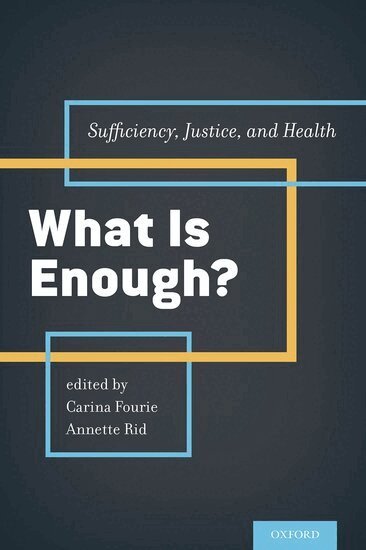
What is Enough?
Sufficiency, Justice, and Health
1 060 kr
Beställningsvara. Skickas inom 5-8 vardagar. Fri frakt över 249 kr.
Du är på sajten för privatpersoner.
1 060 kr
Beställningsvara. Skickas inom 5-8 vardagar. Fri frakt över 249 kr.
Carina Fourie is the Benjamin Rabinowitz Assistant Professor of Medical Ethics at the University of Washington, Seattle. Previously she worked as a Postdoctoral Fellow at the Ethics Centre of the University of Zurich, and she has a PhD in Philosophy from University College London. Her central research interests include social justice and equality, and their application to health and health care policy. She has published widely in philosophy, medical ethics and health policy journals, including Res Publica, Bioethics and Health Policy, and is the co-editor of a collected volume on social equality, published by Oxford University Press.Annette Rid is Senior Lecturer in Bioethics and Society at the Department of Social Science, Health & Medicine at King's College London. Trained in medicine, philosophy and bioethics in Germany, Switzerland and the US, Annette's research interests span research ethics, clinical ethics and justice in health and health care. Annette has published widely in medical journals (e.g. Lancet, JAMA) and bioethics journals (e.g. Journal of Medical Ethics, Hastings Center Report). She has served as an advisor, among others, for the World Health Organization, the World Medical Association and the Council of International Organizations of Medical Sciences. At King's, Annette has lead the new MA in Bioethics & Society as one of its inaugural co-directors. More information at annetterid.org.
"Health care allocation and sufficientarianism, the distributive view according to which what matters is to lift individuals above a certain threshold of needs, are two of the more hotly contested topics in moral and political philosophy. Somehow, however, they have rarely been linked. This book is the first of its kind to weave these two important questions together. It is therefore a very welcome addition to the literature on health care ethics. Not only isit likely to generate a lot of interest among political philosophers and bioethicists, but it will also, in all likelihood, become a key reference point for any future debates about sufficiency inhealth."-Shlomi Segall, The Hebrew University of Jerusalem"The idea that justice requires us to provide citizens with sufficient health care is plausible and attractive to many, across the political spectrum. Making the principle more precise, however, especially when it comes to specifying what counts as sufficient, is difficult. This book contains many excellent papers across a wide range, and is a major step forward in our understanding of the ethics of allocating scarce health care resources."-Roger Crisp,Professor of Moral Philosophy, University of Oxford"How should a country decide how much it should spend on health? Considerations of need, efficiency and justice will be paramount. Yet it is also vital to keep in mind how else those same resources could be spent. These questions often take second-place to political grandstanding, in which medical care becomes an ideologically-charged electoral issue. This excellent collection should help redress the balance, containing bold and highly original contributionsfrom leading health economists, political philosophers, policy makers and bioethicists. The volume concentrates especially on the idea of health sufficiency and its role in health policy. What is'sufficient health' and does justice require that governments supply it? These papers will bring much needed clarity to the general debate about health justice and show the importance of approaching the topic with health sufficiency at the forefront of discussion."-Jonathan Wolff, Blavatnik Chair in Public Policy, University of Oxford
Fredrik Emdén
Kartonnage, 2026
259 kr
Du är på sajten för privatpersoner.
1 060 kr
Beställningsvara. Skickas inom 5-8 vardagar. Fri frakt över 249 kr.
Carina Fourie is the Benjamin Rabinowitz Assistant Professor of Medical Ethics at the University of Washington, Seattle. Previously she worked as a Postdoctoral Fellow at the Ethics Centre of the University of Zurich, and she has a PhD in Philosophy from University College London. Her central research interests include social justice and equality, and their application to health and health care policy. She has published widely in philosophy, medical ethics and health policy journals, including Res Publica, Bioethics and Health Policy, and is the co-editor of a collected volume on social equality, published by Oxford University Press.Annette Rid is Senior Lecturer in Bioethics and Society at the Department of Social Science, Health & Medicine at King's College London. Trained in medicine, philosophy and bioethics in Germany, Switzerland and the US, Annette's research interests span research ethics, clinical ethics and justice in health and health care. Annette has published widely in medical journals (e.g. Lancet, JAMA) and bioethics journals (e.g. Journal of Medical Ethics, Hastings Center Report). She has served as an advisor, among others, for the World Health Organization, the World Medical Association and the Council of International Organizations of Medical Sciences. At King's, Annette has lead the new MA in Bioethics & Society as one of its inaugural co-directors. More information at annetterid.org.
"Health care allocation and sufficientarianism, the distributive view according to which what matters is to lift individuals above a certain threshold of needs, are two of the more hotly contested topics in moral and political philosophy. Somehow, however, they have rarely been linked. This book is the first of its kind to weave these two important questions together. It is therefore a very welcome addition to the literature on health care ethics. Not only isit likely to generate a lot of interest among political philosophers and bioethicists, but it will also, in all likelihood, become a key reference point for any future debates about sufficiency inhealth."-Shlomi Segall, The Hebrew University of Jerusalem"The idea that justice requires us to provide citizens with sufficient health care is plausible and attractive to many, across the political spectrum. Making the principle more precise, however, especially when it comes to specifying what counts as sufficient, is difficult. This book contains many excellent papers across a wide range, and is a major step forward in our understanding of the ethics of allocating scarce health care resources."-Roger Crisp,Professor of Moral Philosophy, University of Oxford"How should a country decide how much it should spend on health? Considerations of need, efficiency and justice will be paramount. Yet it is also vital to keep in mind how else those same resources could be spent. These questions often take second-place to political grandstanding, in which medical care becomes an ideologically-charged electoral issue. This excellent collection should help redress the balance, containing bold and highly original contributionsfrom leading health economists, political philosophers, policy makers and bioethicists. The volume concentrates especially on the idea of health sufficiency and its role in health policy. What is'sufficient health' and does justice require that governments supply it? These papers will bring much needed clarity to the general debate about health justice and show the importance of approaching the topic with health sufficiency at the forefront of discussion."-Jonathan Wolff, Blavatnik Chair in Public Policy, University of Oxford
Fredrik Emdén
Kartonnage, 2026
259 kr
Du är på sajten för privatpersoner.
1 060 kr
Beställningsvara. Skickas inom 5-8 vardagar. Fri frakt över 249 kr.
Carina Fourie is the Benjamin Rabinowitz Assistant Professor of Medical Ethics at the University of Washington, Seattle. Previously she worked as a Postdoctoral Fellow at the Ethics Centre of the University of Zurich, and she has a PhD in Philosophy from University College London. Her central research interests include social justice and equality, and their application to health and health care policy. She has published widely in philosophy, medical ethics and health policy journals, including Res Publica, Bioethics and Health Policy, and is the co-editor of a collected volume on social equality, published by Oxford University Press.Annette Rid is Senior Lecturer in Bioethics and Society at the Department of Social Science, Health & Medicine at King's College London. Trained in medicine, philosophy and bioethics in Germany, Switzerland and the US, Annette's research interests span research ethics, clinical ethics and justice in health and health care. Annette has published widely in medical journals (e.g. Lancet, JAMA) and bioethics journals (e.g. Journal of Medical Ethics, Hastings Center Report). She has served as an advisor, among others, for the World Health Organization, the World Medical Association and the Council of International Organizations of Medical Sciences. At King's, Annette has lead the new MA in Bioethics & Society as one of its inaugural co-directors. More information at annetterid.org.
"Health care allocation and sufficientarianism, the distributive view according to which what matters is to lift individuals above a certain threshold of needs, are two of the more hotly contested topics in moral and political philosophy. Somehow, however, they have rarely been linked. This book is the first of its kind to weave these two important questions together. It is therefore a very welcome addition to the literature on health care ethics. Not only isit likely to generate a lot of interest among political philosophers and bioethicists, but it will also, in all likelihood, become a key reference point for any future debates about sufficiency inhealth."-Shlomi Segall, The Hebrew University of Jerusalem"The idea that justice requires us to provide citizens with sufficient health care is plausible and attractive to many, across the political spectrum. Making the principle more precise, however, especially when it comes to specifying what counts as sufficient, is difficult. This book contains many excellent papers across a wide range, and is a major step forward in our understanding of the ethics of allocating scarce health care resources."-Roger Crisp,Professor of Moral Philosophy, University of Oxford"How should a country decide how much it should spend on health? Considerations of need, efficiency and justice will be paramount. Yet it is also vital to keep in mind how else those same resources could be spent. These questions often take second-place to political grandstanding, in which medical care becomes an ideologically-charged electoral issue. This excellent collection should help redress the balance, containing bold and highly original contributionsfrom leading health economists, political philosophers, policy makers and bioethicists. The volume concentrates especially on the idea of health sufficiency and its role in health policy. What is'sufficient health' and does justice require that governments supply it? These papers will bring much needed clarity to the general debate about health justice and show the importance of approaching the topic with health sufficiency at the forefront of discussion."-Jonathan Wolff, Blavatnik Chair in Public Policy, University of Oxford
Fredrik Emdén
Kartonnage, 2026
259 kr