• Fri frakt över 249 kr
  • •
  • Snabba leveranser
  • •
  • Billiga böcker
Kundservice

Du är på sajten för privatpersoner.

Företag, bibliotek eller offentlig verksamhet?

Du handlar på classic.bokus.com, där alla dina funktioner finns intakta.
Till classic.bokus.com
Bokus logotyp. Gå till startsidan.
  • Erbjudanden
  • Nyheter
  • Student
  • Topplistor
  • Barn & ungdom
  • Bokus Play
  • E-böcker
  • Pocketböcker
  • Spel & pussel

10% rabatt på allt med kod: NYSTART10 →

Sidfot

Mina sidor

    Hjälp

    • Kundservice
    • Vanliga frågor och svar
    • Frakt och leverans
    • Retur vid ångerrätt
    • Reklamera vara
    • Betalning
    • Köpvillkor
    • Allmänna villkor
    • Information om webbplatsens tillgänglighet

    Om Bokus

    • Om oss
    • Pressrum
    • För studenter
    • För företag
    • För bibliotek och offentlig verksamhet
    • För leverantörer
    • Hållbarhet

    Populärt

    • Aktuella erbjudanden
    • Presentkort
    • Studentlitteratur
    • Nya böcker
    • Topplistor
    • Signerade böcker
    • Engelska böcker

    Inspiration

    • Boktips
    • BookTok
    • Populära bokserier
    • Barnbokskaraktärer
    • Populära författare
    Logotyp för Bokus
    Följ oss på Facebook (extern länk)Följ oss på Instagram (extern länk)Följ oss på YouTube (extern länk)Följ oss på TikTok (extern länk)
    bokus @ CookiesAnpassa cookiesIntegritetspolicyKöpvillkor
    Till Citymail hemsida (extern länk)Till Budbee hemsida (extern länk)Till Postnord hemsida (extern länk)Till Schenker hemsida (extern länk)Till Early Bird hemsida (extern länk)Till Walleys hemsida (extern länk)
    1. Naturvetenskap och teknik
    2. Geovetenskap
    3. Miljövetenskap och miljöpolitik

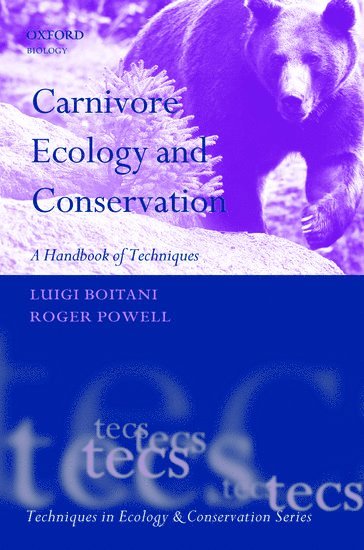
    Carnivore Ecology and Conservation

    A Handbook of Techniques

    AvLuigi Boitani,Roger A. Powell

    Häftad, Engelska, 2012

    Del i serien Techniques in Ecology & Conservation

    833 kr

    Beställningsvara. Skickas inom 7-10 vardagar. Fri frakt över 249 kr.

    Beskrivning

    Animals that must hunt and kill for at least part of their living are inherently interesting to many people and the role that carnivores play in biological communities attract interest from ecologists and conservation biologists. Conflicts with human activities stimulate continual debates about the management of carnivore populations, and throughout the world people seek workable solutions for human/carnivore coexistence.This concise yet authoritative handbook describes research methods and techniques for the study and conservation of all terrestrial carnivore species. Particular attention is paid to techniques for managing the human/carnivore interface. Descriptions of the latest methodologies are supported by references to case studies, whilst dedicated boxes are used to illustrate how a technique is applied to a specific land cover type, species, or particular socio-economic context. The book describes the most recent advances in modelling the patterns of animal distributions, movements, and use of land cover types, as well as including the most efficient methods to trap, handle, and mark carnivores. Carnivores are biogeographically diverse and whilst extensive scientific research has investigated many aspects of carnivore biology, not all species have been equally covered. This book is unique in its intention to provide practical guidance for carrying out research and conservation of carnivores across all species and areas of the world.

    Produktinformation

    • Utgivningsdatum:2012-01-12
    • Mått:158 x 233 x 26 mm
    • Vikt:894 g
    • Format:Häftad
    • Språk:Engelska
    • Serie:Techniques in Ecology & Conservation
    • Antal sidor:526
    • Förlag:OUP OXFORD
    • ISBN:9780199558537

    Utforska kategorier

    • Miljövetenskap och miljöpolitik inom Naturvetenskap och teknik
    • Däggdjur inom Naturvetenskap och teknik
    • Däggdjur inom Djur och Natur

    Mer om författaren

    Luigi BOITANI is Professor of Animal Ecology and Conservation Biology at the University of Rome, Dept of Biology and Biotechnologies, and Affiliated Professor at the Department of Natural Resources, Idaho University, Moscow, USA. He is the current (2009-2011) President of the Society for Conservation Biology. His main scientific interests are on a) the social ecology of carnivores, particularly wolves and bears on which he has been working since 1972; b) patterns and models of species distributions based on GIS tools; and c) conservation planning theory applied to species and protected areas, with emphasis on the African and European continents. He has served as member of the IUCN's Species Survival Commission since 1973 and as member of its Steering Committee since 1994. He is also the Chair of the Large Carnivore Initiative for Europe, a SSC Specialist Group which is a regular consultant to the European Union. He is author of more than 260 scientific papers, 9 books and 80 technical reports.Roger POWELL is Professor Emeritus in the Department of Biology, North Carolina State University, and in the interdepartmental program for Fisheries, Wildlife and Conservation. He is also an Affiliate Professor in the Wildlife Biology Program at the University of Montana and a frequent instructor at the Wilderness Field Station of Coe College. Over the past 30 years, his research has emphasized how limiting resources affect animals, especially predatory mammals. His research has led to diverse applications through state wildlife agencies, the USDA Forest Service, the US Fish & Wildlife Service, and the National Park Service. He has written or co-written 3 books (1 in 2 editions), edited 1 book and 5 special sections for journals, and written over 75 peer-reviewed papers since 1972.

    Innehållsförteckning

    • Foreword ; 1. Introduction: research and conservation of carnivores ; 2. Designing carnivore surveys ; 3. Mind the map: trips and pitfalls in making and reading maps of carnivore distribution ; 4. Non-invasive sampling for carnivores ; 5. Humane and efficient capture and handling methods for carnivores ; 6. Carnivores in hand ; 7. Radio telemetry equipment and applications for carnivores ; 8. Estimating demographic parameters ; 9. Movements, home ranges, activity, and dispersal ; 10. Carnivore habitat ecology: integrating theory and application ; 11. Describing food habits and predation: field methods and statistical considerations ; 12. Reproductive biology and endocrine studies ; 13. Investigating cause-specific mortality and diseases in carnivores: tools and techniques ; 14. Mitigation methods for conflicts associated with carnivore depredation on livestock ; 15. Carnivore restoration ; 16. Designing a monitoring plan ; 17. Assessing conservation status and units for conservation ; References ; Index