• Fri frakt över 249 kr
  • •
  • Snabba leveranser
  • •
  • Billiga böcker
Kundservice

Du är på sajten för privatpersoner.

Företag, bibliotek eller offentlig verksamhet?

Du handlar på classic.bokus.com, där alla dina funktioner finns intakta.
Till classic.bokus.com
Bokus logotyp. Gå till startsidan.
  • Erbjudanden
  • Nyheter
  • Student
  • Topplistor
  • Barn & ungdom
  • Bokus Play
  • E-böcker
  • Pocketböcker
  • Spel & pussel

10% rabatt på allt med kod NYSTART10 →

Sidfot

Mina sidor

    Hjälp

    • Kundservice
    • Vanliga frågor och svar
    • Frakt och leverans
    • Retur vid ångerrätt
    • Reklamera vara
    • Betalning
    • Köpvillkor
    • Allmänna villkor
    • Information om webbplatsens tillgänglighet

    Om Bokus

    • Om oss
    • Pressrum
    • För studenter
    • För företag
    • För bibliotek och offentlig verksamhet
    • För leverantörer
    • Hållbarhet

    Populärt

    • Aktuella erbjudanden
    • Presentkort
    • Studentlitteratur
    • Nya böcker
    • Topplistor
    • Signerade böcker
    • Engelska böcker

    Inspiration

    • Boktips
    • BookTok
    • Populära bokserier
    • Barnbokskaraktärer
    • Populära författare
    Logotyp för Bokus
    Följ oss på Facebook (extern länk)Följ oss på Instagram (extern länk)Följ oss på YouTube (extern länk)Följ oss på TikTok (extern länk)
    bokus @ CookiesAnpassa cookiesIntegritetspolicyKöpvillkor
    Till Citymail hemsida (extern länk)Till Budbee hemsida (extern länk)Till Postnord hemsida (extern länk)Till Schenker hemsida (extern länk)Till Early Bird hemsida (extern länk)Till Walleys hemsida (extern länk)
    1. Samhälle och politik
    2. Krig och försvar
    3. Vapen och utrustning
    4. Kärnvapen

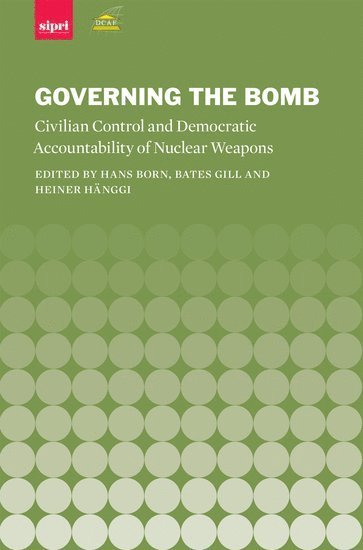
    Governing the Bomb

    Civilian Control and Democratic Accountability of Nuclear Weapons

    AvHans Born,Bates Gill

    Inbunden, Engelska, 2010

    Del i serien SIPRI Monographs

    1 526 kr

    Beställningsvara. Skickas inom 7-10 vardagar. Fri frakt över 249 kr.

    Beskrivning

    'Go nuclear' or 'go zero'-as the international community stands at a nuclear crossroads, a number of questions demand urgent attention: How do established and emerging nuclear-armed states manage their nuclear affairs? Who commands and controls a country's nuclear forces? What effect does the balance between secrecy and openness have on larger questions of security and democracy? Governing the Bomb is grounded in the belief that the public's ability to hold nuclear-armed states accountable for the security of their weapons is contingent on proper knowledge of domestic nuclear governance. With a special emphasis on civilian control and democratic accountability, Governing the Bomb seeks to illuminate the structures and processes of nuclear weapons governance of eight nuclear-armed states: the USA, Russia, the UK, France and China as well as Israel, India and Pakistan. It examines the theoretical as well as practical functions and structures of those who possess the power to make nuclear decisions and those who have the practical means and physical opportunity to execute those decisions. While it assesses the whole spectrum of political oversight and control mechanisms in operation for each country-including the roles and requirements of the executive, the military and specialized civilian institutions-it also takes a closer look at parliamentary institutions and civil society at large. As nuclear terrorism, proliferation and disarmament vie for the top slot on the global security agenda, a comparative understanding of the various national nuclear discourses is no longer optional, but required.

    Produktinformation

    • Utgivningsdatum:2010-10-21
    • Mått:163 x 236 x 26 mm
    • Vikt:560 g
    • Format:Inbunden
    • Språk:Engelska
    • Serie:SIPRI Monographs
    • Antal sidor:264
    • Förlag:OUP OXFORD
    • ISBN:9780199589906

    Utforska kategorier

    • Kärnvapen inom Samhälle och politik
    • Internationella relationer inom Samhälle och politik

    Mer om författaren

    Dr Hans Born (The Netherlands) is a senior fellow at the Geneva Centre for the Democratic Control of Armed Forces (DCAF). He has conducted policy studies in the area of human rights, accountability and security sector governance for the United Nations, the Organisation for Security and Co-operation in Europe, the Council of Europe and the European Parliament. In addition, he is a guest lecturer for the ETH Zurich Master of Advanced Studies on Security Policy and Crisis Management. Born received an MA degree in public administration from Twente University and a PhD in social sciences from the University of Tilburg. Dr Bates Gill (United States) is director of Stockholm International Peace Research Institute (SIPRI). Prior to being named the SIPRI director in 2007, Gill held the Freeman Chair in China Studies at the Center for Strategic and International Studies in Washington, DC, from 2002. He has previously held positions at the Brookings Institution, where he was the inaugural director of the Center for Northeast Asian Policy Studies, and at the James Martin Center for Nonproliferation Studies of the Monterey Institute of International Studies. He is a member of the Council on Foreign Relations and the International Institute for Strategic Studies and has consulted for a number of multinational corporations and government agencies. Gill received his PhD in foreign affairs from the University of Virginia. Dr Heiner Hänggi (Switzerland) is assistant director and head of research at the Geneva Centre for the Democratic Control of Armed Forces (DCAF). He is also an associate fellow at the Geneva Centre for Security Policy (GCSP) and an associate professor of political science at the University of St Gallen, where he teaches courses on security governance, Asia-Pacific security, and democracy and foreign policy. His recent research and publications focus on the concepts of security sector governance and security sector reform, and on the role of inter-regionalism in international relations. Most recently, he has been working with the United Nations and its member states on the development of a UN policy for security sector reform. Hänggi received his PhD in international affairs from the University of St Gallen.

    Recensioner i media

    This important book advances public knowledge of the domestic governance of nuclear weapons and weapon programmes. It tells us, to the extent possible given endemic secrecy, about the actors and processes involved in decisions pertaining to them ... The standard of analysis is high throughout.

    Innehållsförteckning

    • Preface ; Abbreviations ; 1. Introduction ; 2. The United States ; 3. Russia ; 4. United Kingdom ; 5. France ; 6. China ; 7. Israel ; 8. India ; 9. Pakistan ; 10. Conclusions ; About the Authors ; Index