Heiner Hänggi - Böcker
Visar alla böcker från författaren Heiner Hänggi. Handla med fri frakt och snabb leverans.
5 produkter
5 produkter
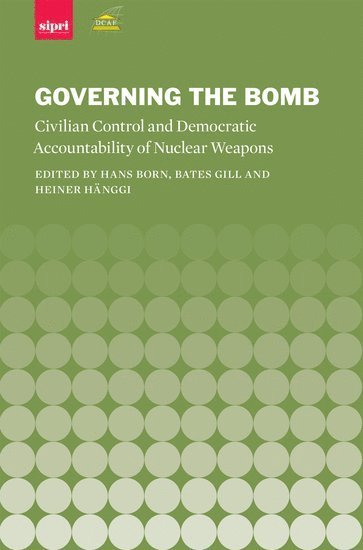
Governing the Bomb
Civilian Control and Democratic Accountability of Nuclear Weapons
Inbunden, Engelska, 2010
1 430 kr
Skickas inom 7-10 vardagar
'Go nuclear' or 'go zero'-as the international community stands at a nuclear crossroads, a number of questions demand urgent attention: How do established and emerging nuclear-armed states manage their nuclear affairs? Who commands and controls a country's nuclear forces? What effect does the balance between secrecy and openness have on larger questions of security and democracy? Governing the Bomb is grounded in the belief that the public's ability to hold nuclear-armed states accountable for the security of their weapons is contingent on proper knowledge of domestic nuclear governance. With a special emphasis on civilian control and democratic accountability, Governing the Bomb seeks to illuminate the structures and processes of nuclear weapons governance of eight nuclear-armed states: the USA, Russia, the UK, France and China as well as Israel, India and Pakistan. It examines the theoretical as well as practical functions and structures of those who possess the power to make nuclear decisions and those who have the practical means and physical opportunity to execute those decisions. While it assesses the whole spectrum of political oversight and control mechanisms in operation for each country-including the roles and requirements of the executive, the military and specialized civilian institutions-it also takes a closer look at parliamentary institutions and civil society at large. As nuclear terrorism, proliferation and disarmament vie for the top slot on the global security agenda, a comparative understanding of the various national nuclear discourses is no longer optional, but required.
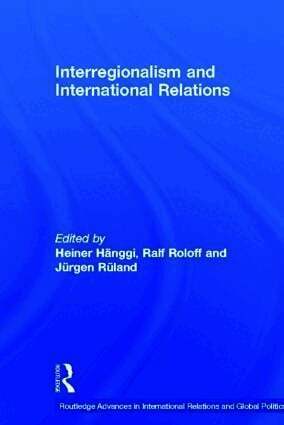
Interregionalism and International Relations
A Stepping Stone to Global Governance?
Inbunden, Engelska, 2005
2 088 kr
Skickas inom 10-15 vardagar
Interregionalism, the institutionalized relations between world regions, is a new phenomenon in international relations. It also a new layer of development in an increasingly differentiated global order.This volume examines the structure of this phenomenon and the scholarly discourse it is generating. It takes stock of empirical facts and theoretical explanations, bringing together with clarity and concision the latest research on this key area. This essential new book:* traces the emergence of interregionalism and reviews the latest literature* provides a conceptual and theoretical framework for study * includes case studies of inter-regional relations between: Asia and America; Asia and Europe; Europe and America; and Europe and Africa.* delivers comparative analyses and special cases such as continental summits and interregional relationships beyond the Triad.* summarizes and evaluates the findings of each chapter, providing a basis for further research.This is a key reference book for students and researchers of regionalism, global governance and international relations.
Interregionalism and International Relations
A Stepping Stone to Global Governance?
Häftad, Engelska, 2008
671 kr
Skickas inom 10-15 vardagar
Interregionalism, the institutionalized relations between world regions, is a new phenomenon in international relations. It also a new layer of development in an increasingly differentiated global order.This volume examines the structure of this phenomenon and the scholarly discourse it is generating. It takes stock of empirical facts and theoretical explanations, bringing together with clarity and concision the latest research on this key area. This essential new book:* traces the emergence of interregionalism and reviews the latest literature* provides a conceptual and theoretical framework for study * includes case studies of inter-regional relations between: Asia and America; Asia and Europe; Europe and America; and Europe and Africa.* delivers comparative analyses and special cases such as continental summits and interregional relationships beyond the Triad.* summarizes and evaluates the findings of each chapter, providing a basis for further research.This is a key reference book for students and researchers of regionalism, global governance and international relations.
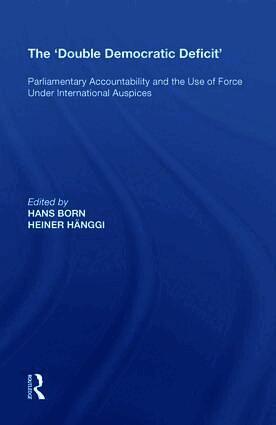
'Double Democratic Deficit'
Parliamentary Accountability and the Use of Force Under International Auspices
Inbunden, Engelska, 2017
2 088 kr
Skickas inom 10-15 vardagar
Many current threats to security arising from terrorism, 'rogue' states and civil wars are highly complex and often transnational in nature and effect. Such threats can no longer be meaningfully addressed at the national level alone but require an international response. Since the end of the Cold War, the use of force under international auspices (UN, NATO, EU) has increased substantially. However, such actions have not necessarily been accompanied by improvements in their democratic accountability. Pre-existing problems and inadequacies of parliamentary oversight of armed forces and use of force at the national level of many democratic states are mirrored, and even magnified, at the international level. The effect of imperfect democratic controls at the national level and the challenges to provide transparent and accountable multilateral responses results in the so-calleddouble democratic deficit of the international use of force. Each chapter in this innovative work analyses the challenges of parliamentary and democratic supervision of international security structures and puts forward proposals on how to improve democratic accountability of multinational responses to complex security challenges.
'Double Democratic Deficit'
Parliamentary Accountability and the Use of Force Under International Auspices
Häftad, Engelska, 2020
332 kr
Skickas inom 10-15 vardagar
Many current threats to security arising from terrorism, 'rogue' states and civil wars are highly complex and often transnational in nature and effect. Such threats can no longer be meaningfully addressed at the national level alone but require an international response. Since the end of the Cold War, the use of force under international auspices (UN, NATO, EU) has increased substantially. However, such actions have not necessarily been accompanied by improvements in their democratic accountability. Pre-existing problems and inadequacies of parliamentary oversight of armed forces and use of force at the national level of many democratic states are mirrored, and even magnified, at the international level. The effect of imperfect democratic controls at the national level and the challenges to provide transparent and accountable multilateral responses results in the so-called double democratic deficit of the international use of force. Each chapter in this innovative work analyses the challenges of parliamentary and democratic supervision of international security structures and puts forward proposals on how to improve democratic accountability of multinational responses to complex security challenges.