• Fri frakt över 249 kr
  • •
  • Snabba leveranser
  • •
  • Billiga böcker
Kundservice

Du är på sajten för privatpersoner.

Företag, bibliotek eller offentlig verksamhet?

Du handlar på classic.bokus.com, där alla dina funktioner finns intakta.
Till classic.bokus.com
Bokus logotyp. Gå till startsidan.
  • Erbjudanden
  • Nyheter
  • Student
  • Topplistor
  • Barn & ungdom
  • Bokus Play
  • E-böcker
  • Pocketböcker
  • Spel & pussel

10% rabatt på allt med kod NYSTART10 →

Sidfot

Mina sidor

    Hjälp

    • Kundservice
    • Vanliga frågor och svar
    • Frakt och leverans
    • Retur vid ångerrätt
    • Reklamera vara
    • Betalning
    • Köpvillkor
    • Allmänna villkor
    • Information om webbplatsens tillgänglighet

    Om Bokus

    • Om oss
    • Pressrum
    • För studenter
    • För företag
    • För bibliotek och offentlig verksamhet
    • För leverantörer
    • Hållbarhet

    Populärt

    • Aktuella erbjudanden
    • Presentkort
    • Studentlitteratur
    • Nya böcker
    • Topplistor
    • Signerade böcker
    • Engelska böcker

    Inspiration

    • Boktips
    • BookTok
    • Populära bokserier
    • Barnbokskaraktärer
    • Populära författare
    Logotyp för Bokus
    Följ oss på Facebook (extern länk)Följ oss på Instagram (extern länk)Följ oss på YouTube (extern länk)Följ oss på TikTok (extern länk)
    bokus @ CookiesAnpassa cookiesIntegritetspolicyKöpvillkor
    Till Citymail hemsida (extern länk)Till Budbee hemsida (extern länk)Till Postnord hemsida (extern länk)Till Schenker hemsida (extern länk)Till Early Bird hemsida (extern länk)Till Walleys hemsida (extern länk)
    1. Språk och ordböcker
    2. Språkvetenskap och lingvistik

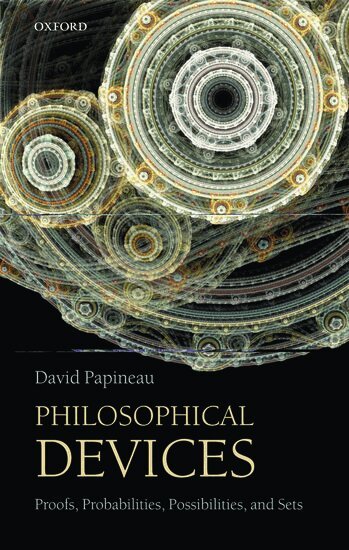
    Philosophical Devices

    Proofs, Probabilities, Possibilities, and Sets

    AvDavid Papineau

    Häftad, Engelska, 2012

    300 kr

    Beställningsvara. Skickas inom 5-8 vardagar. Fri frakt över 249 kr.

    Fler format och utgåvor

    E-bok

    237 kr

    E-bok

    237 kr

    Inbunden

    1 243 kr

    Beskrivning

    This book is designed to explain the technical ideas that are taken for granted in much contemporary philosophical writing. Notions like 'denumerability', 'modal scope distinction', 'Bayesian conditionalization', and 'logical completeness' are usually only elucidated deep within difficult specialist texts. By offering simple explanations that by-pass much irrelevant and boring detail, Philosophical Devices is able to cover a wealth of material that is normally only available to specialists. The book contains four sections, each of three chapters. The first section is about sets and numbers, starting with the membership relation and ending with the generalized continuum hypothesis. The second is about analyticity, a prioricity, and necessity. The third is about probability, outlining the difference between objective and subjective probability and exploring aspects of conditionalization and correlation. The fourth deals with metalogic, focusing on the contrast between syntax and semantics, and finishing with a sketch of Gödel's theorem. Philosophical Devices will be useful for university students who have got past the foothills of philosophy and are starting to read more widely, but it does not assume any prior expertise. All the issues discussed are intrinsically interesting, and often downright fascinating. It can be read with pleasure and profit by anybody who is curious about the technical infrastructure of contemporary philosophy.

    Produktinformation

    • Utgivningsdatum:2012-10-04
    • Mått:135 x 203 x 11 mm
    • Vikt:258 g
    • Format:Häftad
    • Språk:Engelska
    • Antal sidor:224
    • Förlag:OUP OXFORD
    • ISBN:9780199651733

    Utforska kategorier

    • Språkvetenskap och lingvistik inom Språk och ordböcker
    • Matematikens filosofi inom Naturvetenskap och teknik
    • Naturvetenskapens filosofi inom Naturvetenskap och teknik

    Mer om författaren

    David Papineau was educated in Trinidad, England, and South Africa. He has a BSc in mathematics from the University of KwaZulu-Natal and a BA and PhD in philosophy from Cambridge. He has lectured at Reading University, Macquarie University, Birkbeck College London, and Cambridge University. Since 1990 he has been Professor of Philosophy at King's College London.He was President of the British Society for the Philosophy of Science from 1993 to 1995. In 1999-2000 he was a Leverhulme Research Fellow and in 2007 a Mind Fellow. He was President of the Mind Association for 2009-10. In 2010 he gave the Rudolf Carnap Lectures in Bochum, Germany and in 2011 the Gottlob Frege Lectures in Tartu, Estonia.

    Recensioner i media

    an engaging, genuinely expository text. It is hard to imagine a better execution of the project of introducing the basics of technical philosophy non-technically. ... an invaluable addition to undergraduate reading lists, and I certainly will make use of it in my teaching.

    Innehållsförteckning

    • PART I: SETS AND NUMBERS; PART II: ANALYTICITY, A PRIORICITY, AND NECESSITY; PART III: THE NATURE AND USES OF PROBABILITY; PART IV: LOGICS AND THEORIES